How to Learn Kanji: Parts, Then Stories, Then Characters
Published 2026-07-30 · Updated 2026-09-03
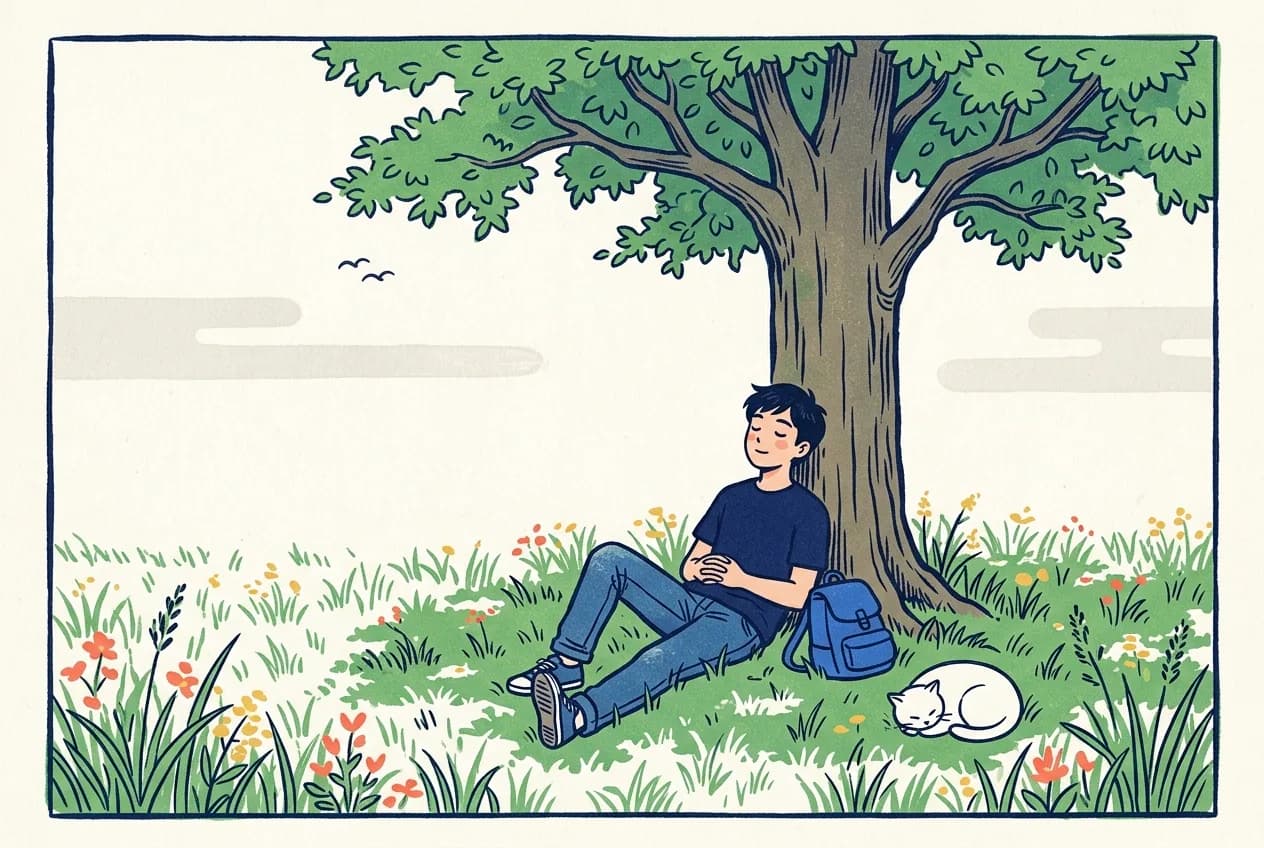
The picture above is a kanji: a person, resting against a tree.
The character inside 休む (yasumu), “to rest,” is literally the part meaning person (亻 (ninben)) leaning against the part meaning tree (木 (ki)). You have now learned a character the way it was built.
That's the whole thesis of this guide, and it's the answer to the question in the title: kanji is not 2,000 unrelated pictures to memorize. It's a construction kit — a couple hundred reusable parts that combine, over and over, into every character you'll ever read. Learn the parts and the stories that glue them together, and each new character costs less than the one before.
Japan's official everyday set is exactly 2,136 characters — a real mountain. But it's a mountain with stairs, and the stairs are the parts. Here's how to climb it without losing your mind.
Stop memorizing pictures (it's the one method that can't scale)
Brute-force works for a while: stare at a character, write it 50 times, move on. It gets you through the first hundred, which is roughly what a beginner needs anyway.
Then it collapses. Character #900 looks exactly like character #400 plus a dot somewhere, and your memory has nothing to attach the difference to.
Almost everyone who keeps going ends up doing the same thing, planned or not. They stop seeing strokes and start seeing parts. The rest character stops being six strokes and becomes two familiar pieces.
That switch, from strokes to parts, is one of the biggest upgrades available in kanji study. You can make it on day one instead of discovering it at character 900.
The parts: a couple hundred pieces, many with day jobs
The traditional catalog counts 214 parts — called radicals, or 部首 (bushu) — and you don't need them all. A few dozen cover the overwhelming majority of everyday characters. Better still, the common ones carry meaning hints.
Three drops on the left (氵 (sanzui)) signal water. The little person (亻 (ninben)) means a human is involved. The speech part (言 (gonben)) means words are being exchanged.
These hints are not a party trick. They are how you will read unknown characters later: the part on the left suggests the topic, and context does the rest. The table at the end of this guide gives you 10 parts worth knowing in week one, with example characters drawn from everyday beginner words.
The stories: three characters that explain themselves
You've met the rest character (person + tree). Here are two more of the classics.
The kanji in 明るい (akarui), “bright,” is the sun (日 (hi)) and the moon (月 (tsuki)) side by side. They are the two brightest things in the sky, sharing one character. 森 (mori), “forest,” is the tree part three times: one tree is 木 (ki), and a crowd of them is a forest.
One more, because it's the best trivia in the writing system: 峠 (touge), “mountain pass,” is mountain + up + down — the exact experience of crossing one. And here's the twist: 峠 (touge) was invented in Japan. A small set of characters — 国字 (kokuji), kokuji, “national characters” — were coined here rather than borrowed from China, and this one is their masterpiece.
Not every character has a story this clean, and honesty matters here. Some popular “etymologies” are cheerful inventions, and for some characters scholars genuinely disagree.
A good resource tells you which stories are documented and which are only useful memory hooks. Both help you remember, but only one should be repeated as fact.
The secret most beginners never hear: sound hints
Meaning hints are only half the kit. The large majority of kanji are actually two-part machines: one part hints the meaning, the other hints the sound.
Take 青 (ao), blue, read せい (sei) in compounds, and watch it work. The kanji in 清い (kiyoi) (pure), 晴れ (hare) (clear sky), 精 (sei) (spirit, refined), and 請 (sei) (request) carry different meanings and the same right-hand part. All of them can be read せい (sei).
Once you know a few dozen of these sound-carriers, unknown characters start pre-announcing their pronunciation. It's the closest thing kanji has to a cheat code.
It's also why character 1,500 is genuinely easier than character 150. By then, almost every new character is made of parts you've already met, in both meaning and sound.
Why one character has five readings (and why that's survivable)
The other famous kanji complaint: 日 (hi) can be read ひ (hi), び (bi), にち (nichi), じつ (jitsu), and more. The reason is historical.
Japan borrowed Chinese pronunciations in several waves, centuries apart, and kept its own native words too, writing both with the same characters. Nobody designed this. It accumulated.
The survival strategy: don't study readings as tables. Learn words, and let the readings come attached.
日曜日 (nichiyoubi) (Sunday) quietly teaches you two readings of 日 (hi) in one word. Frequency does the sorting for you: common readings show up constantly, and rare ones barely matter.
A reading you learned inside a real word sticks. A reading memorized from a chart evaporates by Thursday.
How many, and in what order?
Numbers first, honestly: the official everyday set is 2,136. The JLPT expects roughly 100 characters at N5 and grows level by level toward roughly 2,000 at N1.
It publishes no official kanji lists, so all level counts are community estimates. Newspapers and novels sit inside the everyday set almost entirely.
The order that works is the one from our beginner roadmap: learn characters as the spelling of words you already know, frequency first. Don't grind isolated character lists — a character studied without a word evaporates. Ten pattern-setting parts to watch for from the start:
| Part | Meaning hint | You'll see it in |
|---|---|---|
| 亻 (ninben) | Meaning hintPerson | You'll see it in休む (yasumu)・体 (karada)・何 (nani) |
| 氵 (sanzui) | Meaning hintWater | You'll see it in海 (umi)・泳ぐ (oyogu)・池 (ike) |
| 木 (ki) | Meaning hintTree, wood | You'll see it in林 (hayashi)・森 (mori)・桜 (sakura) |
| 言 (gonben) | Meaning hintSpeech, words | You'll see it in話す (hanasu)・読む (yomu)・語る (kataru) |
| 日 (hi) | Meaning hintSun, day, time | You'll see it in明るい (akarui)・時 (toki)・曜日 (youbi) |
| 扌 (tehen) | Meaning hintHand, action | You'll see it in持つ (motsu)・押す (osu)・指 (yubi) |
| 心 (kokoro)(slim form 忄 (risshinben)) | Meaning hintHeart, feeling | You'll see it in思う (omou)・忘れる (wasureru)・怖い (kowai) |
| 門 (mon) | Meaning hintGate | You'll see it in間 (aida)・開ける (akeru)・閉める (shimeru) |
| 女 (onna) | Meaning hintWoman | You'll see it in好き (suki)・妹 (imouto)・姉 (ane) |
| 雨 (ame) | Meaning hintRain, weather | You'll see it in雪 (yuki)・雲 (kumo)・電気 (denki) |
Climb with stories, not willpower
Put the method together and it's short. See parts, not strokes. Collect the stories.
Let sound-carriers pre-read new characters for you, and meet every character inside a real word. Willpower is for the first hundred. Structure is what carries you to two thousand.
Our kanji sets are built on exactly this method. Every character card comes with its origin story, labeled honestly so that documented history and helpful memory hooks are never confused.
Each card also carries example words, readings in context, and quizzes that feed your review queue. Start with the N5 set and meet 休む (yasumu) properly, the person still resting against the tree.
Explore the kanji sets — every character with its origin story