Kudasai vs. Onegaishimasu: Which “Please” Do You Need?
Published 2026-07-29 · Updated 2026-09-03
Quick answer: ください (kudasai) asks for something specific — a thing (コーヒーをください (koohiiwokudasai)) or an action (温めてください (atatametekudasai)). お願いします (onegaishimasu) is the all-purpose “please handle this” — slightly softer, and powerful precisely because it doesn't need a verb at all.
Start with the request that names an action:
写真を撮ってください (shashinwotottekudasai)
Please take a photo.
Use the te-form (a verb's connecting form) plus ください (kudasai) whenever you ask someone to do something. お願いします (onegaishimasu) cannot attach to a verb, so it does not replace ください (kudasai) after the te-form. With a noun, both are natural.
Both are correct in most shops, so this isn't a right-or-wrong story. It's about knowing which tool reaches the situations the other can't — and お願いします (onegaishimasu) reaches a lot further than your textbook let on.
ください (kudasai) — “please give / please do”
Two attachment points cover almost everything. A thing takes noun + をください (wokudasai), as in 水をください (mizuwokudasai), “water, please.” An action takes te-form + ください (kudasai), as in もう一度言ってください (mouichidoittekudasai), “please say it again.”
In casual speech the を (wo) often drops — コーヒーください (koohiikudasai) is completely natural at a counter. Direct, clear, polite enough for any shop in Japan.
お願いします (onegaishimasu) — “please” without a verb
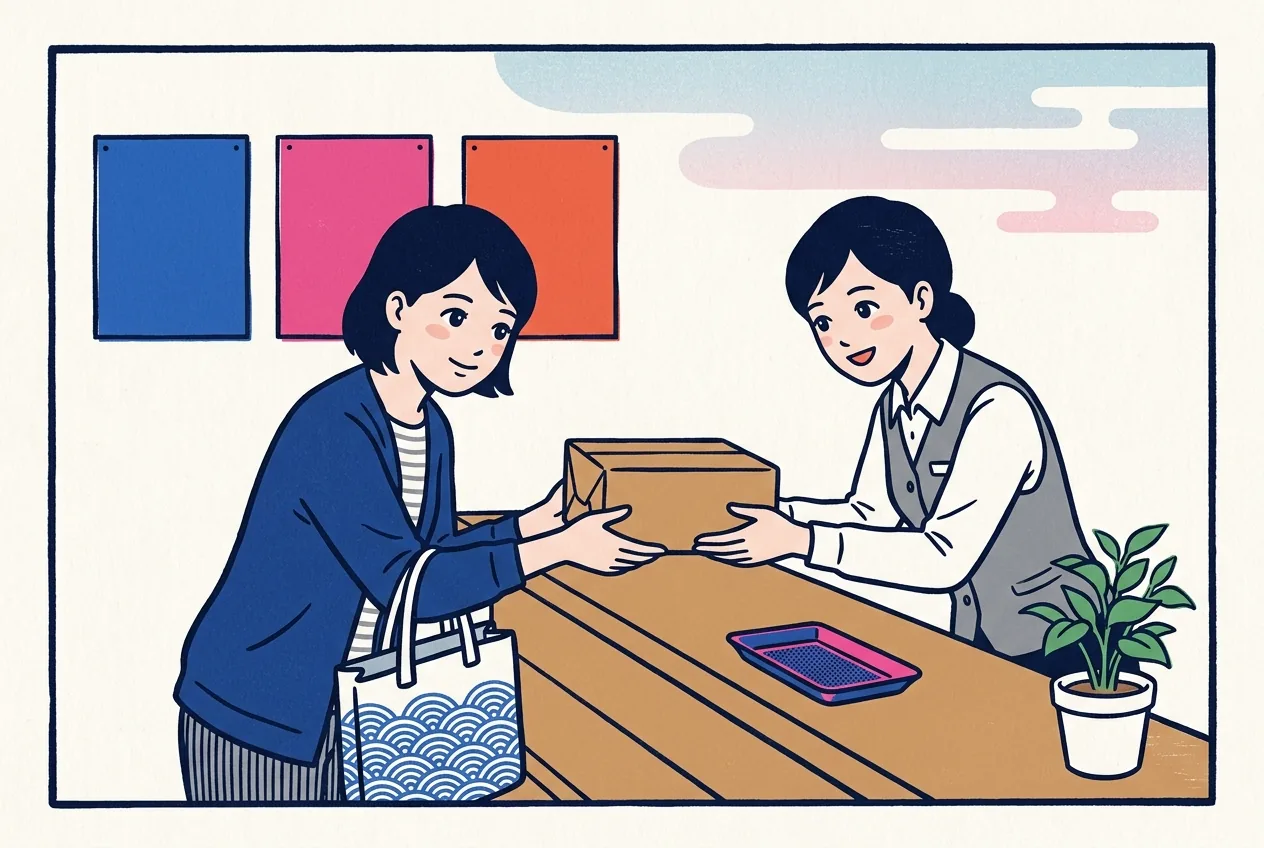
お願いします (onegaishimasu) literally means “I request (humbly),” and it can stand alone. Slide your items across the convenience store counter and say お願いします (onegaishimasu): complete sentence, transaction started, no grammar required.
It also asks for services where ください (kudasai) feels off. タクシーをお願いします (takushiiwoonegaishimasu) at a hotel desk summons a taxi, and you are not asking the clerk to give you one. Dry cleaners, repairs, and deliveries all use this one phrase.
The phone trick: 田中さんをお願いします (tanakasanwoonegaishimasu)
On the phone, 〜をお願いします (~woonegaishimasu) (“may I speak to ~, please”) is how you ask for a person. 田中さんをお願いします (tanakasanwoonegaishimasu) is the standard form — try doing that with ください (kudasai) and you're requesting they gift-wrap Tanaka.
Ordering face-off: both work, feel the gradient
コーヒーをください (koohiiwokudasai) and コーヒーをお願いします (koohiiwoonegaishimasu) are both natural orders. The difference is texture: ください (kudasai) is plainer and more direct, while お願いします (onegaishimasu) adds a touch of softness and deference. Staff will be equally happy with either — pick by mood, not by fear.
One habit worth copying from locals: point at the menu, say これをお願いします (korewoonegaishimasu), small nod. Zero vocabulary risk, maximum smoothness.
よろしくお願いします (yoroshikuonegaishimasu) — the untranslatable one
The same verb carries Japan's most famous untranslatable phrase. よろしくお願いします (yoroshikuonegaishimasu) closes self-introductions, ends emails, and asks for favors.
English has no single equivalent, which is why every translation feels slightly wrong. The closest gloss is “I place myself in your hands; please treat this (and me) well.”
For now, keep the practical rule: meet someone new → say your name → よろしくお願いします (yoroshikuonegaishimasu). It signals “I intend a good relationship,” and it almost never misfires.
Cheat sheet: which “please” when
ください (kudasai) sounds plainer and お願いします (onegaishimasu) sounds softer, so both fit an order for a thing. A service is an arrangement, not something handed to you, so ください (kudasai) feels off and お願いします (onegaishimasu) fits.
The everyday map:
| You want… | Say this | Note |
|---|---|---|
| A thing, by name | Say this水をください (mizuwokudasai) / 水をお願いします (mizuwoonegaishimasu) | NoteBoth natural |
| An action done | Say thiste-form + ください (kudasai): 温めてください (atatametekudasai) | Noteお願いします (onegaishimasu) cannot attach to verbs |
| To hand something over wordlessly | Say this(item) + お願いします (onegaishimasu) | NoteComplete on its own |
| A service arranged | Say thisタクシーをお願いします (takushiiwoonegaishimasu) | NoteArranging a service |
| A person on the phone | Say this田中さんをお願いします (tanakasanwoonegaishimasu) | Note“May I speak to Tanaka-san” — set phrase |
| A good relationship | Say thisよろしくお願いします (yoroshikuonegaishimasu) | NoteUntranslatable and indispensable |
Key takeaways
Ask whether there is a verb: an action takes te-form + ください (kudasai), and no verb takes お願いします (onegaishimasu).
For a thing by name, both work: ください (kudasai) is plainer and お願いします (onegaishimasu) is softer.
On the phone, 〜をお願いします (~woonegaishimasu) asks for a person, and ください (kudasai) does not.
How to practice
Ask one question: is there a verb in what you want? An action takes te-form + ください (kudasai). No verb, or a whole service, takes お願いします (onegaishimasu).
Then test yourself below. The quiz covers the phone pattern, the silent hand-off, and the attachment traps.
Test yourself — take the free “Pairs You Keep Mixing Up” quiz