Types of Sushi, Explained by Shape: Order Anything by Sight
Published 2026-07-31 · Updated 2026-09-03
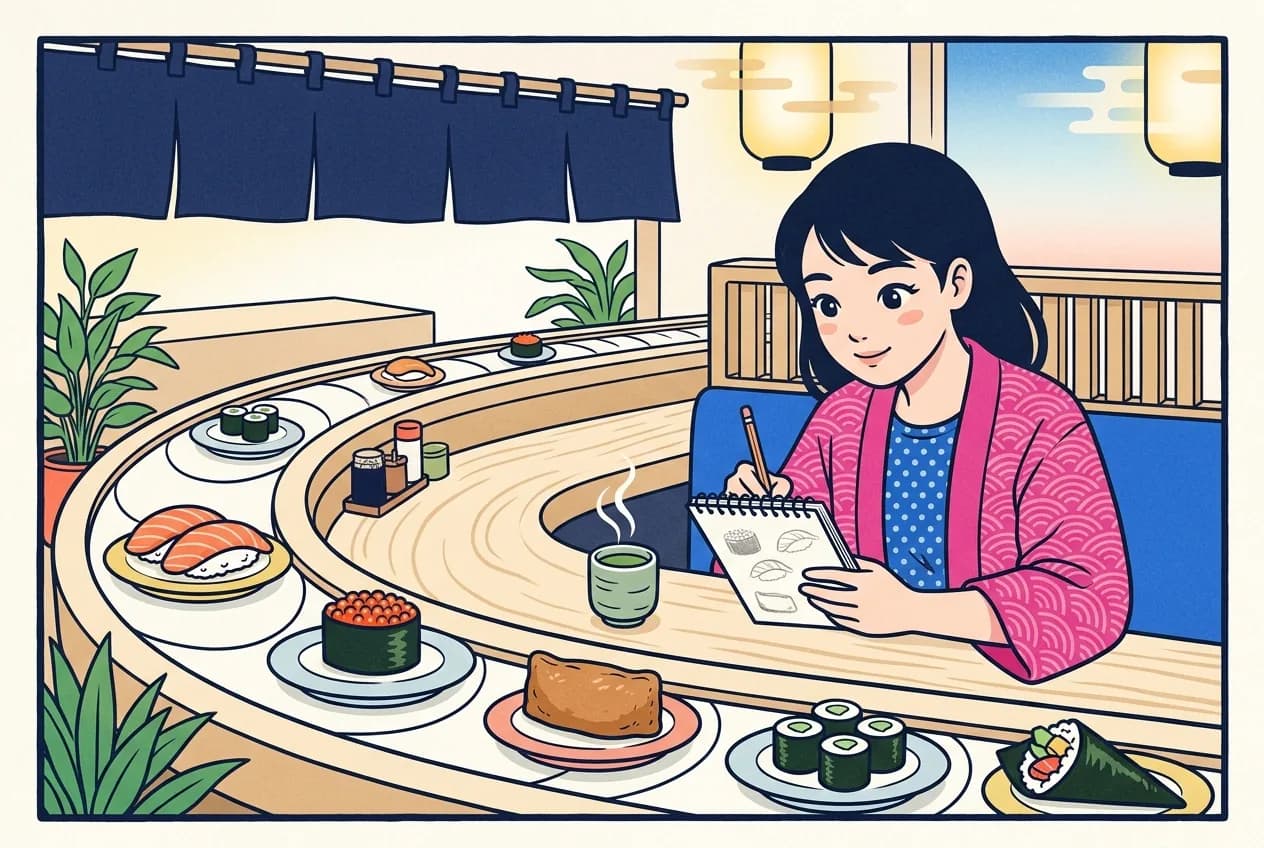
Here's the secret that makes every sushi menu readable: sushi is organized by shape, and the shapes have names. There are seven silhouettes — a pillow, a battleship, a pouch, three kinds of roll, and a bowl. Learn those, and you can identify nearly everything gliding past you on a conveyor belt before you can read a word of Japanese.
Even better, the shapes aren't arbitrary. Each one was invented to solve a problem: toppings that slide off, sushi that has to travel, a party with no chef. The solutions come with some of the best origin stories in Japanese food.
This guide walks the shapes, tells the stories, and decodes the supporting cast — the pink ginger has a job. It finishes at the conveyor-belt restaurant, one of the most fun places in Japan to practice all of it.
握り寿司 (nigirizushi) — the original fast food
The classic: a bite-sized bed of vinegared rice shaped in the palm, wearing one slice of fish on top. 握る (nigiru) means “to grip.” When you picture sushi, you picture this.
Its origin surprises people. Nigiri was invented in Edo, old Tokyo, in the early 1800s as street-stall fast food. It was a quick, cheap bite made with fish straight from the bay.
That style is still honored by name: 江戸前寿司 (edomaezushi), “Edo-front sushi,” after the waters the fish came from. Sushi at its most prestigious began as something eaten standing up, in a hurry.
The roll family: 細巻き (hosomaki), 太巻き (futomaki), 手巻き (temaki)
Rolls — 巻き寿司 (makizushi), from 巻く (maku), “to roll” — come in three main shapes. The 細巻き (hosomaki) is the slim cylinder with one filling at its center.
The cucumber version is かっぱ巻き (kappamaki), named for the kappa, folklore's cucumber-obsessed river dweller. The tuna version is 鉄火巻き (tekkamaki).
The 太巻き (futomaki) is its big sibling, a fat roll packed with several fillings at once. The 手巻き寿司 (temakizushi), the hand-rolled cone, is the home-party format.
The party needs bowls of rice, stacks of nori, and a table of fillings, and everyone rolls their own. If a Japanese friend invites you to a temaki party, clear your evening.
軍艦巻き (gunkanmaki) — the battleship that solved a problem
Some toppings refuse to stay on a nigiri. Salmon roe rolls off. Sea urchin slides away.
The 1941 solution, credited to the Tokyo restaurant 銀座久兵衛 (ginzakyuubee), was to wrap a tall collar of nori around the rice. That makes a little boat, and the boat holds loose toppings on deck. The shape earned the name 軍艦巻き (gunkanmaki) — “battleship roll.”
It's the newest of the classic shapes, and the easiest to spot. If the nori stands taller than the rice and something glistening rides on top, you're looking at a battleship. Usually that's いくら (ikura) (salmon roe) or うに (uni) (sea urchin).
The no-fish team: いなり寿司 (inarizushi), 玉子 (tamago), ちらし寿司 (chirashizushi)
Not all sushi involves fish. いなり寿司 (inarizushi) is rice tucked into a sweet, juicy pouch of fried tofu (油揚げ (aburaage)).
It is named for the deity Inari, whose fox messengers are said to love exactly this food. Cheap, portable, beloved at picnics, and completely raw-fish-free.
玉子 (tamago) is a slice of sweet layered omelet, belted onto its rice with nori. It carries a reputation: old sushi wisdom says to judge a new restaurant by ordering the omelet first. A chef who can layer it perfectly can be trusted with everything else.
And ちらし寿司 (chirashizushi) — “scattered sushi” — skips the shaping entirely: a bowl of sushi rice with sashimi, egg ribbons and colorful toppings strewn across the surface. It's the celebration format, especially on Girls' Day in March.
The supporting cast: ガリ (gari), わさび (wasabi), soy sauce
The mound of pale-pink slices beside your plate is ガリ (gari), sweet-pickled young ginger. It has a job. Eat a slice between different pieces to reset your palate, so the tuna does not taste like the mackerel before it.
It is not a topping. The bright-red pickled ginger 紅しょうが (benishouga) belongs on beef bowls and takoyaki, not sushi.
わさび (wasabi) hides between rice and fish, hot in the nose rather than the mouth. A fun secret: genuine wasabi root costs a small fortune and loses its heat minutes after grating.
That is why the green paste in most of the world's sushi restaurants is dyed horseradish. Top restaurants grate the real thing fresh, order by order.
Now soy sauce. Dip lightly, fish side down if you can manage it. Rice soaks up soy like a sponge and falls apart — the one small tragedy every beginner performs exactly once.
The seven shapes, ready for your camera roll
Everything above, sized for a screenshot — take it to dinner:
| Shape you see | Name | What it is |
|---|---|---|
| Rice pillow + fish slice | Name握り寿司 (nigirizushi) | What it isThe hand-pressed classic |
| Slim roll, one filling | Name細巻き (hosomaki) | What it isThin roll: cucumber かっぱ巻き (kappamaki), tuna 鉄火巻き (tekkamaki) |
| Fat roll, many fillings | Name太巻き (futomaki) | What it isThick festival roll |
| Hand-rolled cone | Name手巻き寿司 (temakizushi) | What it isDIY party sushi |
| Tall nori collar, loose topping | Name軍艦巻き (gunkanmaki) | What it is“battleship” for roe and uni |
| Brown tofu pouch | Nameいなり寿司 (inarizushi) | What it isSweet fried-tofu pocket, no fish |
| Toppings scattered over a bowl | Nameちらし寿司 (chirashizushi) | What it is“scattered” celebration bowl |
Conveyor-belt survival: 回転寿司 (kaitenzushi)
The friendliest place to practice all this is 回転寿司 (kaitenzushi), or “rotation sushi.”
An Osaka restaurateur invented it in 1958, inspired by the bottle conveyors of a beer brewery. He put the plates on a moving belt. Genius verdict: correct.
The system is self-explanatory in the best way: take what you like as it passes, and the stack of plates becomes your bill. At many chains the plate's color or pattern shows its price. Glance at the price board once and you are fluent.
Modern restaurants add a touch-screen for ordering and an express lane that sends your order straight to your seat. Green tea powder and a hot-water tap come free at every table.
Best of all, the belt is a live vocabulary drill. Every silhouette from this guide slides past in an endless parade, and nobody minds how long you sit there naming them. When you're ready to check yourself, our sushi quiz below deals you the same seven shapes — no belt required.