Ganbatte Meaning: Not “Good Luck,” and How to Reply
Published 2026-08-18 · Updated 2026-10-01 · 10 min read
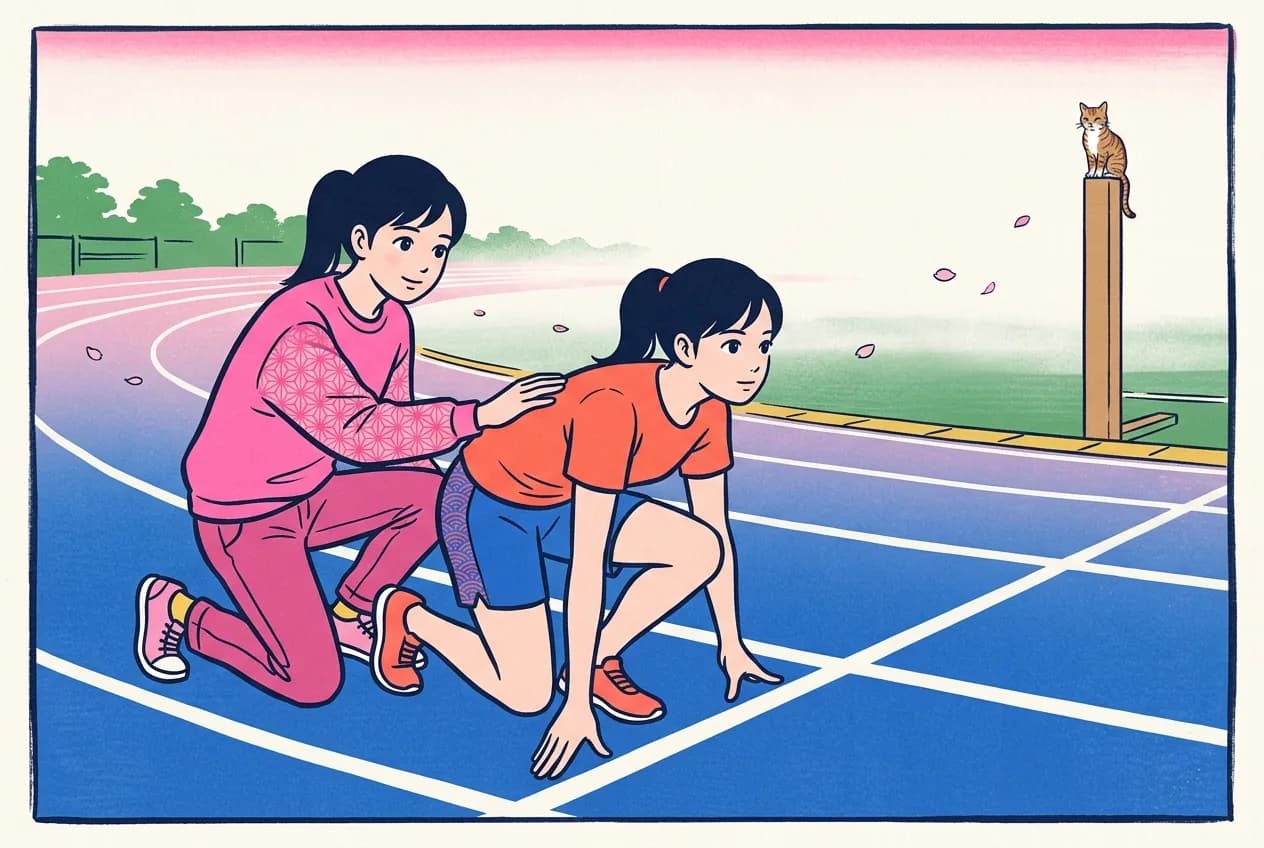
The short answer: 頑張って (ganbatte) is not “good luck.” Luck is a wish thrown into the air, while 頑張って (ganbatte) is a hand placed on your back. It tells you to dig in and see the thing through, aimed at your effort rather than at your odds.
That's why you hear it before an exam, before a match, and before a job interview. You hear it again on the doorstep when a friend heads off to work.
The closest English isn't “good luck” at all. It's “give it everything,” or “hang in there,” depending on whether the hard part is starting or already grinding.
Say 頑張って (ganbatte) to a friend or a classmate who still has work in front of them. Do not say it about something decided by chance, like a lottery ticket.
Here's the rest of it: which form to say to whom, and how to answer when someone says it to you. Then comes the part most guides skip: what to say when 頑張って (ganbatte) is the wrong word for the moment.
Why “good luck” is the wrong translation
The verb underneath everything is 頑張る (ganbaru): to hold out, to stand your ground, to keep going at something difficult. Notice what it doesn't contain. There's no hope, no fortune, no crossed fingers — only the person and the thing they're pushing against.
That single difference explains most of the confusion. English speakers say “good luck” when the outcome is out of the speaker's hands.
Japanese speakers say 頑張って (ganbatte) when the outcome is still in the listener's hands. A friend about to take a driving test gets this:
頑張ってね (ganbattene)
Go get it.
A friend buying a lottery ticket doesn't.
The word stretches further than a cheer, too. Someone three hours into a move, boxes everywhere, might get the same 頑張って (ganbatte).
Three hours in, it means “keep at it, you're nearly there.” One word covers the start line and the middle of the climb.
Ganbatte, ganbare, ganbarimasu, ganbarou: which one to say
All five common forms come from that one verb. The form you pick answers two questions at once: how close you are to the person, and whose effort you're talking about.
頑張って (ganbatte) is what you say to a friend, a classmate, or family, before or during the effort. 頑張れ (ganbare) is a command form that works as a cheer from the stands, not as an order.
頑張ってください (ganbattekudasai) is polite and points at the other person's effort, for when they're the one doing the hard thing. 頑張ります (ganbarimasu) answers your teacher, your boss, or an interviewer, and it is about your own effort.
頑張ろう (ganbarou) is for someone who's in it with you, a teammate or a study partner, and it includes the speaker in the effort.
| What you say | Who you say it to | What it means |
|---|---|---|
| 頑張って (ganbatte) | Who you say it toAnyone you speak casually with | What it means“Give it everything,” the everyday cheer |
| 頑張れ (ganbare) | Who you say it toA teammate or a runner going past | What it means“Give it everything,” shouted |
| 頑張ってください (ganbattekudasai) | Who you say it toSomeone you speak politely to | What it means“Please give it your best,” politely |
| 頑張ります (ganbarimasu) | Who you say it toAnyone you answer politely | What it means“I'll give it my best,” about yourself |
| 頑張ろう (ganbarou) | Who you say it toA teammate or a study partner | What it means“Let's both give it everything” |
The two little endings that change the temperature
Casual speech adds a particle to the end, and the particle carries the warmth. 頑張ってね (ganbattene) is soft — the version you'd say to a friend as they leave. 頑張ってよ (ganbatteyo) leans on them a little harder, closer to “come on, you've got this,” and it needs a friendship that can take a nudge.
One more you'll hear at any school sports day: ファイト (faito), from the English word “fight.” In Japanese it isn't about fighting anyone, but a shout of encouragement used side by side with 頑張れ (ganbare) from the sidelines. It's also an early lesson in how a loanword can arrive in Japanese and pick up a completely different job.
The kanji behind it — and the origin dictionaries won't settle
Written out, the verb is 頑張る (ganbaru): 頑 (gan), the character for stubborn or unyielding, plus 張る (haru), to stretch or to hold something taut. Read that way it looks orderly — stubbornly holding your position.
Japanese dictionaries are more careful, and it's worth knowing why. They treat 頑 (gan) here as a character picked for its sound rather than its meaning.
From there they trace the word to one of two older phrases. One is 眼張る (ganbaru), to fix your eyes on a spot, and the other is 我を張る (gawoharu), to insist on your own way. Neither theory has won.
Both point the same direction, though. Plant yourself somewhere and refuse to be moved — whether it's your eyes or your will doing the planting. So the character story is a useful memory hook, and not a claim about where the word came from.
How to reply when someone says 頑張って (ganbatte) to you
This is the moment most learners freeze, and the fix is one line. Someone wishes you well before your interview; you accept the push and promise to use it. Thanks first, then the same verb turned back on yourself.
To a teacher, a boss, or anyone you're being polite with:
はい、頑張ります (hai,ganbarimasu)
Yes, I'll give it my best.
With a friend, drop the polish: うん、頑張る (un,ganbaru), or ありがとう (arigatou) on its own, which is never wrong.
Two upgrades are worth having ready. If the other person has something hard coming too, return it with お互いに頑張ろう (otagainiganbarou), meaning “let's both give it a shot.”
And if you're already deep in the work, ありがとう、頑張るね (arigatou,ganbarune) keeps it light without pretending you're at the start line.
The same shape works for compliments in Japanese, which our guide to 日本語上手ですね (nihongojouzudesune) covers. Take the warmth, then send a little of it back. Nobody is grading the wording.
Answering at all is the whole point.
頑張ってください (ganbattekudasai) — and why it rarely points upward
ください (kudasai) makes the phrase polite, so it's tempting to treat it as the safe form for anyone senior. It's not quite that simple. The polite wrapper doesn't change what the sentence does: it stands you on the sideline and tells the other person to go work.
Picture the version that goes wrong. Your train is stuck, your manager says they'll start the meeting without you, and you answer:
はい、頑張ってください (hai,ganbattekudasai)
Yes, please do your best.
They're the one covering for you, and you have cheered them on. The Speak scenario built around that exact moment marks that answer as the unnatural one. The natural replies apologize and hand the situation back: ご迷惑をおかけします (gomeiwakuwookakeshimasu) (“sorry for the trouble”) or よろしくお願いします (yoroshikuonegaishimasu).
So it's about the situation, not a rule about rank. 頑張ってください (ganbattekudasai) to a senior colleague running a marathon on Sunday is warm and completely normal.
Same for a teacher about to give a recital. You're a spectator at those, and that's exactly the position the phrase puts you in.
It only jars when they're doing the hard thing on your behalf. If you want the wider map of how ください (kudasai) and 〜ます (~masu) shift the register, our keigo guide lays out the ladder.
When to say something else instead
頑張って (ganbatte) is a hand on the back, and sometimes a hand on the back is the last thing the person needs.
Think of someone who has been pushing for weeks, someone who's sick, or someone who has had bad news. To them, “give it everything” can sound like “what you're already giving isn't enough.”
Not everyone hears it that way. Enough people do that it's worth having the alternatives ready.
Four phrases cover almost every version of that moment. Start with the one you say to a friend who's been at the office until midnight all week:
無理しないでね (murishinaidene)
Don't push yourself.
That's the direct opposite of 頑張って (ganbatte). お大事に (odaijini) is for illness: “take care of yourself,” said to anyone who's unwell or heading home early.
応援してる (ouenshiteru) — “I'm in your corner” — is the one to use when you want to be supportive without adding a task. It says you're watching and you're on their side, and it asks nothing of them. And 気をつけてね (kiwotsuketene) (“take care”) works for anyone heading out into weather, traffic, or a long trip.
None of this makes 頑張って (ganbatte) a mistake. Plenty of people say it in exactly these moments and it lands fine, because tone and friendship do most of the work. But when you're not sure the person has anything left to give, the phrase that offers a chair beats the one that offers a push.
頑張って (ganbatte) before, お疲れ様 (otsukaresama) after
Japanese has a habit of bracketing an activity with two set phrases, one at each end — the way いただきます (itadakimasu) and ごちそうさまでした (gochisousamadeshita) bracket a meal. Effort gets the same treatment.
頑張って (ganbatte) goes in front of the work. お疲れ様 (otsukaresama), literally an acknowledgment of the other person's tiredness, comes after it.
It's the standard thing to say to a colleague leaving the office, to a teammate after a match, to anyone who has finished. In polite settings it's お疲れ様でした (otsukaresamadeshita).
Once you can hear the pair, a lot of everyday Japanese snaps into place. One phrase sends someone into the effort, and the other meets them at the end of it.
Key takeaways
Say 頑張って (ganbatte) when the outcome is still in the other person's hands, not when it rests on luck.
Answer it with thanks and 頑張ります (ganbarimasu), turning the same verb back on yourself.
When the other person is already worn out, say 無理しないでね (murishinaidene) instead.
What's the difference between 頑張って (ganbatte) and 頑張れ (ganbare)?
They carry the same message and differ in delivery. 頑張って (ganbatte) is the everyday casual form, said face to face at conversational volume.
頑張れ (ganbare) is grammatically a command, which sounds harsher than it is. In practice it's the shouted version, the one that comes from the stands or the sidelines. If you're speaking to one person in front of you, 頑張って (ganbatte) is the safer pick.
Is it rude to say 頑張って (ganbatte)?
Not on its own, because it's one of the most common encouragements in the language, said between friends, family, and colleagues every day.
The two situations to think twice about are the ones above. The first is telling someone senior to go work while they're helping you. The second is cheering on a person who's already at their limit.
Both are about timing rather than politeness level, and both have a natural replacement.
What does 頑張ります (ganbarimasu) mean?
It's the polite form aimed at yourself, meaning “I'll give it my best.”
You say it when you accept a task at work, or when you're wished well before something difficult. It also closes interviews and self-introductions.
Its casual twin is 頑張る (ganbaru), and the shared-effort version is 一緒に頑張りましょう (isshoniganbarimashou), meaning “let's give it our best together.”
Where Ukiyoe Japanese fits
Everything above is one page of reading and about five minutes of understanding. The gap opens later, in the half second when someone says 頑張って (ganbatte) to you.
At that moment you answer with your mouth instead of your notes. That's the gap Speak in Ukiyoe Japanese is built for: conversation scenarios where 頑張ります (ganbarimasu) and 一緒に頑張りましょう (isshoniganbarimashou) come up the way they do at work. The feedback tells you not only what was off but why.
If your honest question is “I know which form to use — will it come out in time?” then that is the rep worth getting. Someone puts a hand on your back. All that's left is having something to say back.
Try Speak — real scenarios, instant feedback
Popular
Latest