Why You Can Read Japanese but Can't Speak It: a 3-Minute Fix
Published 2026-07-30 · Updated 2026-09-03
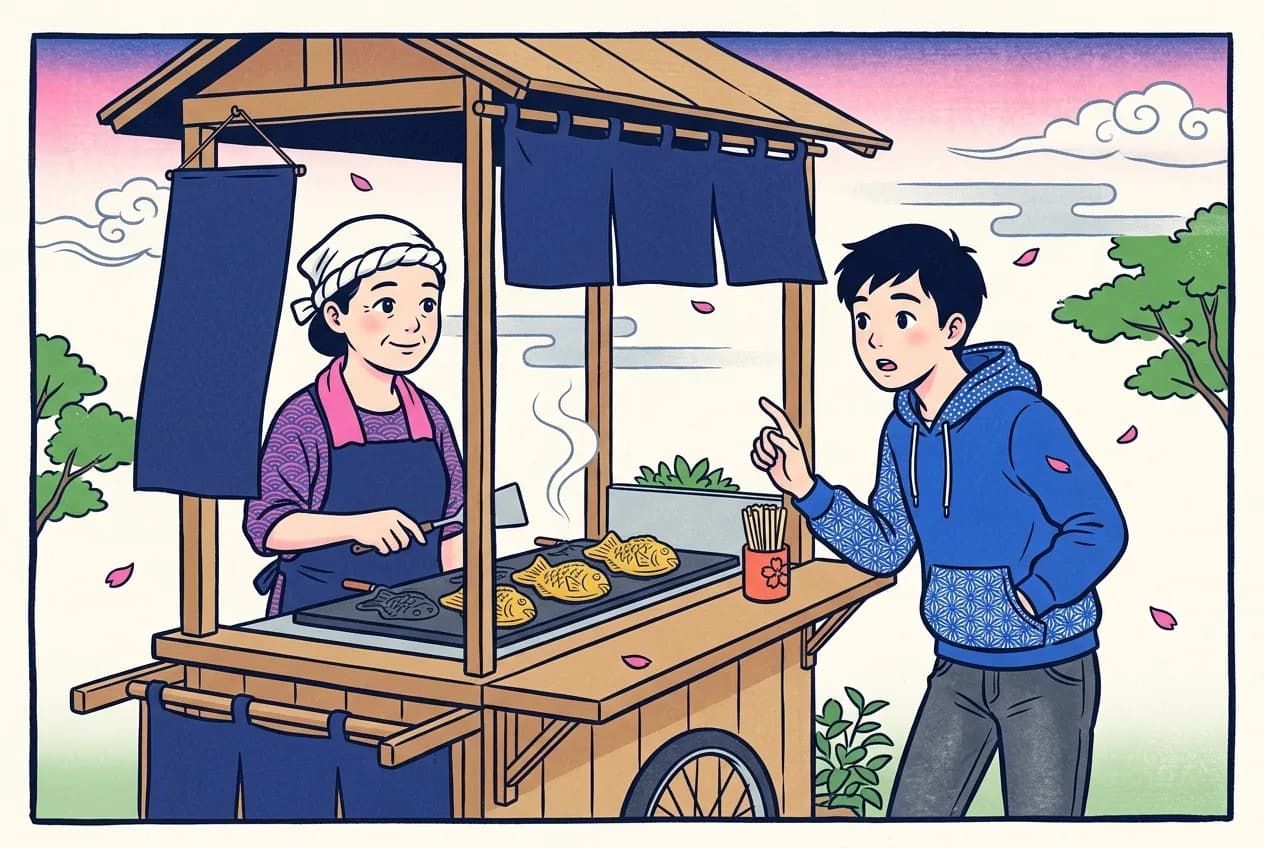
You can pass every vocabulary quiz and still freeze when someone asks you a question in Japanese. That freeze is a memory problem, not a talent problem.
The scene is so common it deserves a name. You've studied for months, you pass your vocabulary quizzes, and you follow more of your favorite shows than you'd admit.
Then a stall owner smiles and asks what you'd like, and nothing comes out. Not broken Japanese: nothing.
It is also not a shyness problem, and not evidence that your studying was wasted. Reading and speaking are two different memory skills, and almost everything beginners do — quizzes, flashcards, watching, reading — trains only the first one. You froze because you've been training goalkeeping and were suddenly asked to take the penalty.
The fix is not to study harder. It's a few minutes a day of a different kind of rep, called production, and this guide shows you what those minutes look like.
Recognition and recall are different muscles
Try this: name the capital of Australia. Even if you hesitated, you would recognize it at once in a list of four.
That gap, recognizing a word you cannot produce on demand, is one of the most reliable quirks of human memory. It is also the entire anatomy of your freeze at the counter.
Multiple-choice quizzes, matching cards, and reading along all give you the answer and ask whether you have seen it before. Speaking gives you nothing and asks you to build it.
Memory researchers have measured this distinction for a century. The effortful version, retrieving from a blank, is also what strengthens memory most. The uncomfortable rep is the productive one.
So when you say “I know the word but couldn't say it,” you are being precise. The word was stored for recognition, and it was never wired for retrieval.
And speaking is harder than recall
Producing one sentence out loud means doing five jobs at once. Find the words, put them in Japanese order, add the right particles, conjugate the verb, and pronounce it.
All of that happens while you listen to the other person and manage the small panic of being watched. Each job might be simple alone, and the traffic jam is the difficulty.
This is why speaking feels like a performance skill. It is one.
Reading sheet music doesn't make your fingers play the piano, and knowing grammar doesn't make your mouth assemble sentences at speed. Performance skills are built one way: small, repeated, slightly-too-hard live attempts.
The encouraging corollary: fluency in your first hundred situations doesn't require more knowledge than you have now. Most freezing learners already own every word they needed. What's missing is assembly practice, not vocabulary.
The silent-study trap
Input, meaning reading and listening, is genuinely necessary. Nobody speaks a language they have barely heard.
The trap is that input-only study keeps rewarding you with visible progress, such as quiz scores and comprehension. Your production muscle meanwhile stays at zero, invisibly. You can ride that comfortable loop for years, and many people do.
There's also a quieter reason the loop holds: input never embarrasses you. Speaking means making mistakes in front of someone, so it gets postponed until you're “ready.”
But ready is a place you can only reach by speaking. The postponement is the problem wearing a sensible disguise.
The 3-minute daily production routine
Three minutes is deliberately small, small enough that you'll actually do it daily, and daily is what wires retrieval. Every drill below follows one rule: nothing on the screen or page gives you the answer. You produce from a blank, out loud.
Minute one is answering your quiz or flashcards out loud before you reveal the answer. Minute two is saying one thing you see, such as コーヒーを飲んでいます (koohiiwonondeimasu) (“I'm drinking coffee”). Minute three is repeating a native sentence a beat behind the audio.
| Minute | Drill | What it trains |
|---|---|---|
| 1 | Say it, don't tap it | Retrieval under mild pressure |
| 2 | Narrate one thing you see | Assembling your own sentence from zero |
| 3 | Shadow one native sentence | Pronunciation, rhythm, and mouth memory |
Make mistakes on purpose (they're the data)
A production mistake is not a failed test. It's the diagnostic you can't get any other way, because saying a sentence wrong announces the gap precisely: that verb ending, that particle.
Input hides these gaps forever, and output finds them in seconds. Trading three polite errors for one exact diagnosis is the best deal in language learning.
And in the field, the stakes are lower than your nerves claim. A wrong particle at a food stall has never once prevented a taiyaki from being handed over.
Point, smile, say お願いします (onegaishimasu), and you have recovered. The freeze feels enormous from inside and is barely noticed from outside.
From three minutes to real conversation
The routine builds the muscle, and conversation is where you use it under real pressure. The graduation path is gentle: scripted dialogues first, such as ordering the coffee or buying the ticket. Then come the same scenes with variations, and then open conversation where you improvise.
Each stage borrows courage from the last.
This gap is exactly why we built Speak mode: real conversation scenarios you can run out loud with an AI partner that listens and answers. It tells you not only what was off but why, with infinite patience and zero audience. A free account gets you a daily conversation to start — the penalty practice, with the goalkeeper on your side.
You already know more Japanese than your mouth has been allowed to show. Three minutes today starts the handover.