Keigo Explained: The Three Politeness Levels of Japanese
Published 2026-07-30 · Updated 2026-09-03
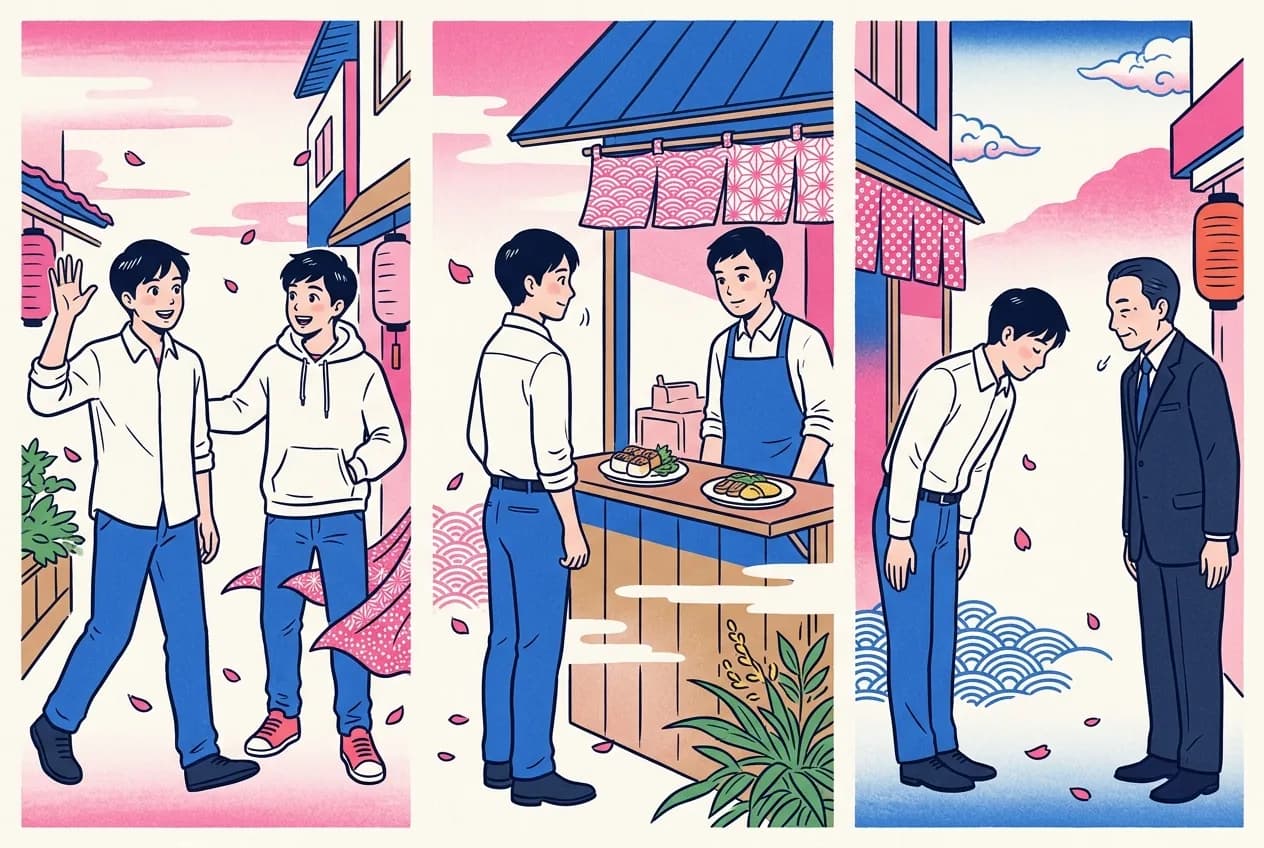
Everyday Japanese runs on three politeness gears: casual plain form, polite です (desu)・ます (masu), and 敬語 (keigo). Gear 1 is for your inner circle, gear 2 for everyone else, and gear 3 for workplaces and customer service.
Start with gear 3, used here for something the manager did:
部長はもうこの資料をご覧になりましたかぶちょうはもうこのしりょうをごらんになりましたか (buchouhamoukonoshiryouwogoranninarimashitaka)
Has the manager looked at this document yet?
Gear 3 is what you will hear at work and in customer service, and understanding it comes before producing it. Do not use it with a close friend, where the distance is already nearly zero. The extra politeness sounds like a joke, or like you are pushing the person away.
If you can handle です (desu)・ます (masu), you are already safe in nearly every situation in Japan. That surprises people, so it bears repeating. You do not need full keigo to be polite.
You may picture keigo as a wall between you and fluency. It is closer to a dial that Japanese speakers turn up and down all day, mostly without thinking about it.
This guide puts the three gears side by side, with the same sentences transformed three ways. It also covers the ideas that make the system work: distance, direction, and inside-versus-outside.
The three gears, in one minute
Gear 1 is plain form: 行く (iku), 食べる (taberu), わかった (wakatta) — short, warm, direct. It belongs to friends, family, and anyone you're fully relaxed with.
Gear 2 is the polite です (desu)・ます (masu) style you met in your first lesson. Here's the first surprise: this already counts as keigo. Its official name is 丁寧語 (teineigo) — “polite language,” one of keigo's three families — so technically you've been speaking keigo since day one.
Gear 3 is what most people mean by keigo, and it makes only two moves. Respectful forms — 尊敬語 (sonkeigo) — raise the other person's actions: 見る (miru) becomes ご覧になる (goranninaru) when they look.
Humble forms — 謙譲語 (kenjougo) — lower your own: 見る (miru) becomes 拝見する (haikensuru) when you look. One question decides which form you need: who is doing the action?
(The official guidelines divide keigo into five categories, but these three gears are the practical version.)
One sentence, three ways
The fastest way to feel the dial is to watch the same everyday lines climb through the gears. Notice two patterns: politeness adds length, and at gear 3 the word itself often changes — します (shimasu) becomes いたします (itashimasu), 見ます (mimasu) becomes ご覧になります (goranninarimasu).
| You mean | With friends | Polite — です (desu)・ます (masu) | Keigo — work & service |
|---|---|---|---|
| Got it | With friendsわかった (wakatta) | Polite — です (desu)・ます (masu)わかりました (wakarimashita) | Keigo — work & service承知しました (shouchishimashita) |
| Sorry | With friendsごめん (gomen) | Polite — です (desu)・ます (masu)すみません (sumimasen) | Keigo — work & service申し訳ございません (moushiwakegozaimasen) |
| Is this okay? | With friendsいい? (ii?) | Polite — です (desu)・ます (masu)いいですか (iidesuka) | Keigo — work & serviceよろしいでしょうか (yoroshiideshouka) |
| I'll do it | With friendsやるよ (yaruyo) | Polite — です (desu)・ます (masu)やります (yarimasu) | Keigo — work & serviceいたします (itashimasu) |
| Thank you | With friendsありがとう (arigatou) | Polite — です (desu)・ます (masu)ありがとうございます (arigatougozaimasu) | Keigo — work & service誠にありがとうございます (makotoniarigatougozaimasu) |
It's a distance dial, not a rank ladder
Textbooks often draw keigo as a ladder of social rank. Native usage makes more sense if you think of distance.
Strangers are far, so you speak politely. Friends are near, so you speak plainly. A boss sits at a respectful professional distance, so the dial goes up.
The proof is what happens when the distance is wrong. Answer a close friend with a perfect さようでございますか (sayoudegozaimasuka) and you will get a laugh, or a chill.
The laugh comes because you pushed the dial up where the distance is nearly zero. Couples do exactly this mid-quarrel, and comedians have built entire routines on sudden, unnecessary keigo.
So choosing a gear is less a test of your manners than a judgment about distance: how far apart are we right now? That idea also explains the strangest keigo rule of all, which comes next.
The inside-outside twist
You answer the phone at work. A client asks for your manager, Tanaka.
The correct form is 田中はただいま席を外しておりますたなかはただいませきをはずしております (tanakahatadaimasekiwohazushiteorimasu) — plain 田中 (tanaka). No さん (san), no title, for the very person you'd carefully call 田中部長 (tanakabuchou) 10 seconds later inside the office.
The reason is a boundary. Toward outsiders, everyone in your own circle counts as “inside,” including your company, your family, and your boss.
Inside people get the humble treatment, exactly like your own actions. Japanese speakers grow up flipping this switch at the edge between groups.
It's the clearest evidence that keigo measures distance between groups, not the rank of individuals. Once you see the boundary, a whole class of confusing examples — humble words for your own side, respectful words for theirs — snaps into one picture.
You don't have to mirror the clerk
Walk into a convenience store and you will be showered in gear-3 keigo: いらっしゃいませ (irasshaimase), 〜でございます (~degozaimasu). You may feel you should answer at the same level.
You do not have to, because service keigo is one-directional. Staff raise the customer, and the customer answers at normal politeness.
Ordinary gear 2 is the natural customer register: お願いします (onegaishimasu), 大丈夫です (daijoubudesu). And いらっしゃいませ (irasshaimase) isn't even a question — it's a welcome, and it expects no reply at all.
Even native speakers study keigo
Here's the most relaxing fact in this guide: keigo is a trained skill, not a birthright. Japanese companies run keigo training for new employees, and students drill it for job interviews. Nobody emerges from childhood with boardroom keigo installed.
Native speakers even have their own disputed keigo. Style guides often flag the service register sometimes called “part-time-job keigo” as over-engineered.
One example is よろしかったでしょうか (yoroshikattadeshouka) for a present-moment question. Yet you will hear it in stores every day, and the fine points are still under negotiation among natives themselves.
So when you blank on a humble form mid-sentence, don't freeze. Finish cleanly in です (desu)・ます (masu). An honest わかりました (wakarimashita) lands better than a mangled attempt at 承知いたしました (shouchiitashimashita) — correctness in gear 2 outranks decoration in gear 3.
Key takeaways
Choose the gear by distance, not by rank: near means plain, far means polite.
Toward an outsider, name your own boss without さん (san) and without a title.
When you cannot recall a humble form, finish the sentence in です (desu)・ます (masu).
How to actually build your keigo
Build in this order. First, make です (desu)・ます (masu) automatic, because it is the register you will live in.
Second, learn the special verb pairs for the everyday core verbs: to be, to go, to say, to eat, to do. They carry most of the keigo you will actually hear.
Third, collect workplace set phrases like 承知しました (shouchishimashita) and お先に失礼します (osakinishitsureishimasu) as vocabulary. Memorize them whole rather than deriving them.
Then train your ear. Restaurants, stations, and offices are running the dial constantly around you — try naming the gear of each sentence you hear. The quiz below starts you off: six situations, three gears, and the inside-outside twist included.