What Itadakimasu Really Means (Not Just “Bon Appétit”)
Published 2026-07-31 · Updated 2026-09-03
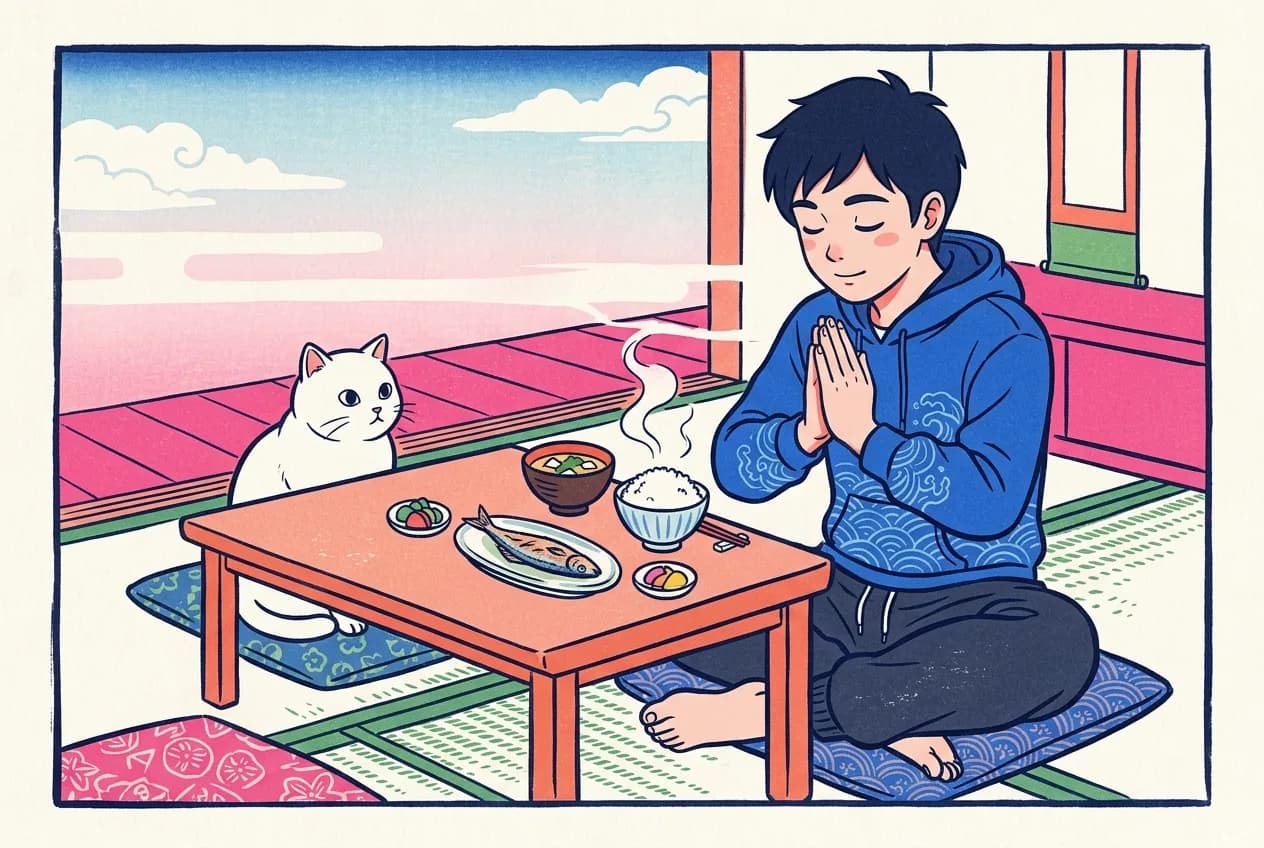
The short answer: いただきます (itadakimasu) literally means “I humbly receive,” not “let's eat” or “bon appétit.” The long answer is why this one word is many people's favorite piece of Japanese culture. What you receive is everything that became the meal: the plants and animals that were once alive, the farmer, the fisherman, the person who cooked.
Said before the first bite, usually with hands pressed lightly together, it is a one-second ritual of gratitude. Children learn it before they learn to write.
And no, it isn't a prayer to any particular deity. That's exactly what makes it portable: gratitude with no membership requirements.
Here's the full picture: the grammar hiding inside the word, the philosophy behind it, and its bookend partner ごちそうさまでした (gochisousamadeshita), whose literal meaning is even better. Plus exactly when — and when not — to say each.
The grammar: you already know this word's family
いただく (itadaku) is the humble form of the verbs “to receive” and “to eat,” and it belongs to 敬語 (keigo). It sits on the humble side, where a verb lowers your own action to show respect to the other side. Our keigo guide explains that side.
When a shop clerk says いただきます (itadakimasu) while taking your payment, it is the same word doing the same job: humbly receiving.
So the mealtime いただきます (itadakimasu) is a tiny keigo sentence with its object left unsaid. If you have studied any polite Japanese, you are one vocabulary word away from it. The full version reads: “I humbly receive this meal, and everything in it.”
The philosophy: receiving lives, not only lunch
Ask what exactly is being received, and the traditional answer taught to Japanese children is disarmingly direct. The meal was made of living things — fish, vegetables, grains — and their lives are what you're receiving. The phrase 命をいただく (inochiwoitadaku), “to receive life,” is how schools and families commonly explain it.
The gratitude then widens in circles. The innermost circle is the lives on the plate. The next takes in the people who grew and caught and cooked.
The widest takes in the circumstances that put food in front of you at all. One word, three thank-yous deep.
Is it religious? The instinct behind it connects to old ideas about life and nature. In practice, though, it is a secular daily habit, said by the devout and the indifferent alike.
Many languages have a set phrase for a sneeze, and nobody treats it as a religious statement. This works the same way. You can say it in full sincerity without signing up for anything.
The bookend: ごちそうさまでした (gochisousamadeshita)
Every いただきます (itadakimasu) has a closing partner, said when you finish. That partner is ごちそうさまでした (gochisousamadeshita), loosely “thank you for the feast,” and its literal meaning is the best etymology in Japanese food language.
馳走 (chisou) originally meant “to run about,” because before supermarkets a proper meal for a guest meant running around to gather ingredients. The word for feast is the word for the host's effort.
So the two phrases bracket the meal with two different thanks. いただきます (itadakimasu) honors what's on the plate, and ごちそうさまでした (gochisousamadeshita) honors the running-around that put it there.
How it's actually used (and the classic learner mix-up)
At home, both phrases are near-universal — kids get reminded the way English-speaking kids get reminded to say please. Eating alone, many people still say them quietly, or press their hands together for half a second. Solo diners in a hurry may skip it entirely, and nobody's counting.
One nuance is worth knowing. いただきます (itadakimasu) is said about your own eating, and not at other people, so it does not mean “dig in, everyone.”
If you're the host inviting guests to start, the phrase you want is どうぞ (douzo) (“please, go ahead”). And at a restaurant, a ごちそうさまでした (gochisousamadeshita) to the staff on your way out is one of the warmest things a customer can say. It means even more than thank you.
The whole meal script in four phrases
Four phrases cover the entire social choreography of a Japanese meal. The last of them belongs to drinks rather than food, so keep it out of the mealtime pair.
| Moment | Say | It means |
|---|---|---|
| Before your first bite | Sayいただきます (itadakimasu) | It means“I humbly receive”: thanks to the meal |
| When you finish | Sayごちそうさまでした (gochisousamadeshita) | It means“thank you for the feast”: to the maker |
| Inviting others to start | Sayどうぞ (douzo) | It means“please, go ahead” |
| Raising a glass | Say乾杯 (kanpai) | It means“cheers” — the drinking toast |
Say it tonight
No phrase in this guide needs a trip to Japan. いただきます (itadakimasu) works over tonight's dinner, wherever you are.
Put your hands together if you like, add one small bow of the head, and mean it for a second. It's the rare piece of language learning that upgrades the meal: you no longer only eat it. You receive it.
Then see how much of Japan's food culture you already have. Our food basics quiz covers the mealtime phrases, the dishes, and the etiquette around them — six questions, right below.