Japanese Onomatopoeia Has Rules: Learn the System, Not Lists
Published 2026-07-29 · Updated 2026-09-03
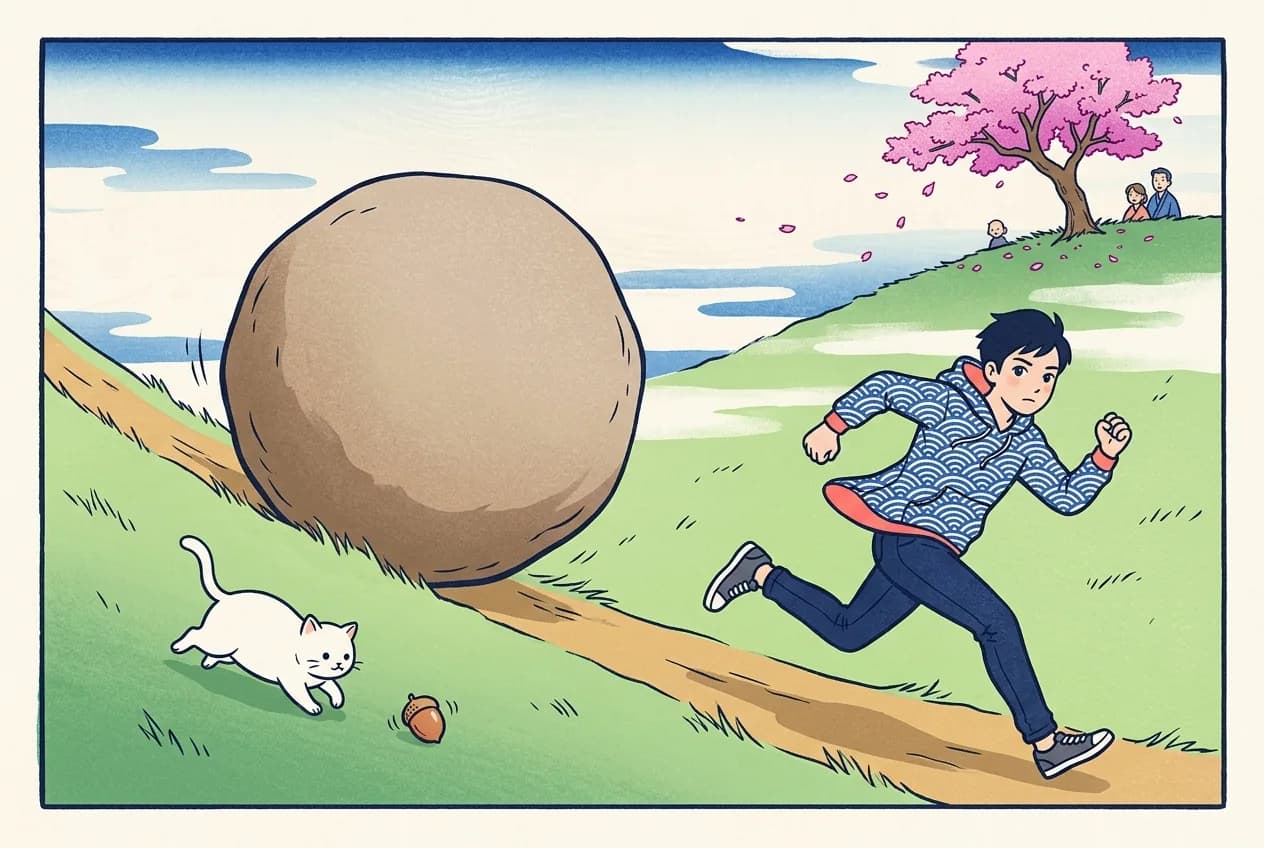
Japanese has thousands of onomatopoeia — words for rain, for heartbeats, for the texture of a sweater, even for silence. Lists of them are endless and unmemorizable.
One rule replaces the list, and it works like a dial: unvoiced sounds (ころころ (korokoro), さらさら (sarasara)) are small, light and pleasant. Add two little dots — the 濁点 (dakuten) — and the same word becomes big, heavy or rough (ごろごろ (gorogoro), ざらざら (zarazara)). Learn that one rule and a large share of Japanese sound words will explain themselves to you on first hearing.
Here is the heavy setting of that dial in a sentence:
山の上で雷がゴロゴロ鳴っているやまのうえでかみなりがゴロゴロなっている (yamanouedekaminarigagorogoronatteiru)
Thunder is rumbling up on the mountain.
Use a sound word whenever you want to say how something moves, feels, or sounds. The thunder in that sentence is a real sound, so it is written in katakana. Do not memorize the heavy setting as a separate word: ころころ (korokoro) and ごろごろ (gorogoro) both roll, and only the weight changes.
Two families: sounds and states
Japanese textbooks split these words into two groups. 擬音語 (giongo) imitate actual sounds, like English “bang” or “meow”: ざあざあ (zaazaa) for pouring rain, わんわん (wanwan) for a barking dog.
The second family is 擬態語 (gitaigo), “sound words” for things that make no sound at all. ふわふわ (fuwafuwa) is fluffiness, どきどき (dokidoki) is a nervous heart, and きらきら (kirakira) is sparkling.
There is almost nothing like this in English. Japanese runs daily conversation on it.
The 濁点 (dakuten) dial: two dots = heavier
Watch the same word at two settings. ころころ (korokoro): a small thing rolling — an acorn, a coin. ごろごろ (gorogoro): something heavy rolling — a boulder, thunder, or you, on the sofa all Sunday.
Same rolling, different weight, and the only change is two dots.
The dial works everywhere. さらさら (sarasara) is smooth and silky, while ざらざら (zarazara) is rough and gritty.
きらきら (kirakira) is a gentle sparkle from jewelry or stars, and ぎらぎら (giragira) is a harsh glare from the midsummer sun. Native speakers feel this instinctively, and now you can too.
Say it twice: repetition = it keeps going
Most of these words are doubled, like どきどき (dokidoki), ぺこぺこ (pekopeko), and ふわふわ (fuwafuwa). The doubling itself means continuation: the heart keeps pounding, the stomach keeps growling, the fluff stays fluffy.
That is the second part of the system: the sound tells you the texture, and the repetition tells you it is ongoing. Two rules cover thousands of words.
The ones you'll use this week
Here's a starter kit of the highest-frequency words. おなかがぺこぺこ (onakagapekopeko) is “I'm starving” — your stomach empty and caved-in — and どきどきする (dokidokisuru) is nervous-excited, heart pounding before a test or a date. わくわくする (wakuwakusuru) is thrilled anticipation, and ふわふわ (fuwafuwa) is fluffy: pancakes, cats, futons fresh off the balcony.
And the one every learner should know exists: ぺらぺら (perapera) — speaking a language fluently. 日本語がぺらぺらですね (nihongogaperaperadesune) is the upgrade compliment above 上手 (jouzu), and it literally evokes pages flipping fast — words flowing without friction.
しーん (shi-n) — the sound of silence
Japanese famously has an onomatopoeia for total silence: しーん (shi-n). It was popularized by manga panels that needed to draw the absence of sound, and it crossed from there into everyday speech. Tell a joke that lands badly and a friend may narrate the moment: しーんとなった (shi-ntonatta) (“it went dead quiet”).
A language that can pronounce silence is a language having fun. That spirit — sound painting reality — is why Japanese keeps coining these words while English borrows them.
Cheat sheet: the dial in action
Feel the pairs, don't memorize them:
| Light (no dots) | Heavy (with 濁点 (dakuten)) | The shared idea |
|---|---|---|
| ころころ (korokoro) — acorn rolls | Heavy (with 濁点 (dakuten))ごろごろ (gorogoro) — boulder, thunder, lazing | The shared ideaRolling |
| さらさら (sarasara) — silky hair, a clear stream | Heavy (with 濁点 (dakuten))ざらざら (zarazara) — sandpaper, gritty skin | The shared ideaSurface texture |
| きらきら (kirakira) — stars, jewelry | Heavy (with 濁点 (dakuten))ぎらぎら (giragira) — glaring sun, hungry eyes | The shared ideaShining |
| とんとん (tonton) — a light knock | Heavy (with 濁点 (dakuten))どんどん (dondon) — pounding, advancing fast | The shared ideaKnocking / momentum |
| ぱくぱく (pakupaku) — happily munching | Heavy (with 濁点 (dakuten))ばくばく (bakubaku) — eating fast, pounding heart | The shared ideaEating (and eating too fast) |
Key takeaways
Two dots make the same word heavier: ころころ (korokoro) rolls small, ごろごろ (gorogoro) rolls big.
A doubled word says the state keeps going.
ぺらぺら (perapera) praises fluent speech and ranks above 上手 (jouzu) as a compliment.
How to build the instinct
Don't study lists — collect encounters. Each time you meet a new sound word, run the dial: voiced or unvoiced? doubled or not? You'll often guess the meaning before anyone explains it, and that's the exact skill native speakers have.
Then test the instinct — the quiz below throws real situations at you and asks your gut which sound fits.