Japanese Verb Conjugation: Five Steps, One Step, One Chart
Published 2026-08-22 · Updated 2026-09-03 · 12 min read
Japanese verb conjugation is smaller than the search results make it look. Japanese verbs come in three groups. Two of them follow rules, and the third has exactly two members.
Those two are する (suru), to do, and 来る (kuru), to come. There are two tenses, and no future to build. One verb has eight basic forms, and then it stops.
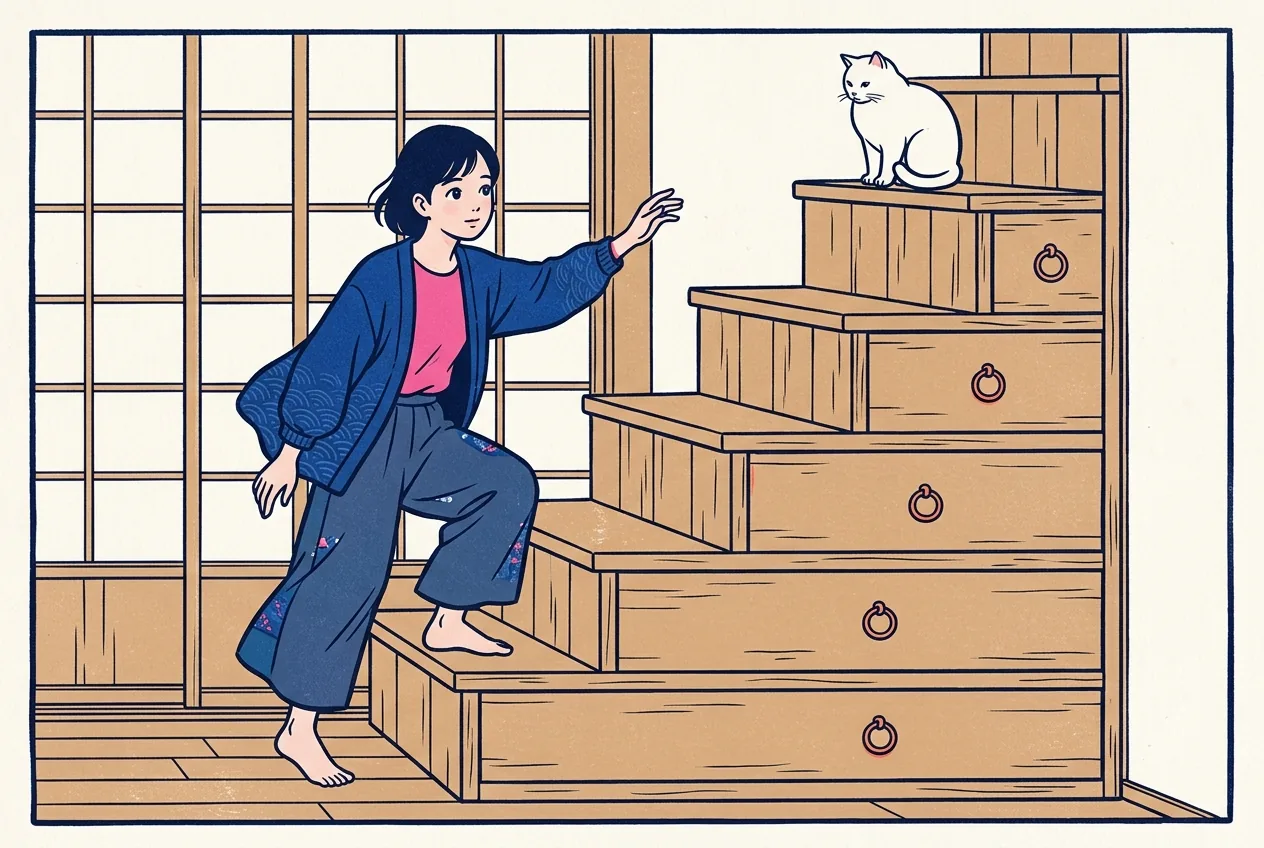
The names already tell you how it works: a 五段 (godan) verb is a five-step verb, and its ending walks all five steps. A 一段 (ichidan) verb is a one-step verb, and it never leaves the step it starts on. Those steps are the あ (a), い (i), う (u), え (e), お (o) you met on your first day of hiragana.
So a Japanese verb conjugation chart isn't a new thing to memorize; it's the kana grid you already own, read in a different direction. The verb takes the last seat in a Japanese sentence — that's the one fixed rule in our field note on sentence structure. This note is about what the verb does once it's sitting there.
Use these eight forms for any verb, because Japanese builds tense, politeness, and negation on the ending alone. A verb that ends in anything but る (ru) is always a five-step verb. Only the ones ending in る (ru) need a test: 帰る (kaeru) and 走る (hashiru) end in る (ru) but are five-step verbs.
Japanese verb conjugation: three groups, two tenses, and eight forms per verb
Take one verb and count. 飲む (nomu) means drink, and it belongs to the largest of the three groups.
Two tenses, two levels of politeness, positive and negative: two times two times two. Eight forms. That's the basic set for this verb, and for nearly every other verb too.
Each group carries two or three names, which is most of the reason the topic looks crowded. U-verbs are also called godan verbs, or Group 1, and ru-verbs are ichidan verbs, or Group 2.
The irregulars are Group 3, and the whole of Group 3 is する (suru) and 来る (kuru). Learn those two as words and the irregular verbs are finished.
Say someone offers you a refill and you've already had one, and a single form answers the whole question:
もう飲みました (mounomimashita)
(I) already drank it.
Here are all eight, plain on one side and polite on the other. As you read down the meanings, watch what stays still: the front of the verb never moves.
| Meaning | Plain | Polite |
|---|---|---|
| Drink / will drink | Plain飲む (nomu) | Polite飲みます (nomimasu) |
| Don't drink / won't drink | Plain飲まない (nomanai) | Polite飲みません (nomimasen) |
| Drank | Plain飲んだ (nonda) | Polite飲みました (nomimashita) |
| Didn't drink | Plain飲まなかった (nomanakatta) | Polite飲みませんでした (nomimasendeshita) |
Godan verbs walk all five steps; ichidan verbs stay on one
The name is the explanation. 段 (dan) is a step of a staircase, and it's also the word for a row of the kana chart. A godan verb is a five-step verb, and its ending moves up and down five of them.
Take 聞く (kiku), to listen or to ask: the ending is く (ku), which sits on the う (u) step.
Slide it down to か (ka) and the negative appears. Slide it to き (ki) and you have the polite form. The dictionary form stays where it started, and two more steps sit above it.
An ichidan verb does none of this, and 食べる (taberu) keeps べ (be) in place for every form — 食べない (tabenai), 食べます (tabemasu), 食べる (taberu). One step, and the verb never steps off it. The name says so.
That staircase is the あ (a), い (i), う (u), え (e), お (o) grid from the hiragana field note. You learned it as an alphabet. It turns out to be the engine.
Lost near a station, you stop someone and ask the way, and afterwards you can report the whole thing in one sentence:
駅で道を聞きました (ekidemichiwokikimashita)
(I) asked the way at the station.
Here is 聞く (kiku) on all five steps, in the order of the chart.
| Kana row | The form | What it does |
|---|---|---|
| The あ (a) row | 聞かない (kikanai) | Plain negative — doesn't listen or ask |
| The い (i) row | 聞きます (kikimasu) | Polite non-past — listens, will ask |
| The う (u) row | 聞く (kiku) | Dictionary form — the shape you look up |
| The え (e) row | 聞ける (kikeru) | The can-do form — can hear it, can ask |
| The お (o) row | 聞こう (kikou) | The let's-do form — let's ask someone |
How to tell a ru-verb from a u-verb that ends in ru
Here's the one place where the ending lies to you. Plenty of u-verbs end in る (ru) as well, so the る (ru) on its own sorts nothing. It is where wrong forms come from most often in the first year.
There is a decent test, and it looks at the sound right before the る (ru). If that sound sits on the あ (a), う (u), or お (o) row, the verb is a u-verb, every time.
If it sits on い (i) or え (e), the verb is usually a ru-verb. Usually, not always.
帰る (kaeru) is the famous counterexample. It means to go home, it ends in る (ru), and the sound in front is え (e).
So the test says ru-verb, and the test is wrong. 帰る (kaeru) is a u-verb, which is why the polite form is 帰ります (kaerimasu) and not かえます (kaemasu).
Treat the ending as a hint, never a rule: check the group, and don't guess from the る (ru).
The verb appears the moment you talk about your evening:
六時に帰ります (rokujinikaerimasu)
(I) go home at six.
Three verbs get you most of the way through the trap: 帰る (kaeru), 入る (hairu), 走る (hashiru). All three end in る (ru). All three are u-verbs.
The masu form is the polite non-past — and three more forms come with it
The masu form is the polite ending, and it's the first one most courses teach. Attach ます (masu) and you have the polite non-past. Three more forms then come from the same stem, with nothing new to learn.
ません (masen) is the polite negative. ました (mashita) is the polite past. ませんでした (masendeshita) is the polite past negative.
The stem holds still through all four. 飲み (nomi) stays 飲み (nomi), and you only swap the tail.
Plain forms sit beside them in the chart above, and they aren't ruder. They are a different setting, chosen by who you're speaking to and where you are. That choice is a subject of its own, and the field note on politeness levels takes it apart properly.
Telling a colleague what your day looks like takes one verb and one ending:
今日は働きません (kyouhahatarakimasen)
(I) am not working today.
Four endings, one stem. That's the polite half of the eight already done.
Japanese has only two tenses, so there is no future to conjugate
Japanese verb tenses come to two, and that's the whole list: non-past and past. English speakers go looking for a future form and don't find one. There isn't one to find.
The non-past covers now and later at the same time. 飲みます (nomimasu) is drink and will drink at once, and a time word decides which: today, tomorrow, every morning.
The verb doesn't stretch to reach the future. The sentence around it does that work.
Say where you're going tomorrow and the verb stays exactly where it was:
明日東京へ行きます (ashitatoukyouheikimasu)
(I) will go to Tokyo tomorrow.
Japanese past tense is the only other one you build, and it takes two shapes: plain 飲んだ (nonda) and polite 飲みました (nomimashita). Put the two tenses against politeness and polarity and you get the eight forms from the top of this page. There is no ninth waiting behind them.
The te form is the connector, and this is the whole sound-change table
The Japanese te form isn't a tense at all. It's the connector.
It links one clause to the next, it sits under polite requests, and it carries the ongoing forms you meet soon afterwards. Most of the longer patterns lean on it, which is why it arrives so early.
Building it is where the sound changes live, and there are five rules that sort by the last sound of the dictionary form. Ru-verbs skip the whole business: drop る (ru), add て (te), done.
Two errands in one sentence, connected at the て (te):
水を買って、帰りました (mizuwokatte,kaerimashita)
(I) bought water and went home.
Here are the five, one row each, for u-verbs, with a verb you already know beside them.
| Dictionary ending | Te form | Example |
|---|---|---|
| Ends in く (ku) | Becomes いて (ite) | 歩く (aruku) walk — 歩いて (aruite) |
| Ends in ぐ (gu) | Becomes いで (ide) | 泳ぐ (oyogu) swim — 泳いで (oyoide) |
| Ends in む (mu), ぶ (bu), or ぬ (nu) | Becomes んで (nde) | 飲む (nomu) drink — 飲んで (nonde) |
| Ends in う (u), つ (tsu), or る (ru) | Becomes って (tte) | 買う (kau) buy — 買って (katte) |
| Ends in す (su) | Becomes して (shite) | 話す (hanasu) speak — 話して (hanashite) |
One verb refuses to play. 行く (iku) ends in く (ku), so the table above predicts いいて (iite), and nobody has ever said that. The real form is 行って (itte), borrowed from the って (tte) row, and it's the exception everybody quotes — in this table it's the only one.
The slips that do happen are almost always a rule applied to the wrong row:
❌ かいて (kaite) — the く (ku) pattern, put on 買う (kau)
⭕ 買って (katte) — う (u) takes the small っ ()
Five rows and one exception. That's the connector.
Japanese adjectives conjugate too — and that is where the chart stops
Verbs aren't the only words that change shape, and an い (i)-adjective conjugates itself, the way a verb does. 高い (takai) is expensive; 高かった (takakatta) is the same word saying was expensive. Nothing is added to help it.
That catches nearly everyone once. Past tense feels like something you bolt on at the end, so でした (deshita) goes on and the adjective is left untouched:
❌ 高いでした (takaideshita)
⭕ 高かったです (takakattadesu)
The です (desu) is only politeness. It never carries tense, so the adjective has to do it.
な (na)-adjectives work the other way around. They don't bend at all, and the ending after them does instead, so 静かだ (shizukada) becomes 静かだった (shizukadatta). A few words ending in the い (i) sound belong to this group anyway — きれい (kirei), 有名 (yuumei), 嫌い (kirai).
Reporting back on a place you tried takes one adjective and no verb at all:
その店は高くなかったです (sonomisehatakakunakattadesu)
That shop wasn't expensive.
And here's the thing that makes conjugation look endless. Forms stack. 飲む (nomu) becomes 飲みたい (nomitai), want to drink, and 飲みたい (nomitai) can go negative and past like anything else.
But look at what it turned into on the way — たい (tai) ends in い (i), and it bends like an い (i)-adjective: 飲みたくない (nomitakunai), 飲みたくなかった (nomitakunakatta). The plain negative does the same — 飲まない (nomanai), 飲まなかった (nomanakatta). Stack as far as you like and you land back on the adjective endings from the top of this section.
So the chart does end, and the end is close. Three groups, two of them regular. Two tenses, no future.
Two irregular verbs, both of them words you'll use in your first week. And for any one verb, eight basic forms, the same eight you counted at the top.
Key takeaways
Find the group of a verb first, because the group decides how its ending changes.
Change only the tail of the verb, because the front never moves.
Only する (suru) and 来る (kuru) are irregular, so memorize those two.
How do you conjugate Japanese verbs?
Find the group first, then change the ending. A u-verb moves its ending along the kana rows, so 飲む (nomu) gives 飲まない (nomanai) and 飲みます (nomimasu). The past 飲んだ (nonda) takes a sound change on top.
A ru-verb drops る (ru) and adds the ending you want: 食べる (taberu) gives 食べない (tabenai), 食べます (tabemasu). する (suru) and 来る (kuru) are irregular and get learned as words. Through all of it the front of the verb never moves, and only the tail does.
What is the difference between godan and ichidan verbs?
The names describe it exactly: 五段 (godan) means five steps and 一段 (ichidan) means one step. A godan verb's ending walks all five rows of its kana column: 聞かない (kikanai), 聞きます (kikimasu), 聞く (kiku), 聞ける (kikeru), 聞こう (kikou).
An ichidan verb keeps one sound and changes only what follows it: 食べない (tabenai), 食べます (tabemasu), 食べる (taberu). Godan verbs are also called u-verbs or Group 1, and ichidan verbs are ru-verbs or Group 2.
How many verb tenses does Japanese have?
Two: non-past and past. There's no separate future tense, so the non-past covers the present and whatever is still to come. A time word tells you which one is meant.
飲みます (nomimasu) is drink and will drink at the same time, and adding politeness and polarity to those two tenses gives one verb eight basic forms.
How do you know if a verb ending in ru is a ru-verb or a u-verb?
Look at the sound right before the る (ru). If it sits on the あ (a), う (u), or お (o) row of the kana chart, the verb is a u-verb, every time.
If it sits on い (i) or え (e), it's usually a ru-verb, and the exceptions are real ones you meet early: 帰る (kaeru), 入る (hairu), 走る (hashiru). Treat the ending as a hint, never a rule.
How many irregular verbs does Japanese have?
Two: する (suru), to do, and 来る (kuru), to come. Both are common, so you meet them early and learn their forms as words rather than working them out: します (shimasu), して (shite), 来ます (kimasu), 来て (kite).
A few other verbs bend a single form each. 行く (iku) is the one you'll notice, with 行って (itte) where the く (ku) pattern would predict something else. Past that, the two groups behave.
Where Ukiyoe Japanese fits
Everything above is a map, and a map is not the walk. Inside Ukiyoe Japanese the same map exists as a concept lesson, The shape of conjugation.
It holds three verb groups, two adjective types, and two tenses on one page, with example sentences attached. It's there so that every conjugation table you meet later has somewhere to sit.
The step-by-step changes live in the drills, where you type the form yourself instead of recognizing it on a page.
The Conjugation gym asks for the て (te) form, the ない (nai) form, and the rest, one verb at a time. When you miss, it tells you which pattern you used. Three groups, two tenses, eight forms, and somewhere to practice all eight.
Open the N5 Grammar shelf — one pattern, one lesson, in order
Popular
Latest