Japanese Sentence Structure: One Fixed Rule, Then Name Tags
Published 2026-08-20 · Updated 2026-09-18 · 10 min read
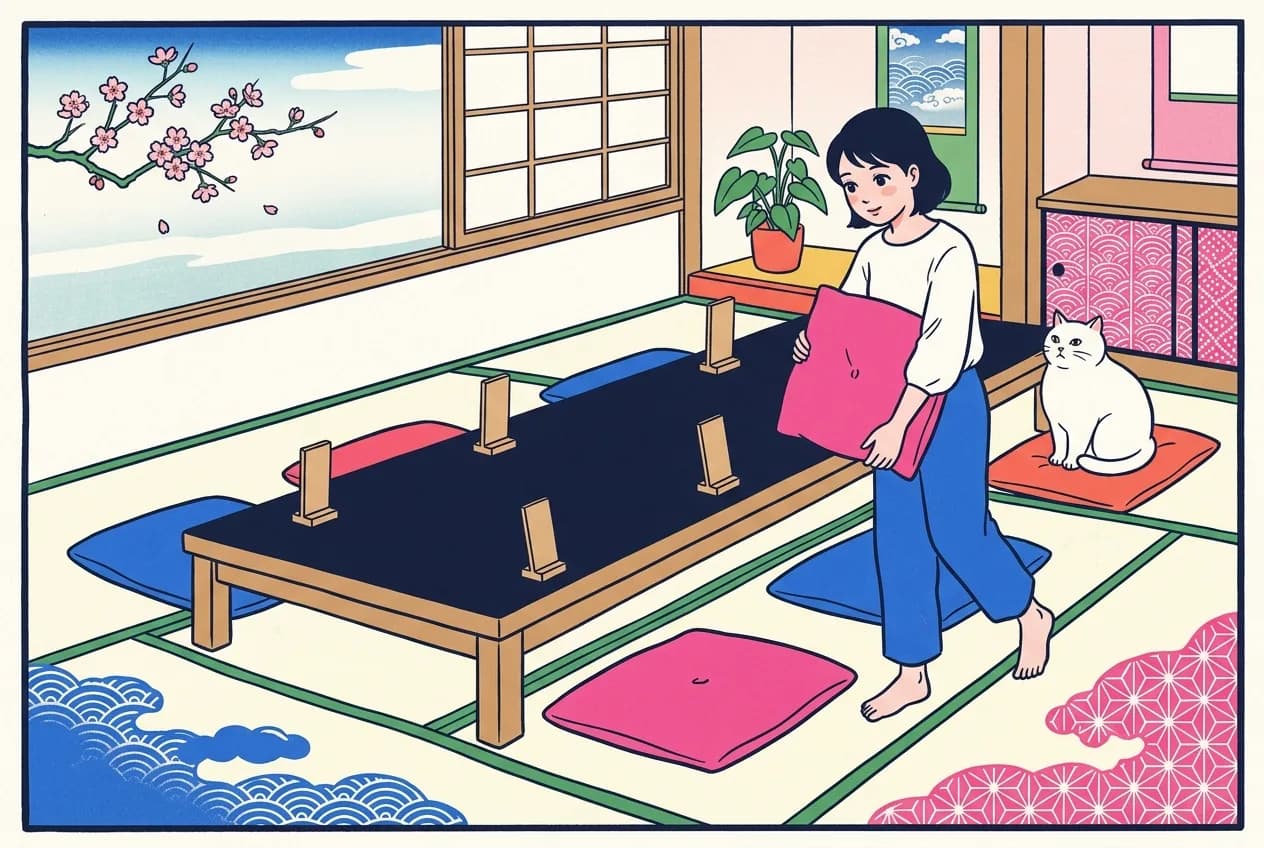
Japanese sentence structure runs on one fixed rule: the verb comes last. That's the whole list.
English tells you who does what by seating order, with the subject before the verb and the object after it. Japanese gives every word a name tag instead, a short particle glued to its back, so the seats can move and the roles can't.
Two more things follow from that swap. The subject usually isn't said at all. A statement doesn't turn negative, past, or into a question until its very last syllable.
Use this shape for every sentence you build, from a one-word answer to a long report. By the end, SOV should read less like a label and more like a seating chart with one reserved seat.
Japanese sentence structure has one fixed rule: the verb comes last
Every Japanese sentence ends with its predicate — a verb, an adjective, or です (desu) for “is.” That position isn't negotiable. Everything else lines up in front of it, in an order you get to choose.
Say you're telling a friend about your mornings. The shortest honest report is three words in English and two pieces in Japanese:
コーヒーを飲みます (koohiiwonomimasu)
(I) drink coffee.
English puts drink in the middle. Japanese holds it for the end — coffee first, then what happens to it. However long the front grows, the verb keeps the final word.
The classic beginner mistake is keeping English seating and swapping words one for one:
❌ 食べますパンを (tabemasupanwo) — the verb walked out first
⭕ パンを食べます (panwotabemasu) — bread wears its tag, and the verb closes the door
The rule covers more than verbs, too. Adjective sentences and です (desu) sentences close the same way — whatever does the asserting goes last.
Japanese word order: SOV on paper, tags in practice
Textbooks file Japanese as an SOV language: subject, object, verb. English is SVO — subject, verb, object. Put the same sentence side by side and the difference is plain:
私はお茶を飲みます (watashihaochawonomimasu)
I drink tea — assembled, tea comes before drink.
So the label is accurate. It's also only half useful, and it helps to know which half.
The V part is a real rule: the verb ends the sentence every time. The S and O parts describe the neutral order, not a law. Both can move, because neither one's job depends on where it sits.
That's the practical answer to whether Japanese is SOV: yes for the verb, roughly for the rest. What actually pins each role in place is the tag on the word — and that's where particles come in.
So stop asking where a word goes. Ask which tag it wears, and the position will mostly follow.
Particles are the name tags that tell you who does what
A particle, 助詞 (joshi), is a short syllable attached to the end of a word, announcing that word's job to everyone in the sentence.
は (ha) tags the topic you're talking about. を (wo) tags the thing the verb acts on. Five of them cover most beginner sentences, and each one stays with its word wherever the word goes.
One habit to recognize, not to copy at this stage: relaxed speech often drops the tag, and you will hear コーヒー飲みます (koohiinomimasu) with no を (wo). The tagged form is the one to learn, because を (wo) is what marks the coffee as the thing you drink. A dropped tag is not a sign that tags are optional.
Two pronunciation notes before the table: as a particle, は (ha) is pronounced wa, and を (wo) is pronounced o. Your ear will accept both within a week.
One more note before the table. は (ha) marks the topic rather than the subject, and が (ga) marks the subject, often as new information.
| Particle | What it tags | Example | In English |
|---|---|---|---|
| は (ha) | What it tagsThe topic — “as for …” | Exampleここは寒いです (kokohasamuidesu) | In EnglishIt's cold here |
| が (ga) | What it tagsThe subject — who or what does it | Example猫がいます (nekogaimasu) | In EnglishThere's a cat |
| を (wo) | What it tagsThe object — what the verb acts on | Exampleお茶を飲みます (ochawonomimasu) | In English(I) drink tea |
| に (ni) | What it tagsA destination, or a point in time | Example七時に起きます (shichijiniokimasu) | In English(I) get up at seven |
| で (de) | What it tagsWhere an action happens, or the means | Example家で働きます (iedehatarakimasu) | In English(I) work at home |
Build one sentence from a single word up
Now watch the tags in action. Here's a breakfast report, starting from the smallest sentence Japanese allows:
食べます (tabemasu)
(I) eat. One verb — already a complete sentence.
パンを食べます (panwotabemasu)
(I) eat bread. Bread walks in wearing its object tag.
毎朝パンを食べます (maiasapanwotabemasu)
(I) eat bread every morning. The time word slots in at the front.
家で毎朝パンを食べます (iedemaiasapanwotabemasu)
(I) eat bread at home every morning. Home joins with で (de), the where-tag.
Notice two things. The sentence only ever grew at the front, and the verb never moved. No stage was incomplete.
Japanese sentences don't build toward being finished. They start finished and take on passengers.
This is one sentence taken apart by role, the same way our writing-system field note takes one apart by script. Between the two, you can see everything a Japanese sentence is doing.
The subject usually stays silent
Here's the part no English instinct prepares you for: none of the breakfast sentences above say who's eating. They don't need to. Japanese leaves the subject out whenever context already answers it — and context almost always does.
In conversation this is the default, not a shortcut. A question gives you the context, and your answer rides on it:
コーヒーを飲みますか (koohiiwonomimasuka)
Will you have coffee?
飲みます (nomimasu)
(I) will. One word back, and nothing is missing.
Starting every sentence with 私は (watashiha) is grammatical, and it sounds like introducing yourself each time you speak. Native speakers save the subject for when it's genuinely unclear, or genuinely the point.
So when do you say it? When you'd stress it in English: contrast, correction, or real doubt about who did what.
If your friend drinks tea and you don't, the subject earns its seat and its tag. The rest of the time, silence is the fluent choice.
Negatives, questions, and the past all happen at the ending
In English, a question reshuffles the sentence and a negative recruits extra words — do, don't, didn't. Japanese does both jobs at the tail of the verb, and the rest of the sentence never feels a thing:
映画を見ます (eigawomimasu)
(I)'ll watch a movie.
映画を見ません (eigawomimasen)
(I) won't watch a movie.
映画を見ますか (eigawomimasuka)
Will you watch a movie?
Three sentences, and the only difference is the verb's tail: -masu, -masen, -masu ka. To ask a question, you add か (ka) to the end of a statement and change nothing else.
Move that same movie plan into the past, and again only the tail changes:
きのう友だちと映画を見ましたきのうともだちとえいがをみました (kinoutomodachitoeigawomimashita)
I saw a movie with a friend yesterday.
Two more verbs, one negative and one past negative:
肉は食べません (nikuhatabemasen)
(I) don't eat meat.
けさは新聞を読みませんでしたけさはしんぶんをよみませんでした (kesahashinbunwoyomimasendeshita)
This morning I didn't read the newspaper.
That is the whole set: four endings for now-or-later, negative, past, and past negative. A question adds か (ka) on top of any of them. The front of the verb does not change — only its tail does.
The field note on verb conjugation shows how each of those tails is built.
Question words obey the same rule of position. どこ (doko) sits where the answer would sit, not at the front of the sentence. Which word to use for each kind of question is the subject of the field note on asking what.
The flip side is a real listening habit: a Japanese sentence doesn't commit until its final syllable. You can hear every word of the movie plan and still not know whether it's on, off, or an invitation. So you listen to the end — not out of politeness, but because that's where the sentence is decided.
This also gives you the best exercise for getting used to the structure. Don't study the rules table again.
Listen to any sentence and guess the tail before it arrives: -masu, -masen, -mashita, or -masen deshita. You'll be wrong for a week. Then your ear starts leaning toward the end of the sentence on its own, and that lean is the entire skill.
Reordering is legal — it only moves the spotlight
Because the tags travel with their words, you can reseat almost everything in front of the verb. What changes isn't the meaning — it's the emphasis. Whatever comes first gets a small spotlight.
Here's the same breakfast twice, with the spotlight moved:
毎朝パンを食べます (maiasapanwotabemasu)
(I) eat bread every morning — time first, the neutral order.
パンを毎朝食べます (panwomaiasatabemasu)
(I) eat bread every morning — same fact, bread up front, as if someone had asked what you keep buying so much of.
“Free word order” oversells it, so here's the honest degree. The verb is fixed.
Topics and time words like the front. Everything else can shuffle, at the price of a nudge in emphasis.
In relaxed speech you'll even hear a piece tacked on after the verb, as an afterthought, with its tag keeping it legible. That's seasoning, not structure. Verb-last is the shape you build on.
Key takeaways
Put the verb last in every sentence, and let the particles decide the other roles.
Say the subject only when you would stress it in English.
Move a word to the front to emphasize it, and the meaning stays the same.
What is the basic sentence structure of Japanese?
Topic and time first, then place and object, then the verb — with every noun carrying a particle that marks its job. A neutral beginner sentence runs topic + は (ha), time, place + で (de), object + を (wo), verb. Only the verb's position is fixed; the particles let everything else move.
Is Japanese SOV or SVO?
Japanese is SOV: the verb comes last, and in a neutral sentence the subject, when it's said at all, comes before the object. English is SVO.
The practical difference is that English positions are load-bearing, while Japanese positions mostly aren't. Particles carry the load instead.
Does word order matter in Japanese?
Less than in English, with one exception: the predicate must come last. Reordering the rest never changes who does what — the particles fix that — but it shifts emphasis toward whatever you put first. So word order in Japanese works less like a grammar rule and more like tone of voice.
Where does the question word go in a Japanese sentence?
In the same place the answer would go. Japanese does not move a question word to the front.
か (ka) still closes the sentence. The question words themselves belong to the field note on asking what.
What is the difference between wa and ga?
は (ha) tags the topic, the thing the sentence is about. が (ga) tags the grammatical subject, who or what does the action, especially when that's new information.
They overlap often enough that the full choice between them has its own logic. That is why it gets its own drill in Ukiyoe Japanese, separate from the everyday particles.
Does Japanese have articles like “a” and “the”?
No. Japanese has no articles, and nouns don't regularly mark singular versus plural either.
パン (pan) covers a bread roll, the bread, and bread in general. Context and the particle do the sorting. English speakers tend to miss articles less than they expect, because context was already doing most of that work.
Where Ukiyoe Japanese fits
Everything in this note exists inside Ukiyoe Japanese as something to do rather than something to read. The concept lesson How Japanese sentences work covers the same ground with reviewed example sentences: verb-last, the tags, and the silent subject.
The Particle gym turns the table above into fill-in-the-blank reps. You place は (ha), が (ga), を (wo), に (ni), and で (de) until the tags start placing themselves.
Once the tags feel automatic, the next step is patterns. The N5 grammar shelf takes the sentence shape you learned here and grows it, one pattern per lesson. The verb keeps its reserved seat the whole way.
Open the N5 Grammar shelf — every pattern, one lesson each
Popular
Latest