Anime Japanese vs. Real Japanese: Can You Use These 6 Words?
Published 2026-07-29 · Updated 2026-09-03
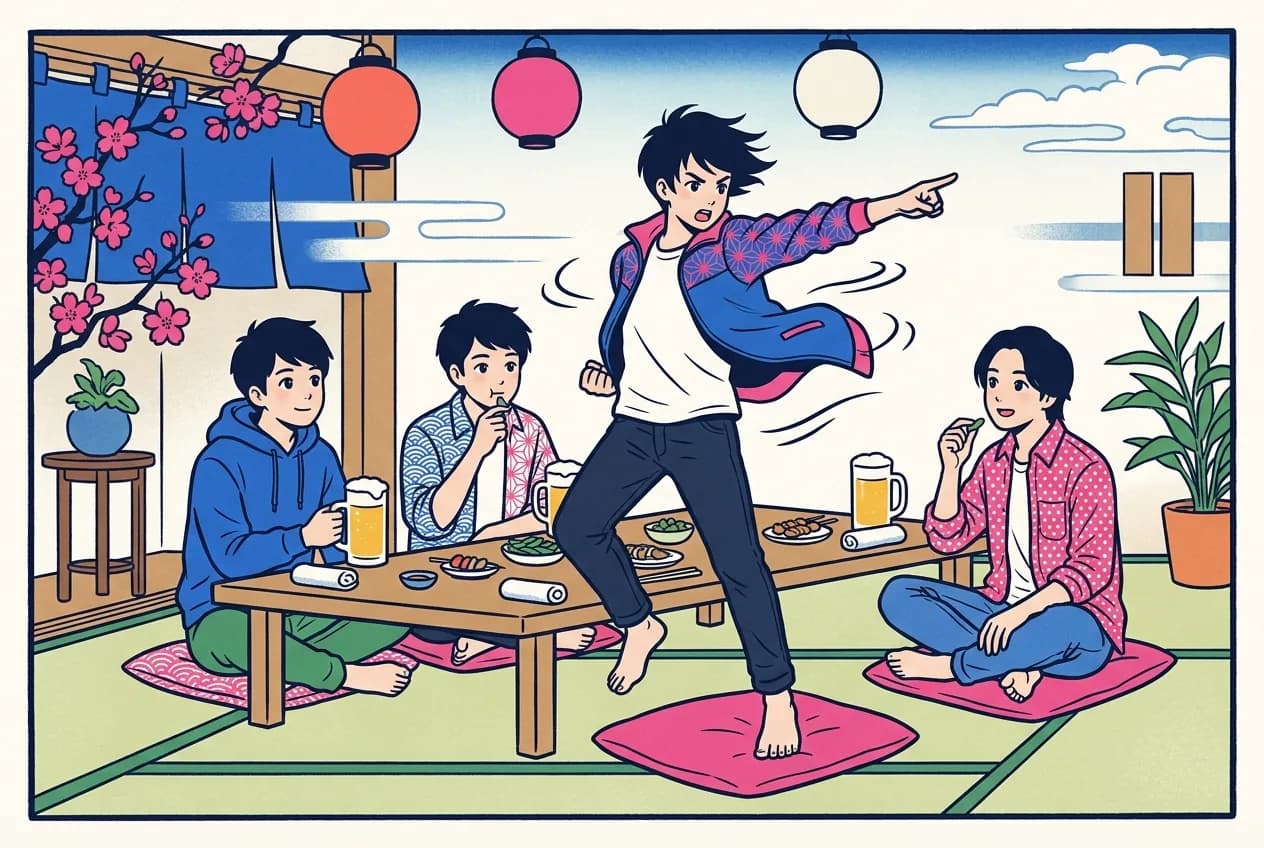
If you've watched enough anime, you already own a surprising amount of Japanese. You can sense a coming fight, you know three words for “I,” and you could yell a dramatic threat with decent pronunciation.
Here's the catch: anime dialogue is written in costume. Some of that Japanese is exactly what people say every day in Tokyo.
Some of it exists only in fiction, where it instantly tells the audience “this is the villain” or “this is the wise old master.”
Use the wrong kind at an izakaya and you'll get a very memorable reaction, though not the one you wanted. So let's sort six of the words you hear in almost every show: which are real, which are fiction-only, and what to say instead.
貴様 (kisama) — the villain's “you”
In anime, 貴様 (kisama) is practically punctuation for villains and rivals — spat out right before swords are drawn. It is not a polite word for “you,” ever. In real life it lands the same way: openly hostile, archaic, and very much “do you want to fight?”
The strange part: centuries ago 貴様 (kisama) was a respectful written form. Over generations it slid all the way down the politeness scale, and today it survives almost exclusively in fiction, as villain-speak. The kanji themselves still literally mean “noble, honored person.”
What to do instead: real Japanese barely uses any word for “you” at all. People address each other by name — 田中さん (tanakasan), 先生 (sensei) — or drop the subject entirely. When in doubt, name + さん (san) is almost always right.
お前 (omae) — rough, but real
Unlike 貴様 (kisama), お前 (omae) is alive and well in real Japanese. Close friends — especially men — and family members use it casually all the time. Anime didn't invent this one; it borrowed it from real locker rooms and living rooms.
The rudeness is entirely about the relationship. Between two old friends, お前 (omae) is warm banter. Aimed at a stranger, a coworker, or your boss, the exact same word becomes a provocation.
Nothing about the word changed. The relationship did.
Verdict: understand it everywhere, use it only with close friends who already use it with you — and never “upward.”
〜だぜ (daze) — the hero's swagger
Anime heroes end half their sentences with 行くぜ (ikuze) or 勝つぜ (katsuze), and that punchy ぜ (ze) is pure cool-guy energy. And that's exactly what it is: energy for the audience.
Real speakers do use ぜ (ze) occasionally, but overuse it and you sound like you're playing a character rather than having a conversation.
Real casual Japanese gets the same friendly emphasis from よ (yo) and ね (ne) — 行くよ (ikuyo), いいね (iine). Those two little particles cover almost every situation where an anime hero would say だぜ (daze).
俺 (ore) — completely normal, actually
Good news: not every anime word is a trap. 俺 (ore) is the “I” used by virtually every male anime lead. It is also the most common casual “I” for real men in Japan, with friends, family, and anyone they are relaxed around.
The skill is not avoiding 俺 (ore), but switching. The same man is 俺 (ore) at the izakaya, 僕 (boku) or 私 (watashi) in a meeting, and 私 (watashi) on the phone with a client. All in one day.
Formal situations call for 私 (watashi), and everything casual is 俺 (ore) territory.
わし (washi) and 〜じゃ (ja) — the old sage who doesn't exist
Every anime elder talks like this: わしは知っておるんじゃ (washihashitteorunja) (“I know, my child…”). Here's the twist — real Japanese grandfathers mostly don't. Elderly Tokyoites talk like everyone else, only with more life experience.
This “old man speech” is the textbook example of what linguists call role language. It's loosely based on older western-Japan dialects. Fiction has kept it on life support for decades, because it instantly signals “wise elder” to the audience.
Recognize it, enjoy it, quote it for laughs — but don't learn it as “how old people talk.”
〜ですわ (desuwa) — the anime rich girl
The elegant rising ですわ (desuwa)・ますのよ (masunoyo) style belongs to one specific fictional archetype: the お嬢様 (ojousama), the refined young lady of a wealthy family. Outside fiction it is vanishingly rare, and modern Japanese women do not talk like this.
One real-world lookalike is worth knowing. Kansai speakers of all genders do end sentences with わ (wa), as in 知らんわ (shiranwa).
In Kansai the intonation is flat and the feel is everyday, nothing like the anime rich girl. Same kana, different world.
The secret behind all of this: 役割語 (yakuwarigo) (role language)
There's a name for what's going on here. 役割語 (yakuwarigo), “role language,” is the set of speech styles Japanese fiction assigns to character types.
Those types are the villain, the sage, the rich girl, and the brash hero. The concept was described by linguist Kinsui Satoshi. Once you know it, you'll see it in every show you watch.
Role language is why anime Japanese is such efficient storytelling — one sentence tells you exactly who a character is. It's also why you can't copy it blindly: some of that speech is real casual Japanese, and some is costume that no living person wears.
Here is your test: notice who says a word. If it's said by ordinary characters in ordinary scenes, it's probably real. If only villains, elders, and heiresses say it, it's costume.
How to actually use anime for learning
None of this means anime is bad input — the opposite. Anime trains your ear for real casual speech, natural speed, and emotional range that textbooks never touch. You need one extra step: before a word goes from your ear to your mouth, check which side of the fiction line it is on.
And the line isn't “anime words are dangerous.” 俺 (ore) and お前 (omae) are everyday Japanese, while 貴様 (kisama) and わし (washi) are theater.
Degree matters. Here are all six words, sorted on one screen:
| You hear it as | In fiction it signals | In real life |
|---|---|---|
| 貴様 (kisama) | In fiction it signalsThe villain / the rival | In real lifeHostile and archaic (do not use it) |
| お前 (omae) | In fiction it signalsRough friendliness | In real lifeReal: close friends only, never upward |
| 〜だぜ (daze) | In fiction it signalsThe hero's swagger | In real lifeRare — よ (yo)・ね (ne) do the same job |
| 俺 (ore) | In fiction it signalsVirtually every male lead | In real lifeCompletely normal casual “I” for men |
| わし (washi) + 〜じゃ (ja) | In fiction it signalsThe wise elder | In real lifeCostume (real elders rarely use it) |
| 〜ですわ (desuwa) | In fiction it signalsThe refined young lady | In real lifeCostume (vanishingly rare in life) |
Test yourself — take the free “Anime Japanese vs Real Japanese” quiz