Which Anime Genre Should You Learn Japanese From? We Counted
Published 2026-07-31 · Updated 2026-09-02
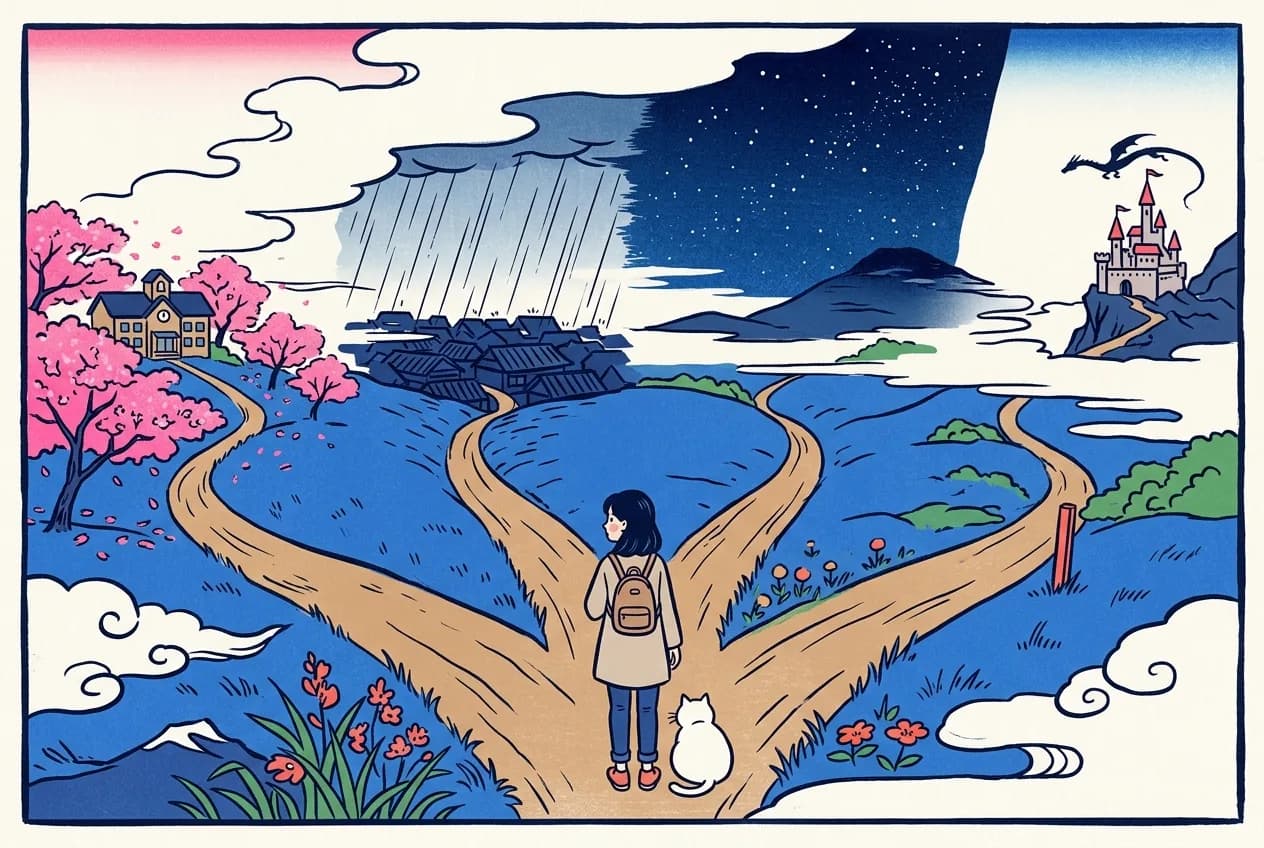
Whether anime teaches you useful Japanese depends almost entirely on the genre you watch. We counted the vocabulary in six genres of subtitle dialogue, nearly 69,000 lines.
Some genres feed you words you'll use at a real Japanese office next year. Some teach you to address a Demon King.
Below, the six genres compared honestly — corpus size, their three most frequent words, and what each one is actually good for.
The six genres, compared
事件 · 捜査 · 殺人
The biggest corpus by far. Procedural vocabulary — case, investigation, culprit — that anchors every detective show, and doubles as the Japanese of news broadcasts.
地球 · 宇宙 · ロボット
Science words that double as news-article vocabulary — what you learn on the bridge transfers to the newspaper.
会議 · 部下 · 部長
Future business Japanese disguised as drama. Four of its top-10 words are N1 on standard JLPT lists — and all of them are everyday office language.
魔法 · ドラゴン · 魔女
Gloriously genre-locked — magnificent for immersion, useless at the bank. Learn to recognize, not to deploy.
愛する · デート · 彼氏
Feelings vocabulary that transfers straight to real conversations — with one caveat about how rarely real couples say 愛してる (aishiteru).
授業 · 教室 · 生徒会
The smallest corpus but the friendliest to beginners — the classroom is where anime vocabulary and textbook vocabulary agree.
So which should you pick?
If you're after real-life Japanese, start with School Life (beginner-friendly) or Work & Office (career-ready).
If you're after your favorite shows without subtitles, pick the genre you actually watch. The words repeat until they stick, and frequency does the rest. And if you want to follow the news, Crime & Mystery is a stealth current-events course.
None of the six is a wrong choice. Every genre above links to its full ranking, and each ranking to a study track where the words come with audio and spaced review.
Where do these numbers come from?
All counts come from genre-tagged lines of JESC, a public research corpus of Japanese TV and film subtitles (pre-2018). The statistics are used under CC BY-SA 4.0, and no corpus text is reproduced.
Rankings are positions within each genre's dialogue set, not Japanese overall. Each genre page lists only words our editors have reviewed.
Browse all six Fan Tracks — every genre's frequency map in one study system