Yakuwarigo: How One Line of Japanese Reveals Who's Talking
Published 2026-07-29 · Updated 2026-09-03
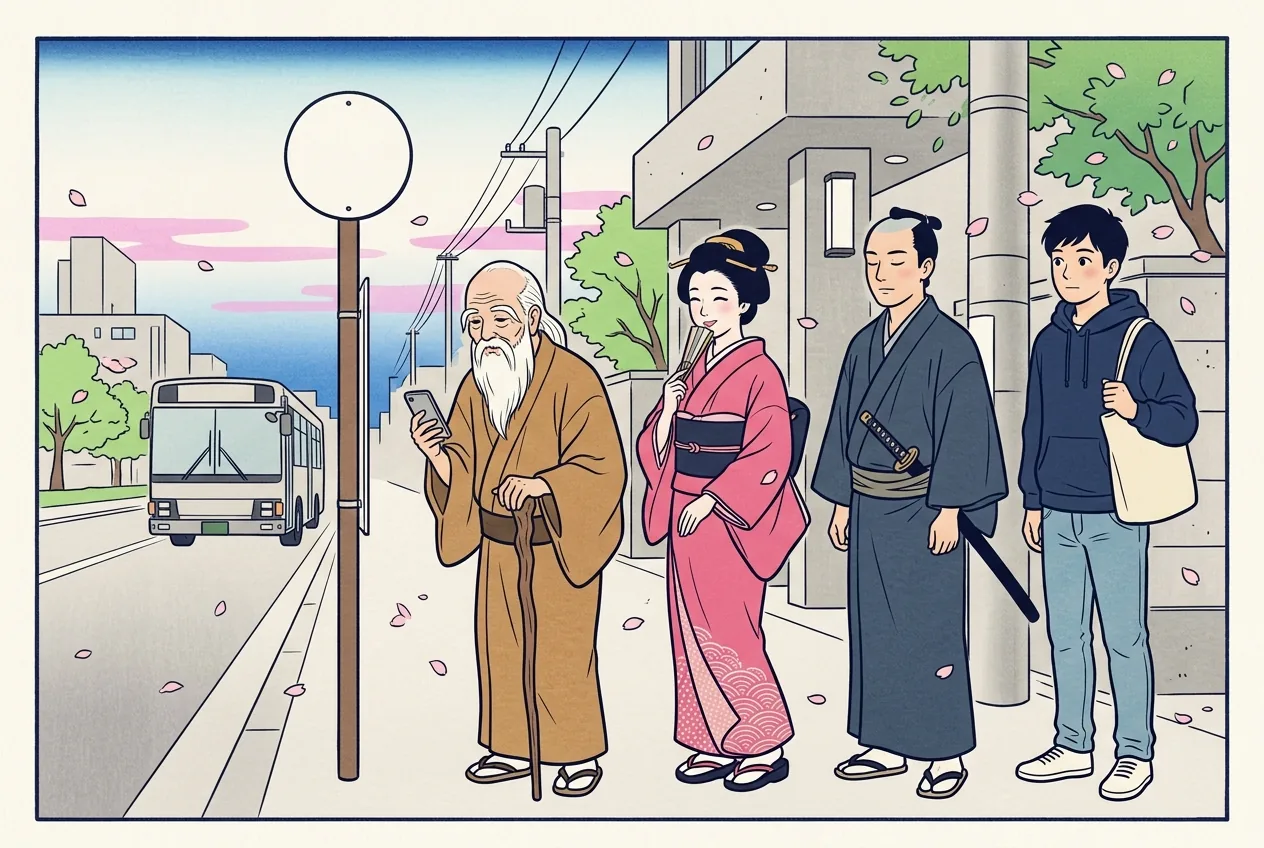
Read one line of Japanese fiction, わしが知っておるんじゃ (washigashitteorunja), and you already know the speaker: old, wise, probably stroking a beard. One sentence gives you the full character, with no description needed.
This system has a name: 役割語 (yakuwarigo), “role language,” coined by linguist Kinsui Satoshi in 2003. It is a shared codebook of speech styles between Japanese writers and audiences. Each style signals an archetype instantly, even though almost nobody in real life talks that way.
If you've read our guide on anime Japanese vs. real Japanese, this is the system behind it. Here is how it works, and where these voices actually came from.
The recipe: a pronoun, an ending, done
Role language runs on shockingly few parts. Swap the word for “I,” swap the sentence ending, and the whole speaker changes.
わし (washi) + 〜じゃ (~ja) makes the sage. わたくし (watakushi) + 〜ですわ (~desuwa) makes the refined young lady. 拙者 (sessha) + 〜でござる (~degozaru) makes the samurai, and 俺 (ore) + 〜だぜ (~daze) makes the brash hero.
That's why translators despair: English has one “I,” and its sentence endings carry grammar, not personality. Japanese hands fiction a full costume department inside the grammar itself.
Where the sage's voice came from
The best story in Kinsui's research is that the “old man voice” is the older speech of western Japan. In the Edo period, the cultural center shifted from the Kansai region to Edo (today's Tokyo).
On stage and in stories, young fashionable characters spoke the new Edo way. Scholars, doctors, and elders kept the older Kamigata-flavored speech: 知っておる (shitteoru) instead of 知っている (shitteiru), 〜じゃ (~ja) instead of 〜だ (~da).
Fiction froze that contrast and never let go. Real speech moved on centuries ago. In stories, though, wisdom still speaks with a western-Japan accent, a 300-year-old echo inside modern entertainment.
The main cast of voices
The archetypes you'll meet most, and how real each one is:
| Archetype | Signature markers | Real-world status |
|---|---|---|
| Wise elder | Signature markersわし (washi)・〜じゃ (~ja)・〜おる (~oru) | Real-world statusFiction, but わし (washi) is real in western Japan |
| Refined lady | Signature markersわたくし (watakushi)・〜ですわ (~desuwa) | Real-world statusFiction, but Kansai 〜わ (~wa) is flat, unisex |
| Samurai | Signature markers拙者 (sessha)・〜でござる (~degozaru) | Real-world statusHistorical, now period-drama flavor |
| Brash hero | Signature markers俺 (ore)・〜だぜ (~daze) | Real-world status俺 (ore) is everyday, but heavy だぜ (daze) is fiction |
| Country speaker | Signature markersおら (ora)・〜だべ (~dabe) | Real-world statusReal east/north dialects, exaggerated |
So does anyone actually talk like this?
Mostly no — that's the point of the codebook: it works because everyone recognizes it, not because anyone speaks it. Real elderly Tokyoites say 私 (watashi) and 〜だ (~da) like everyone else, and you won't hear an office meeting end with ですわ (desuwa) (rising intonation, pinky raised).
But fragments are real. Kansai speakers really do end sentences with a flat 〜わ (~wa), and parts of northern Japan really use 〜べ (~be). In parts of western Japan, older men really do say わし (washi).
Role language borrows real materials and then exaggerates them into costume. Knowing which part is costume and which is fabric is exactly the skill you're here for.
Why this matters for learners
First, comprehension. Once you can read the codebook, fiction gets dramatically easier to follow — you identify a character's type from one line, the way native audiences do. Second, safety: you'll never accidentally study the sage's grammar as “how Japanese works,” a genuinely common learner accident.
And third, joy. Watch a translator try to render 〜でござる (~degozaru) in English and fail, then hear it work perfectly in Japanese. That is the moment the original language rewards all the studying.
Test your ear
One sentence, full character — now run it in reverse. The quiz below gives you one line each — sage, lady, samurai, and friends — and asks who's talking. Pass it and you have internalized a piece of literary craft that few people ever notice.