How to Order Food in Japan: Ticket Machines and Key Phrases
Published 2026-07-29 · Updated 2026-09-03
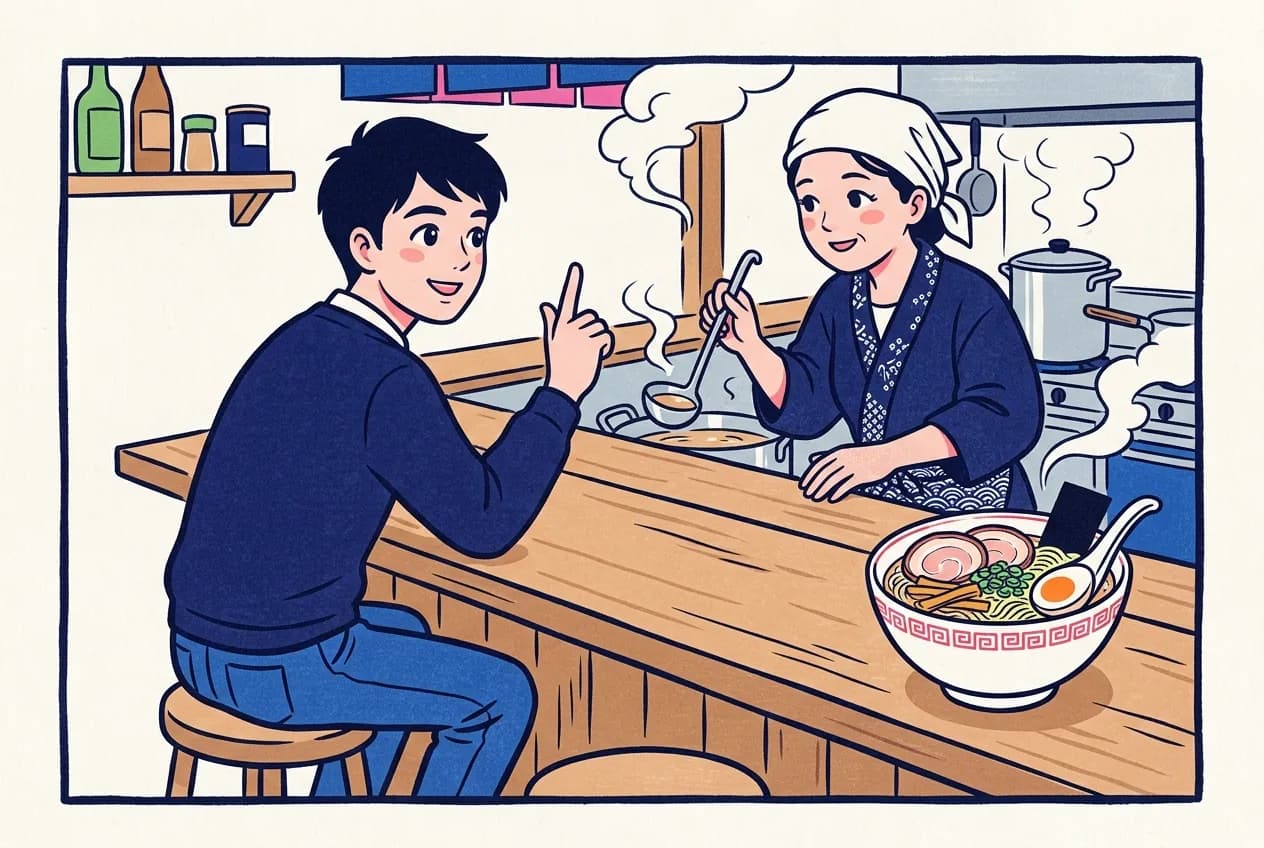
Nearly every restaurant in Japan runs on one of three systems: a ticket machine, calling the staff, or a tablet. Work out which one you are in within 10 seconds of entering, and you can order with no Japanese.
Here's the flow for each, plus the script the staff will use on you. That last part matters: the hard part of ordering in Japan usually isn't saying your order — it's catching the questions that come back.
System 1: the ticket machine (食券 (shokken))
Ramen shops, gyudon chains, and many casual places put a vending machine at the entrance. You pay first, receive a small ticket, and hand it to the staff, often before you even sit down.
No wallet appears again for the rest of the meal. No tipping exists anywhere in Japan, either.
The machine's buttons are the menu, and the big buttons at the top are the shop's signature dishes. After that, look for the recurring words: 大盛り (oomori), a large portion, and 並 (nami), the regular size. At ramen shops you'll also meet 替え玉 (kaedama) — an extra serving of noodles for your remaining soup, a beloved custom from Hakata.
If the machine defeats you, the escape phrase is pointing at a photo and saying これをください (korewokudasai) (“this one, please”). Staff see lost travelers at the machine every day and will happily push the buttons with you.
System 2: call the staff — yes, by (politely) shouting
At izakaya and traditional restaurants, you summon staff by calling すみません (sumimasen) across the room. To many visitors this feels rude. It is the opposite: calling out is the correct, expected move, and waiting silently for eye contact means nobody comes.
Once they arrive: point at the menu and say これをください (korewokudasai), or これと (koreto), これをお願いします (korewoonegaishimasu) for several items. Finish with 以上です (ijoudesu) — “that's all” — and you'll sound like you've done this before.
One izakaya surprise to expect: a small appetizer you didn't order, the お通し (otooshi), appears automatically and is added to the bill. It's a cover charge in food form, not a mistake.
System 3: the tablet (or QR code)
Chain izakaya and family restaurants increasingly give you a tablet, and most have an English toggle hiding on the first screen. This is the easiest mode — browse, tap, and food arrives. Your only remaining job is the staff script below.
The staff script: what they'll say to you
Staff questions are formulaic, which is great news. The same five lines cover nearly every restaurant in the country.
| They say | It means | You answer |
|---|---|---|
| 何名様ですか (nanmeisamadesuka) | It meansHow many people? | You answerHold up fingers, or 一人です (hitoridesu) / 二人です (futaridesu) |
| お決まりですか (okimaridesuka) | It meansReady to order? | You answerはい (hai) + point, or もう少し (mousukoshi) (a little longer) |
| ご注文は以上でよろしいですかごちゅうもんはいじょうでよろしいですか (gochuumonhaijoudeyoroshiidesuka) | It meansIs that everything? | You answerはい (hai), or add one more thing |
| 麺のかたさは (mennokatasaha)? | It meansNoodle firmness (ramen) | You answer普通で (futsuude) (regular) or かためで (katamede) (firm) |
| お会計、ご一緒でよろしいですかおかいけい、ごいっしょでよろしいですか (okaikei,goisshodeyoroshiidesuka) | It meansPaying together? | You answerはい (hai) (together) / 別々で (betsubetsude) (separately) |
Paying: go to the register, not the table
In most Japanese restaurants the bill is settled at the register by the door, not at the table. Take the slip from your table, walk up, and say お会計お願いします (okaikeionegaishimasu).
Money often goes on a small tray rather than hand-to-hand. Put your cash or card on the tray. That is the custom, not coldness.
Then the best part. As you leave, staff will call out thanks, and you can reply with nothing at all, a nod, or a cheerful ごちそうさまでした (gochisousamadeshita).
The phrase means “thank you for the meal.” Say it and watch the whole counter light up.
Your ten-second decision tree
Machine at the door → buy a ticket first. No machine → sit, then call すみません (sumimasen) when ready. Tablet on the table → tap away.
Whichever system you meet, これをください (korewokudasai) + 以上です (ijoudesu) + お会計お願いします (okaikeionegaishimasu) will feed you anywhere in Japan.