Rice in Japanese: Gohan Is Also the Word for a Meal
Published 2026-09-30 · 6 min read
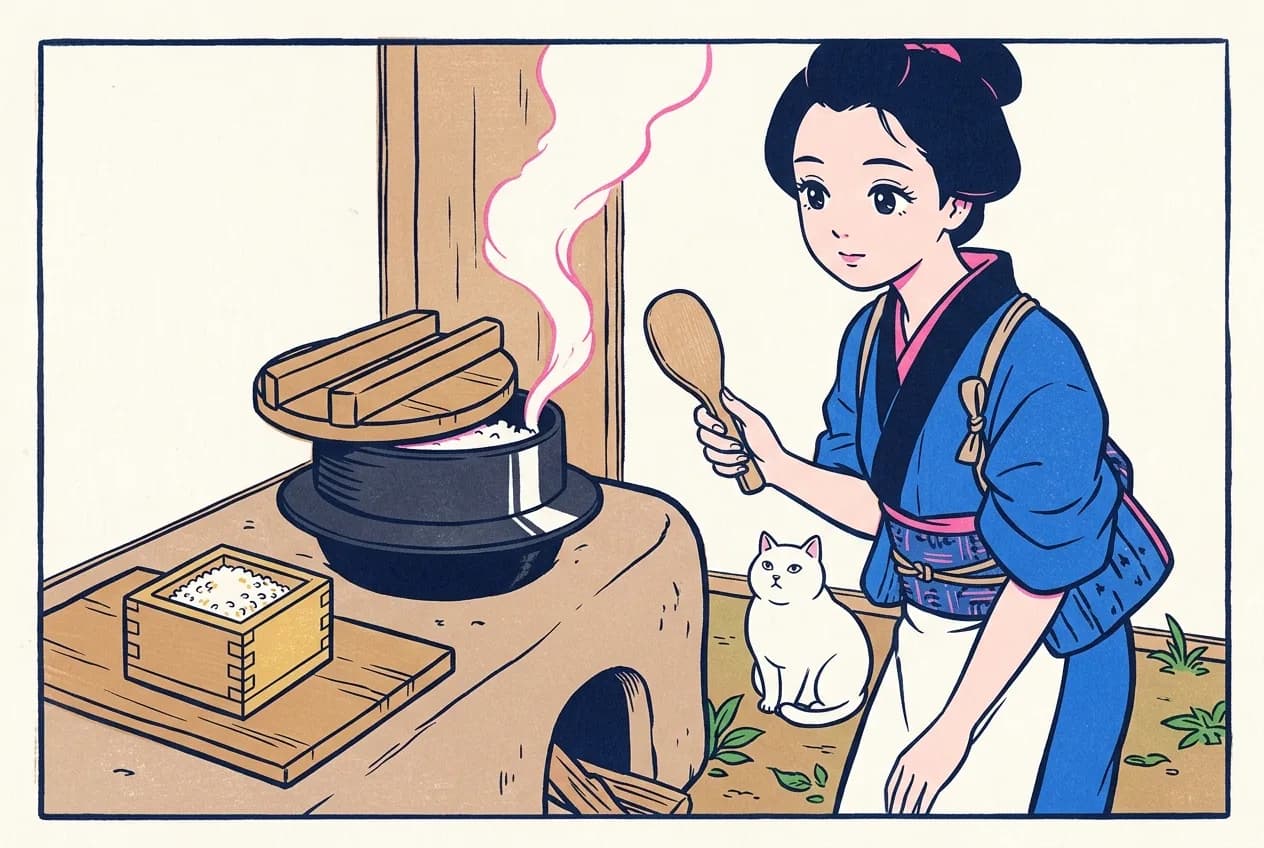
One word, ごはん (gohan), covers both cooked rice and a meal in Japanese, where many languages use two. Water is the reverse case, because heated water has a noun of its own.
Around midday, a coworker might ask you:
もうごはんを食べましたか。もうごはんをたべましたか。 (mougohanwotabemashitaka.)
Have you eaten yet?
People use ごはん (gohan) when they talk about meals, invite each other to eat, or gather at the table. Do not call uncooked rice ごはん (gohan), since the grain before cooking is 米 (kome).
Rice before and after cooking
米 (kome) is rice as a raw grain, before anyone cooks it. Digital Daijisen, a Japanese dictionary published by Shogakukan, defines it as the seed of the rice plant with the husk removed.
Once the rice is cooked, the word changes to ごはん (gohan). The same dictionary calls ごはん (gohan) a polite word for cooked rice and similar grains, and also for a meal. With the words similar grains, it does not limit ごはん (gohan) to rice alone.
Nihon Kokugo Daijiten, a historical dictionary from the same publisher, lists the senses in that order. Cooked rice comes first, and the meal sense follows as an extended use.
So the two words divide the same food by whether it is ready to eat. A bag of dry rice is 米 (kome), and the rice in your bowl is ごはん (gohan).
A children's page from Japan's Ministry of Agriculture, Forestry and Fisheries says the same thing in plain words. Rice that has been cooked is ごはん (gohan), and a meal is ごはん (gohan) too. The page gives the two senses side by side.
In the meal sense, there does not have to be any rice at all. A breakfast of bread and milk is still 朝ごはん (asagohan):
朝ごはんはパンと牛乳です。あさごはんはパンとぎゅうにゅうです。 (asagohanhapantogyuunyuudesu.)
Breakfast is bread and milk.
The same goes for an invitation. When a friend suggests ごはん (gohan) together, the plan can be any meal, with rice or without it.
The question at the top of this page uses this meal sense. It asks whether you have had a meal, whatever was on the plate.
Breakfast, lunch, and dinner
Because ごはん (gohan) also means a meal, it forms the everyday words for breakfast, lunch, and dinner. Each word names the meal by the time of day when it is eaten.
朝ごはん (asagohan) is breakfast, 昼ごはん (hirugohan) is lunch, and 晩ごはん (bangohan) is dinner. The last part of each word is the same ごはん (gohan) that you already know, and each one takes 食べる (taberu) as its verb for eating.
At home in the afternoon, someone planning the evening might ask:
今日の晩ごはんは何ですか。きょうのばんごはんはなんですか。 (kyounobangohanhanandesuka.)
What's for dinner tonight?
食事 (shokuji) also means a meal, and it is the more formal of the two words. In talk with family and friends, ごはん (gohan) is the usual choice.
Both dictionaries still class ごはん (gohan) as a polite word, so the everyday choice is not a rude one.
Digital Daijisen describes 食事 (shokuji) as eating food as a daily habit, and also as the food that is eaten.
Before and after eating, people say いただきます (itadakimasu) and ごちそうさま (gochisousama). The meaning of both phrases is covered in the field note on いただきます (itadakimasu).
For praising the food, おいしい (oishii) works with anyone and at any meal. うまい (umai) belongs to casual conversation, and it is mostly men who use it. When you are unsure, choose おいしい (oishii).
When water is heated
水 (mizu) is water that is cold or has not been heated. When you want hot water, the word to ask for is お湯 (oyu).
Digital Daijisen defines 湯 (yu), the base word of お湯 (oyu), as water heated to a boil until it is hot. So the heat is already part of the noun.
At a café, when you want a cup of hot water:
❌ 熱い水をください。 (atsuimizuwokudasai.)
⭕ お湯をください。 (oyuwokudasai.)
Hot water, please.
熱い (atsui) is a correct word for something hot, but 水 (mizu) is not the noun for heated water. Asking for お湯 (oyu) by name is also shorter, since one noun replaces two words. The field note on hot and cold words explains where 熱い (atsui) is used.
熱い (atsui) itself is fine with other drinks. Hot tea is 熱いお茶 (atsuiocha), because tea keeps the same noun whether it is hot or cold.
Tea has a default as well. When someone offers お茶 (ocha) with no other word, green tea is the usual meaning. Black tea has a name of its own, 紅茶 (koucha), so ask for it by that name.
Offering tea to a guest, you might say:
お茶をいれますから、少し待ってください。おちゃをいれますから、すこしまってください。 (ochawoiremasukara,sukoshimattekudasai.)
I'll make some tea, so please wait a moment.
For making a cup of tea, the usual verb is いれます (iremasu) rather than 作ります (tsukurimasu), the general verb for making things.
Drinks and medicine
飲む (nomu) is the verb for drinking, and it is also the verb for medicine you swallow. An English translation says take medicine, but the Japanese verb is still 飲む (nomu).
The Japanese vocabulary module from Tokyo University of Foreign Studies shows this directly. Its example sentences for 飲みます (nomimasu) include one about medicine, next to sentences about cola and water.
飲みます (nomimasu) is the polite form of 飲む (nomu), so the two are forms of the same verb. Water, tea, and milk take it as well.
At a pharmacy counter, you might hear:
食事の後で、この薬を飲んでください。しょくじのあとで、このくすりをのんでください。 (shokujinoatode,konokusuriwonondekudasai.)
Please take this medicine after the meal.
The usual mistake is the verb for eating:
❌ 薬を食べました。 (kusuriwotabemashita.)
⭕ 薬を飲みました。 (kusuriwonomimashita.)
I took the medicine.
A pill is swallowed rather than chewed like food, so the verb is 飲む (nomu). 食べる (taberu) usually goes with food you bite and chew. A question about medicine uses the same verb as a question about milk.
Here are the meal and drink words from this note. The Compare with column gives a nearby word to keep apart from each one:
毎日、会社で昼ごはんを食べます。まいにち、かいしゃでひるごはんをたべます。 (mainichi,kaishadehirugohanwotabemasu.)
I eat lunch at the office every day.
家族と食事をします。 (kazokutoshokujiwoshimasu.)
I have a meal with my family.
水をたくさん飲みます。 (mizuwotakusannomimasu.)
I drink a lot of water.
熱いお茶を飲みます。 (atsuiochawonomimasu.)
I drink hot tea.
牛乳を飲みますか。 (gyuunyuuwonomimasuka.)
Do you drink milk?
ごはん (gohan) with a time of day in front gives you breakfast, lunch, and dinner. Heated water is お湯 (oyu), and medicine takes the same verb as tea.
Each of these differences has an example sentence earlier on this page, and you can reuse it as it is.
Does gohan always mean rice?
No. ごはん (gohan) can mean cooked rice, and it can also mean a meal with no rice in it, such as a breakfast of bread and milk.
The meal sense is the one in greetings and invitations, as in もうごはんを食べましたか (mougohanwotabemashitaka).
As food, it names cooked grain such as rice, and rice before cooking is 米 (kome).
How do you say rice in Japanese?
Uncooked rice is 米 (kome), and cooked rice is ごはん (gohan). In a sentence about eating, ごはん (gohan) can mean the whole meal rather than the rice. For the rice in a bowl at the table, ごはん (gohan) is the usual word.
Where Ukiyoe Japanese fits
The Food & Drink topic in Ukiyoe Japanese lists words such as ごはん (gohan), 米 (kome), 水 (mizu), and 食事 (shokuji) in small sets. Each set has flashcards, a listening mode, and a quiz, so you can check these words a few at a time.
Food & Drink words to study: {{ごはん}}, {{米|こめ}}, {{お茶|おちゃ}}, and more
Popular
Latest