Reading Japanese Folk Tales: An Honest Guide + Momotaro
Published 2026-07-30 · Updated 2026-09-03 · 7 min read
Folk tales look ideal for reading practice, but faithful tellings use a storyteller's Japanese you haven't met. Those texts are upper-beginner to intermediate material, not first steps.
The appeal is real, because the tales are short, world-famous, and free. The catch is the register, with old-fashioned verb endings and grandfatherly speech.
The fix is not to skip folk tales. It's to read them in modern retellings first, and to know in advance which old-story phrases you'll meet.
Do that, and tales become some of the best reading practice there is. You already know the plots, so the story itself carries you across the words you don't know yet.
This guide gives you the honest difficulty picture and a starter shelf of five tales. Then the opening lines of 桃太郎 (momotarou), unpacked phrase by phrase — because you shouldn't leave a reading guide without reading actual Japanese.
Why folk tales are harder than they look
Open a faithful text of any classic tale and you'll meet the storyteller's register immediately. Elderly characters speak in the old-man role language you may know from our fiction guides: わし (washi) for “I,” sentences ending in じゃ (ja).
The narration joins in, using old-fashioned forms like 〜ておった (~teotta) where modern Japanese says 〜ていた (~teita). It's the written equivalent of a folk tale told in a rocking chair. And it's wonderful, once you can read it.
There's a second trap for self-starters. Free archives carry many classic texts in their original early-20th-century printings, and many of those use pre-reform spelling and kanji.
It's like opening a bedtime story and finding the spelling of another century. Nothing is wrong with you. The text is from another era.
None of this means you should stay away. Choose modern-Japanese retellings now, and file the faithful old texts as a treat for your intermediate self.
Why they're still gold for learners
First, cultural literacy. These stories are load-bearing in Japanese culture.
A team-up against a big rival gets framed as an 鬼退治 (onitaiji), an ogre hunt, and opening something you'd better not is opening Urashima's 玉手箱 (tamatebako). Advertising borrows the imagery constantly. Each story you know gives you a small dictionary of references.
Second, they're built for memory. Oral tales repeat their structures: three encounters, the same offer three times, formula openings and closings.
So the grammar you meet gets recycled within the same story. The effect is spaced repetition inside one tale.
Third, they teach story grammar: the narrative past, quoted speech with と言いました (toiimashita), and sequences of events. Those are the same forms you need to talk about your weekend. A tale is a safe gym for the tenses.
The starter shelf: five tales in one line each
Start anywhere, but start with a story whose plot you can already guess, because a known plot is the best dictionary there is.
You can guess every plot below. A peach-born boy recruits three animal friends, and a fisherman opens a box that costs him everything.
A rescued crane weaves until someone peeks, and an old man's hats come back as kindness at night. The bamboo princess story is often called Japan's oldest surviving tale.
Here are five to choose from:
| Tale | The story in one line | Nice for learners because |
|---|---|---|
| 桃太郎 (momotarou) | The story in one lineA peach-born boy defeats the ogres | Nice for learners becauseFamous plot, repeated structure |
| 浦島太郎 (urashimatarou) | The story in one lineA fisherman's box costs him everything | Nice for learners becauseBittersweet, the box everyone knows |
| つるの恩返し (tsurunoongaeshi) | The story in one lineA rescued crane repays kindness | Nice for learners becauseQuiet, built on one promise |
| かさじぞう (kasajizou) | The story in one lineHats given to six stone statues | Nice for learners becauseGentle, very little dialogue to decode |
| かぐや姫 (kaguyahime) | The story in one lineA bamboo princess returns to the moon | Nice for learners becauseVery old, with gorgeous imagery |
Read some right now: Momotaro's opening, unpacked
Here are the opening lines of 桃太郎 (momotarou) in a modern retelling — the version below sticks to beginner vocabulary on purpose. First, read them straight through:
むかしむかし、あるところに、おじいさんとおばあさんが住んでいました。むかしむかし、あるところに、おじいさんとおばあさんがすんでいました。 (mukashimukashi,arutokoroni,ojiisantoobaasangasundeimashita.) — “Long, long ago, in a certain place, there lived an old man and an old woman.”
おじいさんは山へしばかりに、おばあさんは川へせんたくに行きました。おじいさんはやまへしばかりに、おばあさんはかわへせんたくにいきました。 (ojiisanhayamaheshibakarini,obaasanhakawahesentakuniikimashita.) — “The old man went to the mountain to gather firewood, and the old woman went to the river to do the laundry.”
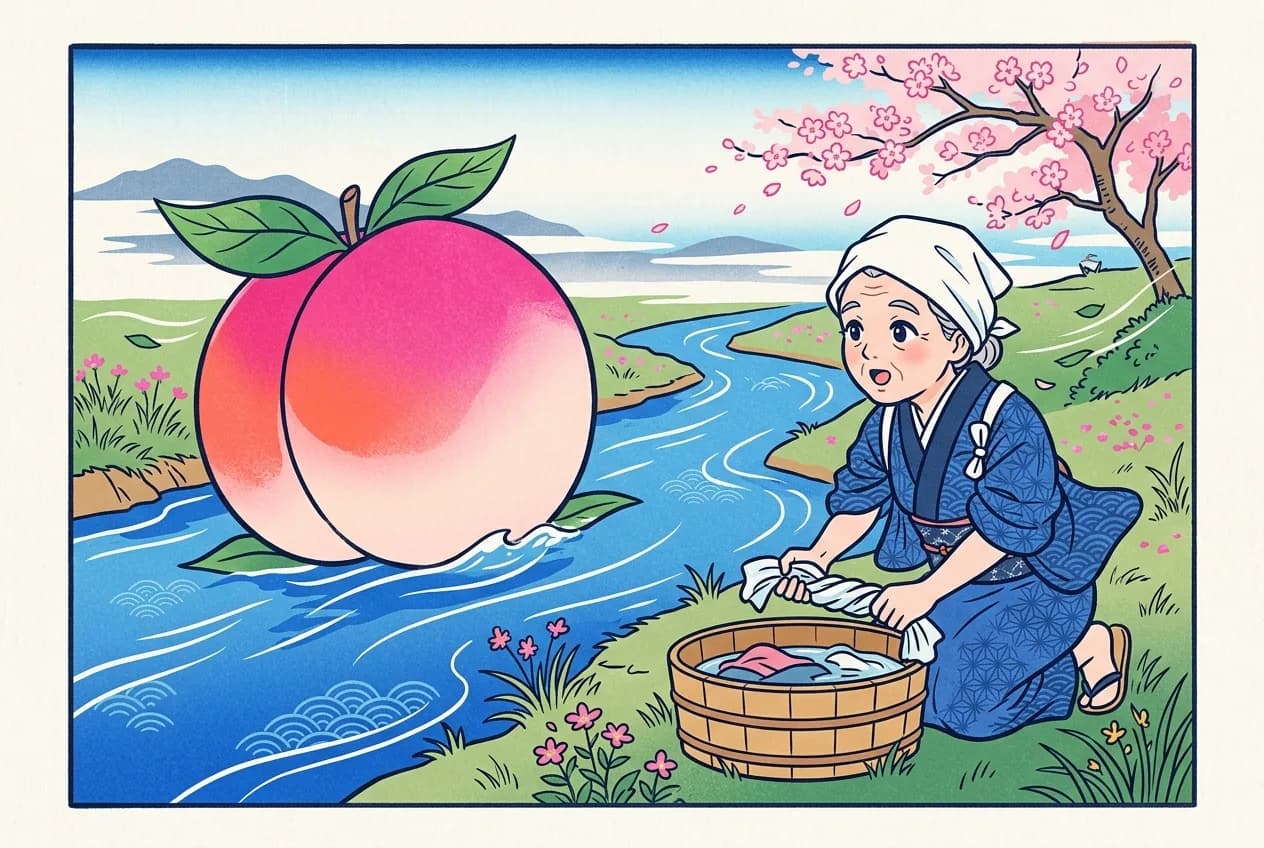
おばあさんが川でせんたくをしていると、大きなももが、どんぶらこ、どんぶらこと流れてきました。おばあさんがかわでせんたくをしていると、おおきなももが、どんぶらこ、どんぶらことながれてきました。 (obaasangakawadesentakuwoshiteiruto,ookinamomoga,donburako,donburakotonagaretekimashita.) — “As the old woman was doing the laundry in the river, a huge peach came floating down — donburako, donburako.”
Now the unpacking. むかしむかし、あるところに (mukashimukashi,arutokoroni) is the formula opening, “once upon a time,” and virtually every tale starts with it. Learn it once, and you own every opening.
住んでいました (sundeimashita) is the ています (teimasu) state form in the past, and it means “was living.”
The second sentence uses the purpose-of-motion pattern from the N5 grammar list twice, in elegant parallel. Both halves say that someone went somewhere to do something.
And どんぶらこ (donburako)? That's the sound of a giant peach bobbing down a river. It's an onomatopoeia so specific that it exists almost entirely for this one scene, and practically every Japanese speaker knows it.
Notice the voiced d: as the sound-words guide would predict, this is a big, heavy object. A tiny one would splash by with something lighter.
One more thing is worth knowing, because Japanese readers know it too. Momotaro has been retold many times.
The version most often told in Japan today, the one our Read shelf follows, gives the ogres a crime first. They have hoarded stolen treasure, and at the end Momotaro spares them. That framing is newer than it looks.
The oldest printed tellings give no reason for the raid at all. In 1871 Fukuzawa Yukichi, writing for his own children, called Momotaro a thief for carrying the ogres' treasure home.
During the Second World War the tale was used as propaganda, with Momotaro as the hero and the enemy nations as the ogres. Postwar writers supplied the ogres' wrongdoing to give the raid a reason.
Japanese publishers still argue about it. One 2017 picture book draws the ogres' island from above as an ordinary town of shops and theaters. The paper band around its cover asks whether being an ogre is reason enough.
You don't have to settle the question to enjoy the story. It's worth knowing that Japanese readers haven't settled it either.
How to read a tale (without a dictionary marathon)
Read in two passes. Pass one is the story pass: push through to the end and let the plot you already know fill the gaps. Underline anything opaque, and don't look it up yet.
Pass two is the language pass: return to your underlines, resolve the ones that appear more than once, and let single-appearance rarities go. A word the story only needed once, you probably don't need at all yet.
If your text has audio, listen while you read on the second pass. Folk tales were spoken things first, and the rhythm helps the old-story phrases settle. And when a line resists completely, suspect the register, not yourself — check whether it's an old form, like 〜ておった (~teotta) for 〜ていた (~teita).
Where to find texts (and what to expect)
The famous free source is 青空文庫 (aozorabunko) (Aozora Bunko), Japan's public-domain digital library — thousands of classic texts at no cost. It's a treasure, with the caveat you now expect. Many texts are faithful early-20th-century printings, so check the era before assuming a children's tale reads like children's Japanese.
For the gentler on-ramp, our Read shelf carries graded passages: tap-friendly readings on every kanji, comprehension questions after each text. It also holds public-domain classics adapted into learner-level Japanese — Akutagawa's “The Spider's Thread” retold in N4 vocabulary, with the original credited. Known stories, modern Japanese, and no catch this time.
Open the Read shelf — graded passages with readings and questions