Ne and Yo in Japanese: Who Already Knows It
Published 2026-09-18
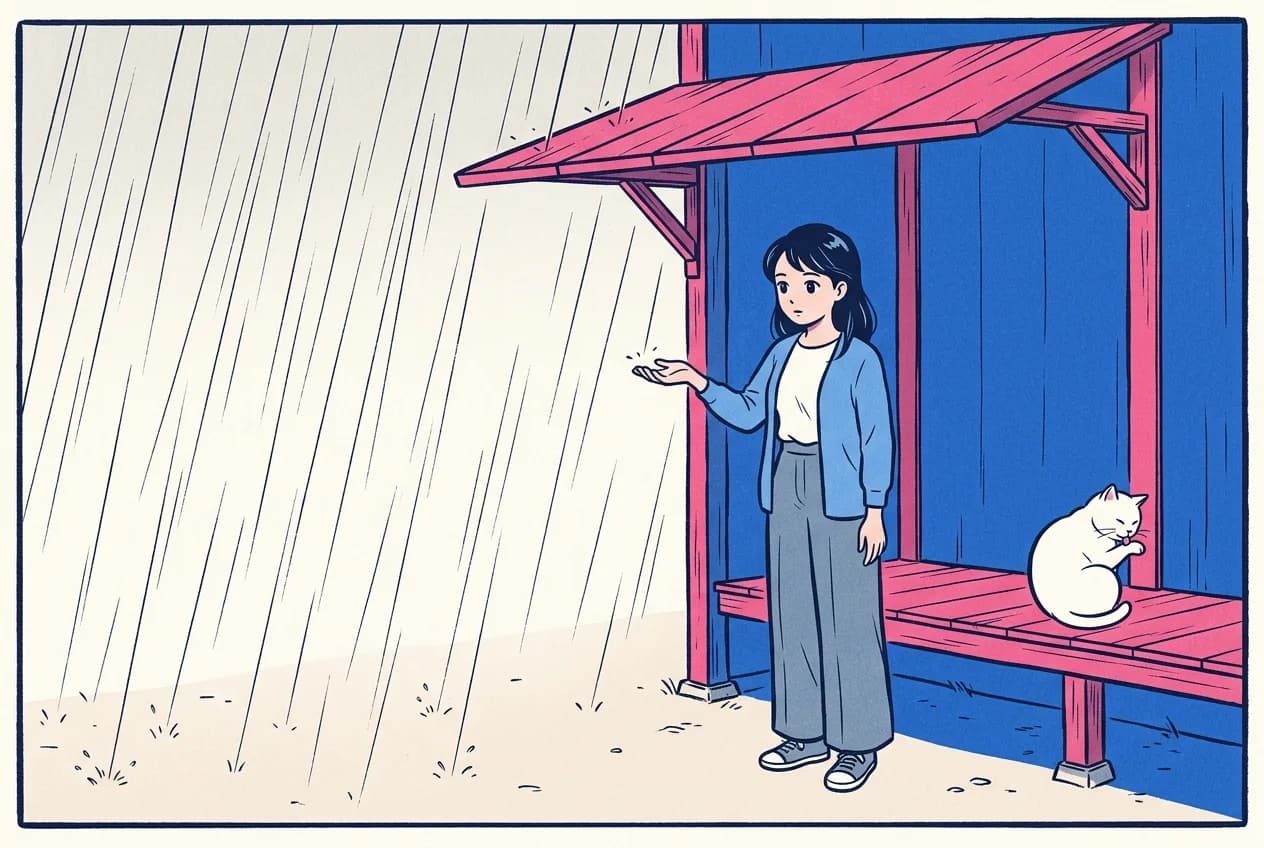
ね (ne) and よ (yo) go on the end of a sentence and mark who already knows what it says. ね (ne) asks the listener to agree, and よ (yo) gives the listener something new.
Say something you both notice, then something only you noticed:
今日はいい天気ですね。 (kyouhaiitenkidesune.)
Nice weather today, isn't it?
あ、電車が来ましたよ。 (a,denshagakimashitayo.)
Oh, the train's here, you know.
Use ね (ne) when the fact belongs to both of you, and よ (yo) when it belongs to you alone. The choice is made at the end, and the rest of the sentence is not involved.
Do not add ね (ne) to a fact the listener has no way to share, such as your own name.
Who already knows it
These endings are not a politeness setting. The polite style is already decided by です (desu) and ます (masu), and what comes after it answers a different question.
That question is who already has the fact. One of you has it, or both of you have it, and the answer is what the ending reports.
Ask it about the listener rather than about yourself. The ending does not measure respect.
The sentence is already finished before the ending arrives. What you add at the very end is a report about the listener.
Each ending answers that question a different way:
この部屋は少し寒いですね。このへやはすこしさむいですね。 (konoheyahasukoshisamuidesune.)
It's a little cold in this room, isn't it?
かばんが開いていますよ。 (kabangaaiteimasuyo.)
Your bag is open.
明日も休みですよね。 (ashitamoyasumidesuyone.)
Tomorrow's a day off too, right?
The knowledge names the only thing you have to decide, and the ending follows from it.
よね (yone) is よ (yo) and ね (ne) in that order, and the order never reverses. Every one of them lands in the same place: the very end, whether the sentence closes with です (desu) or with a plain form.
The rest of the sentence stays as it was. You are adding an ending, not rebuilding anything.
Leaving the end bare is also a choice. A sentence with no ending reports nothing about the listener, and it stands as a plain statement.
These endings stay outside the sentence. The particles inside it are chosen by a different question, and that question has a field note of its own.
ね (ne) asks the listener to agree
ね (ne) works where the knowledge is already shared. Caught in the same shower, or tasting food from the same plate, you both have the fact before anyone says it.
Say おいしいですね (oishiidesune) in that moment and the listener is expected to agree. The sentence brings no news, and it was never meant to.
This is what small talk is made of. What matters is not the news in it but the agreement it asks for.
Say what you think of the bread at a bakery you walked into together:
この店のパン、おいしいですね。このみせのパン、おいしいですね。 (konomisenopan,oishiidesune.)
This store's bread is really good, isn't it?
The adjective says what is true, and the ending invites the listener to say so too. Take the ending away and you have an announcement instead.
The reply it wants is そうですね (soudesune), which agrees and returns the same ending. A remark about the weather can open a conversation with anyone, which is exactly why it is built this way.
A fact the listener cannot see is not shared, and ね (ne) has nothing to ask for there.
よ (yo) tells the listener what they do not know
よ (yo) runs in the other direction. The fact is on your side only, and you are letting the listener know.
Give a stranger the way to the station:
駅はあっちですよ。 (ekihaatchidesuyo.)
The station's that way.
The same ending fits a time that only you have checked:
映画は三時からですよ。 (eigahasanjikaradesuyo.)
The movie starts at three, you know.
The size of the news makes no difference. A train arriving and an open bag both take よ (yo), because in each case only one of you has noticed.
Because よ (yo) makes you the one who knows, it can sound a little like instruction. With someone above you, soften it.
Aimed at a teacher or a manager, the same sentence sounds harder than you meant it to.
The listener decides this, and not the fact. One sentence takes ね (ne) with one person and よ (yo) with another, depending on what they already have.
What you are doing is telling, and the ending says so before the listener has to work it out.
よね (yone) checks what you already believe
Put them together and よね (yone) checks a belief you have almost settled. You have the fact, and you want the listener to confirm it.
Neither ending alone would do that. ね (ne) would assume the listener already agrees, and よ (yo) would tell them something they may know better than you.
It fits a plan that needs confirming before anyone relies on it.
Tomorrow being a day off is that kind of fact. You believe it, the schedule is not in front of you, and one word from the listener settles it.
Both halves keep their meaning inside the stack. よ (yo) says the fact is yours, and ね (ne) asks the listener to agree with it.
The order in the stack is fixed. よね (yone) exists, and ねよ (neyo) does not.
Using it does not weaken what you said. It marks the fact as yours and still asks the listener to settle it.
So this is the middle case. You are not informing the listener, and you are not assuming their agreement either.
Where the endings do not fit
Some facts have no listener to agree with them. Your own name is the clearest case.
Introduce yourself to someone you have never met:
❌ はじめまして。私はマリアですね。はじめまして。わたしはマリアですね。 (hajimemashite.watashihamariadesune.) — a stranger cannot agree about your name
⭕ はじめまして。私はマリアです。はじめまして。わたしはマリアです。 (hajimemashite.watashihamariadesu.) — plain です (desu) states it and asks nothing
ね (ne) fails there because the listener has never heard your name before. They have nothing to agree to, so the ending has no work to do.
Anything the listener has no access to behaves the same way. A plan you have not announced yet is yours alone, and the same rule decides it.
The order of the stack is the other place a sentence comes apart:
❌ いい天気ですねよ。 (iitenkidesuneyo.) — the endings never stack in this order
⭕ いい天気ですね。 (iitenkidesune.) — one ending, and the shared one
Weather is something the two of you share, so ね (ne) is what it takes. ねよ (neyo) fails because the stack only ever runs よね (yone).
The last case is different, because nothing in it is ungrammatical.
Tell a teacher that they are wrong, and the grammar holds while the tone does not:
❌ 先生、それは違いますよ。 (sensei,sorehachigaimasuyo.) — correct Japanese, and hard aimed upward
⭕ 先生、それは違うと思いますが……。せんせい、それはちがうとおもいますが……。 (sensei,sorehachigautoomoimasuga…….) — an opinion, left open for the teacher to answer
Nothing is wrong with the first sentence as Japanese. よ (yo) makes you the one who knows, and that is what sounds hard here.
Each case failed for a different reason: a fact the listener cannot share, an order that does not exist, and a tone aimed upward. What the fix changes is which of those the sentence was getting wrong.
Plain forms change who the ending sounds like
Everything so far used the polite です・ます (desu/masu) style, where these endings work the same way for everyone.
After a plain form they do not. Everyone says 休みだね (yasumidane) and きれいだよ (kireidayo), and dropping the だ (da) changes who the sentence sounds like.
休みね (yasumine) and きれいよ (kireiyo) sound distinctly feminine. Both versions are correct Japanese, and usage splits by speaker rather than by rule.
In the polite style that split disappears. There, ね (ne) and よ (yo) sound the same from any speaker.
So the polite style is the safe place to begin. The ending you learned keeps working in plain speech, and only the だ (da) in front of it needs attention.
Every case before this one came back to the same question. The ending reports who already knows it, and nothing else in the sentence has to change.
That much is enough to be understood today. The finer cases settle as you hear more of them, one conversation at a time.
Key takeaways
Shared knowledge takes ね (ne), and knowledge only you have takes よ (yo).
よね (yone) means you are almost sure and still want the listener to confirm.
What does ne mean at the end of a Japanese sentence?
It marks the fact as shared and asks the listener to agree with it. Nothing in the rest of the sentence changes meaning.
Weather and food are the usual places, because those are things you both notice at the same moment.
What is the difference between ne and yo?
ね (ne) says both of you have the knowledge, and it invites agreement. よ (yo) says only you have it, and it gives that knowledge to the listener.
よね (yone) stands between them. You have the fact, you are almost sure of it, and you are checking to be sure.
Is it rude to use yo with a teacher or a boss?
It is not ungrammatical, and it can sound hard. よ (yo) makes you the one who knows, which is an uncomfortable thing to be toward a teacher.
Saying what you think instead keeps the correction open. と思いますが…… (toomoimasuga……) leaves the other person a way to answer.
The softening is aimed upward, where being the one who knows is the awkward part.
Where Ukiyoe Japanese fits
Inside Ukiyoe Japanese these endings have a page of their own. It holds the sentences on this page, plus a check that asks why an open bag takes よ (yo) before it tells you. In Speak the same endings appear in scenarios where the other side answers.