Hot and Cold in Japanese: Air Words and Touch Words
Published 2026-09-30 · 7 min read
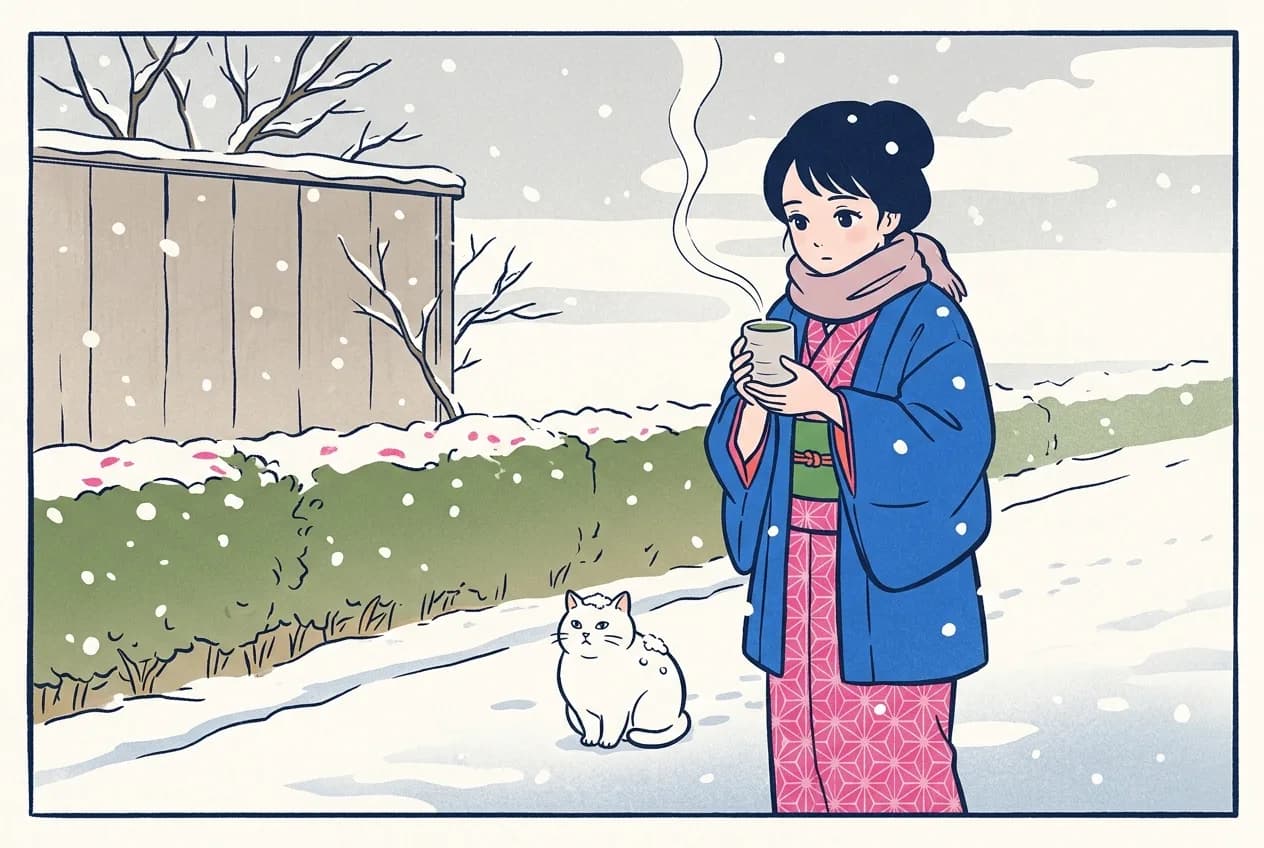
Hot and cold are hard for many learners in Japanese, since each one splits into two separate words. One question settles most cases: whether the heat or cold is in the air around you, or in something you touch or drink.
On a hot day, someone offering you a drink might say:
暑いですね。冷たいお茶を飲みませんか。あついですね。つめたいおちゃをのみませんか。 (atsuidesune.tsumetaiochawonomimasenka.)
Hot, isn't it? Would you like some cold tea?
These words come up in small talk about the weather and whenever you offer or accept a drink. 寒い (samui) is not a word for tea, water, or anything else you touch or drink.
Hot air and hot tea
暑い (atsui) and 熱い (atsui) have the same reading, so in speech they sound alike. They are still two words, and each one has its own kanji.
暑い (atsui) is heat in the air, the kind you feel all over on a summer day. 熱い (atsui) is the heat of a thing, and you feel it when you touch it or drink it.
When you hear あつい (atsui) in conversation, the rest of the sentence tells you which word it is. A remark about the day means the air, and a remark about tea or soup means the thing.
Picking up a cup of tea that was poured a moment ago, you would say:
このお茶は熱いです。 (konoochahaatsuidesu.)
This tea is hot.
The Japanese language subdivision of Japan's Council for Cultural Affairs covered this pair in a 2014 report on kanji that share a reading. It describes 暑い (atsui) as air hot enough to be unpleasant, and 熱い (atsui) as heat that feels very high.
The report presents its examples as one reference for writing, not as a rule that rejects other choices. It also allows the word to be written in kana instead.
The common mistake is 熱い (atsui) on a hot day:
❌ 今日は熱いですね。 (kyouhaatsuidesune.)
⭕ 今日は暑いですね。 (kyouhaatsuidesune.)
It's hot today, isn't it?
The weather is the air around you, so it takes 暑い (atsui). 熱い (atsui) is for the tea in your cup, not for the day.
Because both words are read あつい (atsui), this mistake does not show when you speak. It appears when you type or write the sentence, because that is where you choose the kanji.
Six words, sorted by air and touch
The cold side splits the same way as the hot side. 寒い (samui) is cold air and cold weather, and 冷たい (tsumetai) is a cold thing, such as water or a drink.
Warm has two words as well, and both are read あたたかい (atatakai). Here are all six words, each with its opposite:
暑い夏 (atsuinatsu)
A hot summer
熱いお茶 (atsuiocha)
Hot tea
寒い朝 (samuiasa)
A cold morning
冷たい水 (tsumetaimizu)
Cold water
暖かい春 (atatakaiharu)
A warm spring
温かいスープ (atatakaisuupu)
Warm soup
In the Opposite column, air words are paired with air words. Touch words, for things you touch or drink, are paired with each other.
The opposites show how the warm pair divides. 暖かい (atatakai) means not 寒い (samui), and it is used mostly for weather and air. 温かい (atatakai) means not 冷たい (tsumetai), as with warm soup or a warm dish.
The two warm words are not always kept apart. The same 2014 report lists a warm blanket under 暖かい (atatakai), so a warm thing you touch does not always take 温かい (atatakai).
The warm pair also sounds the same in speech. As with 暑い (atsui) and 熱い (atsui), the difference shows when you write the kanji.
The cold pair has a limit in one direction only. 寒い (samui) is not used for a drink, but 冷たい (tsumetai) can describe air or wind that feels cold on your skin.
Describing a glass of iced tea, you would say:
❌ このお茶は寒いです。 (konoochahasamuidesu.)
⭕ このお茶は冷たいです。 (konoochahatsumetaidesu.)
This tea is cold.
Tea is a thing you drink, so it takes 冷たい (tsumetai). 寒い (samui) is about the air around your whole body.
Verbs for rain, snow, and wind
Weather words come with set verbs too. Rain and snow share one verb, 降る (furu), which is used for most things that fall from the sky.
Before leaving the house on a gray morning, you might say:
今日は雨が降ります。 (kyouhaamegafurimasu.)
It's going to rain today.
Snow takes the same verb:
山に雪が降りました。 (yamaniyukigafurimashita.)
Snow fell on the mountain.
落ちる (ochiru) also means to fall, and it is the usual verb for a cup that falls from a table. To say that it is raining or snowing, use 降る (furu) instead:
❌ 外は雨が落ちています。 (sotohaamegaochiteimasu.)
⭕ 外は雨が降っています。 (sotohaamegafutteimasu.)
It's raining outside.
Wind takes a different verb, 吹く (fuku). When rain stops, the usual verb is やむ (yamu), and a clear or cloudy sky takes 晴れる (hareru) or 曇る (kumoru).
On a day with strong wind:
今日は風が強く吹いています。きょうはかぜがつよくふいています。 (kyouhakazegatsuyokufuiteimasu.)
The wind is blowing hard today.
The Japan Meteorological Agency's guide to forecast terms uses these same verbs. Rain and snow fall with 降る (furu), rain stops with やむ (yamu), and wind takes 吹く (fuku).
The same guide lists 晴れ (hare) and 曇り (kumori) among its names for kinds of weather. Forecasts often use these nouns in place of full sentences, and a full sentence uses the verb form:
明日は晴れて、暖かくなります。あしたははれて、あたたかくなります。 (ashitahaharete,atatakakunarimasu.)
Tomorrow it will clear up and turn warm.
Pleasantly cool air
涼しい (suzushii) is the cool you are glad to feel, such as the air on an autumn morning. It is a word for air, so a cold drink takes 冷たい (tsumetai) instead. Like 暑い (atsui) and 寒い (samui), it describes the air around you rather than a thing you touch.
On a fresh autumn morning:
秋の朝は涼しくて、気持ちがいいです。あきのあさはすずしくて、きもちがいいです。 (akinoasahasuzushikute,kimochigaiidesu.)
Autumn mornings are cool and pleasant.
Between 暑い (atsui) and 寒い (samui), the mild air words are 暖かい (atatakai) and 涼しい (suzushii). Warm spring air takes the first, and cool autumn air takes the second.
Small talk about the weather
暑いですね (atsuidesune) said to a neighbor is a greeting, not a question about how hot it is. The field note on ね (ne) and よ (yo) explains how people answer it and what the ending ね (ne) adds.
In winter, the same greeting uses the air word for cold:
今日はずいぶん寒いですね。きょうはずいぶんさむいですね。 (kyouhazuibunsamuidesune.)
It's quite cold today, isn't it?
The sentence at the start of this note uses both kinds of word. The day is 暑い (atsui) because the heat is in the air, and the tea is 冷たい (tsumetai) because it is something you drink.
Key takeaways
For the air around you, say 暑い (atsui) or 寒い (samui); for a thing you touch or drink, say 熱い (atsui) or 冷たい (tsumetai).
Rain and snow take 降る (furu), and wind takes 吹く (fuku).
What is the difference between samui and tsumetai?
寒い (samui) is cold air and cold weather, felt all over your body. 冷たい (tsumetai) is a cold thing you touch or drink, and it can also describe a cold wind on your skin.
So 寒い (samui) is for the air, and 冷たい (tsumetai) is usually for a thing.
Is atsui for hot weather or a hot drink?
It is for both, written with two different kanji. Hot weather and hot air take 暑い (atsui), and a hot drink or anything hot to the touch takes 熱い (atsui).
In speech the two sound the same, so the listener knows which one you mean from what you are talking about.
Where Ukiyoe Japanese fits
“Same sound, different kanji” is one of the Skill Drills in Ukiyoe Japanese. Its questions give you a sentence with a blank and three kanji that share a reading, such as 暑い (atsui), 熱い (atsui), and 厚い (atsui). That practice is aimed at the mistake that appears only in writing.
Sort {{暑い|あつい}}, {{熱い|あつい}}, and other same-sound kanji, one sentence at a time
Popular
Latest