Japanese Train Etiquette: The 3 Rules That Actually Matter
Published 2026-07-31 · Updated 2026-09-03
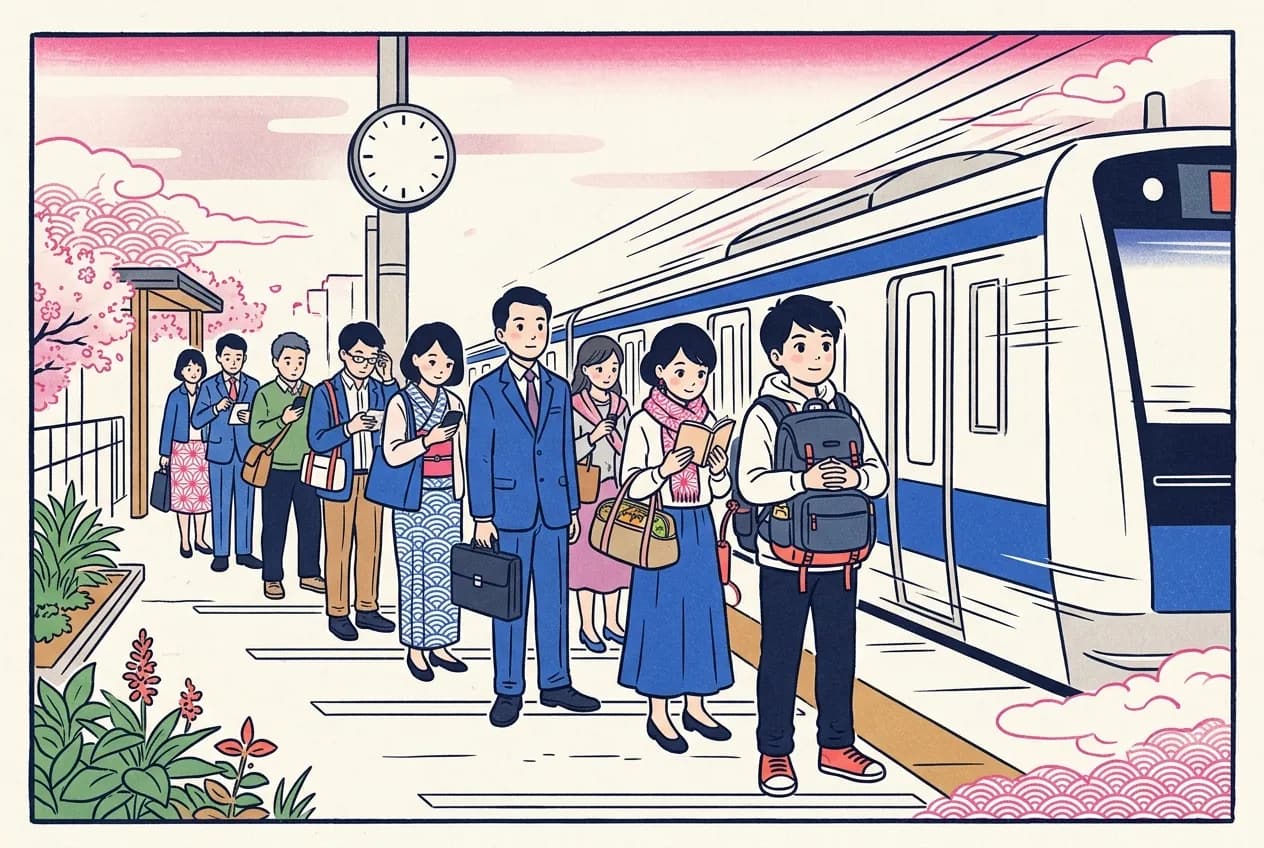
Japanese train etiquette rests on one idea: during the ride, everyone agrees to leave everyone else alone. It is not law, and it is not shyness.
In practice that compresses into three rules: don't make calls, mind the priority seats, and manage your body and bags in a crowd. Get those three and you can ride anywhere in the country without a single sideways glance.
Board a commuter train in Tokyo and the first thing you notice is the sound, or rather its absence. A car holding 200 people hums along in near silence. Thumbs move across screens, a few passengers doze, and no phone rings out loud.
Below: the logic, the three rules, the station skills around them, and the glorious exception that is the bullet train.
The idea underneath: the commute is protected time
Japanese commutes are long — an hour each way is unremarkable in greater Tokyo. The train is where the day's only guaranteed downtime happens. Reading, sleeping, gaming with the sound off: the quiet is less a rule about noise than a pact about rest.
What breaks the pact is anything that forces itself on people who can't leave. That's why one loud conversation registers so sharply in a car where everyone else has powered down.
Japan even renamed the phone setting: マナーモード (manaamoodo), “manner mode.” English calls that switch silent, and Japanese names it for the consideration it shows.
Onboard announcements ask riders to use it and to hold their calls. Notice the framing: it's called manner, not menace. It works as a shared habit rather than an enforced rule, and riders are opted in by default.
Rule 1: calls wait, everything silent is fine
The clearest line in Japanese train culture: speaking into a phone on a regular train is the thing not done. Texting, browsing, and watching with earbuds at a volume only you can hear are all fine.
Talking with a friend beside you is fine too, at a low conversational volume. It's specifically the phone call, half a conversation broadcast to captive strangers, that crosses the line.
If your phone rings out loud anyway — it happens — silence it. If the call is genuinely urgent, answer briefly with a hand cupped over your mouth. Say you'll call back, or step off at the next stop to talk.
A small apologetic nod to your neighbors repairs everything. The etiquette cares about intent, not perfection.
Sleeping, by the way, is not rude. The dozing salaryman is one of the great sights of the Japanese evening train.
Rule 2: know the 優先席 (yuusenseki)
Japanese trains set aside 優先席 (yuusenseki) — priority seats, marked in a different color. They are for elderly riders, passengers with disabilities, expectant mothers, and people with small children.
Sitting there when the car is empty is fine. The rule is to stand up the moment someone who needs the seat boards.
You may also see a マタニティマーク (matanitimaaku), a small badge on a bag that quietly signals early pregnancy. Its whole purpose is to let you offer a seat without anyone having to ask.
Offering a seat needs only two words: どうぞ (douzo) — “please, go ahead” — with a small gesture toward the seat. It's one of the highest-value phrases in this app: two syllables, and you've been graceful in public.
Rule 3: your bag is also a passenger
In a packed car, space is the shared currency. The classic move is wearing your backpack on your front, and rail-company posters have promoted it for years.
Front-worn, the bag stops hitting the person behind you and stays where you can see it. Bigger luggage goes on the overhead rack.
And rush hour, roughly 7:30–9:00 on weekday mornings, is worth avoiding entirely with a suitcase. You and the suitcase will both regret it.
The companion rule plays at the platform: when the door chime sounds, don't sprint for it. Stations run regular announcements warning against 駆け込み乗車 (kakekomijousha) — “dash-aboard boarding” — because a body in a closing door delays the entire line. The next train is rarely more than a few minutes away; in central Tokyo, often two.
Station skills: gates, lines, melodies
Getting to the train has its own small choreography. At the 改札 (kaisatsu) — the ticket gates — the local rhythm is a tap of an IC transit card on the reader.
The gate registers it faster than you can slow down, even with the card buried in a wallet or phone case. Tourist versions are sold at airports, and loading one is one of the biggest upgrades you can make to getting around.
On the platform, look down. Painted markings show exactly where each door will open, and riders form neat lines behind them.
The choreography at arrival is strict in the friendliest way: those waiting stand aside, everyone lets riders step off first, then the line files in.
And listen for your departure. Many stations play their own short 発車 (hassha) melody instead of a plain buzzer. It is a few seconds of jingle unique to that platform, which regulars know by heart.
Two more station notes. Some urban lines run a 女性専用車両 (joseisen'yousharyou) — a women-only car — during rush hours, marked in pink on the platform edge and car doors. Check the signs before boarding.
And when you exit to the taxi stand, keep your hands off the taxi's rear door. It opens and closes by itself, worked by the driver's lever. Touching it is the classic first-timer move, harmless and instantly recognized.
The 新幹線 (shinkansen) exception: please, eat
On commuter trains, eating a full meal is quietly out of place. A sip of a drink passes without comment.
Then you board the 新幹線 (shinkansen) — the bullet train — and the rulebook flips. Seats have tray tables, and attendants roll carts of snacks down the aisle.
And unpacking a 駅弁 (ekiben), a station-bought boxed meal, at bullet-train speed is not merely tolerated but one of the country's cherished travel rituals. The distinction is context: the bullet train is travel, the commuter train is everyone's shared hallway.
The numbers on that system deserve their reputation. The ride puts Osaka roughly two and a half hours from Tokyo, and operators report yearly average delays measured in seconds.
The on-time culture runs so far that rail companies have publicly apologized for trains leaving mere seconds ahead of schedule.
At the other end of the scale sits Shinjuku, the Guinness-listed busiest station on the planet. It moves on the order of 3 million people through its gates daily. And the lines still form.
The onboard rules on one screen
Everything above, sized for your pocket:
| Situation | What riders do |
|---|---|
| Phone rings | Silence it — calls wait for the platform |
| Chatting with a friend | Fine at low volume |
| Music / video | Earbuds, volume leaks are the faux pas |
| 優先席 (yuusenseki) priority seat | Sit if empty, stand for anyone in need |
| Backpack in a crowd | Wear it on your front or rack it |
| Door chime sounding | Let it go — next train in minutes |
| Boarding | Line up at the marks, riders off first |
| Eating a meal | Save it for the shinkansen tray table |
| Feeling sleepy | Doze freely — a beloved national pastime |
Ride like you've done it before
Three rules, one idea, and a bento at the end of it: that's the whole art. Do it right and nobody notices you at all, which on a Japanese train is the highest compliment there is.
Our Trains & Stations quiz covers the same material in six questions: gates, bullet trains, taxi doors, and the polite way past a crowd.