Watashi, Boku or Ore? How to Choose Your Japanese “I”
Published 2026-07-29 · Updated 2026-09-03
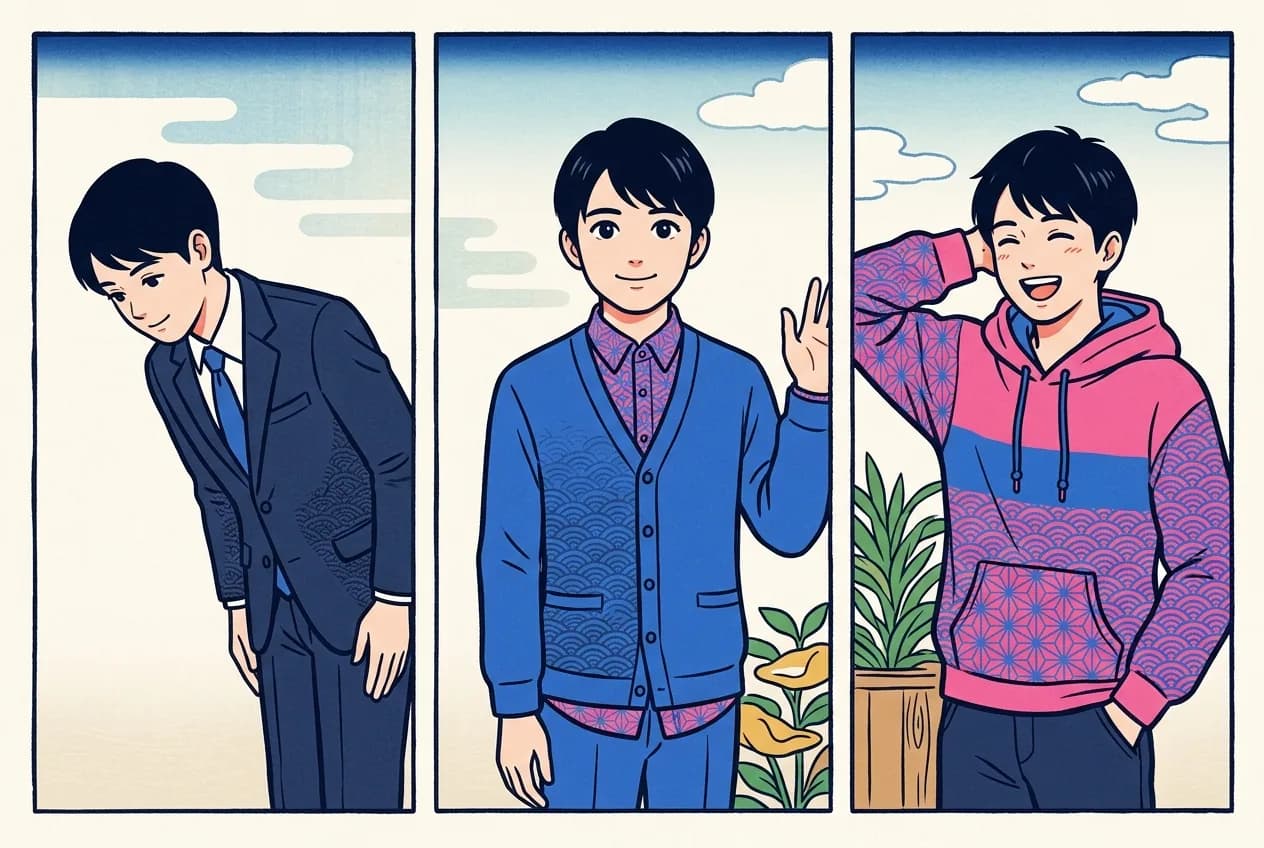
Here's the short answer: 私 (watashi) is safe for everyone, everywhere. 僕 (boku) is a soft male “I,” 俺 (ore) is a casual male “I,” and うち (uchi) is a casual, mostly female “I.” If you remember nothing else, remember that.
Start with the one word that fits every listener:
初めて会う人には私と言いますはじめてあうひとにはわたしといいます (hajimeteauhitonihawatashitoiimasu)
With someone I am meeting for the first time, I say watashi.
Use 私 (watashi) when you do not yet know who you are talking to, and whenever choosing feels stressful. Do not use 俺 (ore) at interviews, in first meetings, or with a boss.
But the interesting part is why Japanese needs so many. A first-person pronoun in Japanese is not only a grammar word. It is an outfit.
The same person changes their “I” the way they change clothes: one for the job interview, one for the izakaya, one for texting. Learning to switch is learning to read the situation, and that skill is a large part of speaking Japanese.
The secret nobody tells beginners: the best “I” is often none at all
One surprise before the sorting: natural Japanese drops the subject whenever it's obvious. 行きます (ikimasu) on its own is a complete, natural sentence for “I'm going.”
Beginners who start every sentence with 私は (watashiha) sound like their textbook. Grammatically right, unmistakably foreign.
So the real skill has two parts: drop the pronoun when you can, and choose the right one when you can't.
私 (watashi) — the one you can never get wrong
私 (watashi) works for every gender in every situation, from a first conversation to a business meeting. If choosing feels stressful, use it, because hardly anyone has ever been bothered by 私 (watashi).
The same kanji can also be pronounced わたくし (watakushi), the ultra-polite version. You will hear it from hotel staff, in ceremonies, and in very formal speeches.
You do not need to produce it yourself. You only need to recognize it: 私 (watashi) in a tuxedo.
僕 (boku) — the gentle one
僕 (boku) sits between casual and formal: soft, modest, and acceptable in most workplaces as well as among friends. Many men use 僕 (boku) as their lifetime default. Boys grow up being called ぼく (boku) by adults before they ever choose a pronoun themselves.
A fun cultural note: J-pop lyricists love 僕 (boku). Plenty of songs use it for the narrator regardless of the singer's gender, because it sounds sincere and a little vulnerable. Your favorite song is quietly teaching you pronoun nuance.
俺 (ore) — the everyday one (yes, it's fine)
Anime may have taught you 俺 (ore) first, and here anime is right. 俺 (ore) is the most common casual “I” for men in Japan — with friends, family, and anyone they're relaxed around.
It is not rude, only informal.
Using 俺 (ore) is not the mistake. Using it in the wrong setting is.
A man who says 俺 (ore) at the izakaya switches to 僕 (boku) or 私 (watashi) in a meeting without thinking. It is the same as not wearing beach sandals to a job interview.
うち (uchi) — the in-group one
うち (uchi) is a casual “I” heard especially from younger women and all over Kansai. Its logic is lovely.
うち (uchi) literally means “my household / my in-group” — うちの猫 (uchinoneko) is “our cat,” うちの会社 (uchinokaisha) is “my company.” Using it as “I” wraps the speaker in that same warm, in-group feeling.
And “you”? The word あなた (anata) is a trap
Textbooks teach あなた (anata) = “you,” but real Japanese mostly avoids “you”-words altogether. People use names and titles instead: 田中さん (tanakasan), 先生 (sensei) — or drop the subject entirely, as with “I.”
Overusing あなた (anata) sounds distant, like addressing a stranger in an official letter. And in one famous twist, あなた (anata) is also what some wives affectionately call their husbands — roughly “dear.”
Same word, two opposite feelings. Meanwhile お前 (omae) is for close friends only, and never for anyone above you.
The cheat sheet
Screenshot this — it covers nearly every situation you'll actually meet.
俺 (ore) is the one to avoid at interviews, in first meetings, and with bosses. うち (uchi) sounds regional and youthful, so recognize it before you adopt it.
| Word | Who uses it | Where it fits | Watch out |
|---|---|---|---|
| 私 (watashi) | Who uses itEveryone | Where it fitsAnywhere — the universal safe choice | Watch outA little stiff in casual male groups |
| わたくし (watakushi) | Who uses itEveryone | Where it fitsCeremonies, hotel staff, formal speech | Watch outToo formal for daily life |
| 僕 (boku) | Who uses itMostly men | Where it fitsFriends, most workplaces | Watch outSoft image, fine almost everywhere |
| 俺 (ore) | Who uses itMen | Where it fitsFriends, family, casual settings | Watch outNot for interviews or bosses |
| うち (uchi) | Who uses itMostly women and Kansai speakers | Where it fitsCasual conversation | Watch outRegional, young (recognize before use) |
| (none) | Who uses itEveryone | Where it fitsWhenever context makes “I” obvious | Watch outThe most natural choice of all |
Key takeaways
Use 私 (watashi) whenever you are unsure, because it fits every speaker and every setting.
Choose your “I” by the setting: 俺 (ore) at the izakaya, 僕 (boku) or 私 (watashi) in a meeting.
Address people by name or title, and avoid あなた (anata) in ordinary conversation.
So which one is yours?
Start with 私 (watashi) everywhere. As Japanese friendships form, listen to how people your age and gender talk to you.
Let your casual “I” — 僕 (boku), 俺 (ore), or うち (uchi) — arrive naturally. Choosing a pronoun is a small identity decision, and it is genuinely fun to make. The first outfit is already hanging there: 私 (watashi) fits everyone.