Japanese Honorifics: -San, -Kun, -Chan, -Sama, or Nothing
Published 2026-08-17 · Updated 2026-09-18 · 11 min read
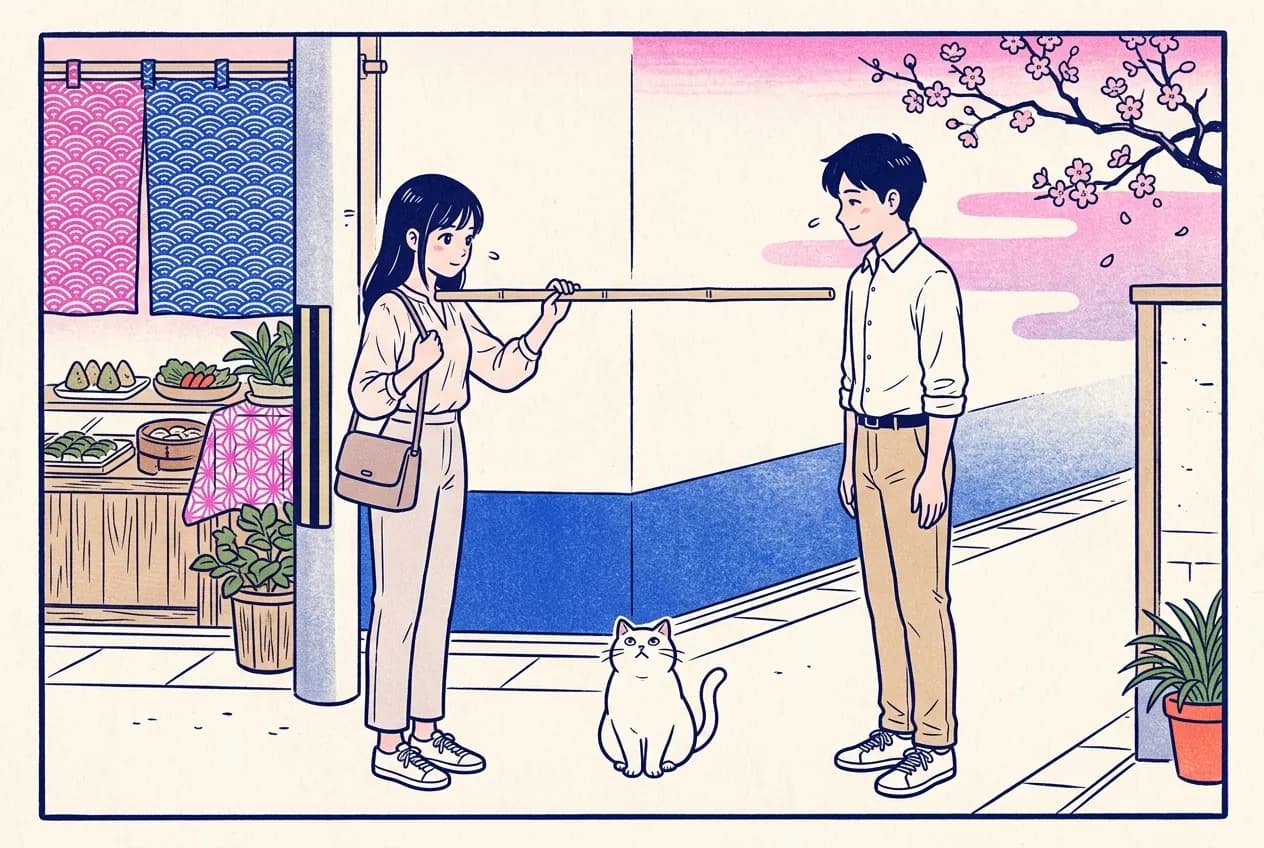
Japanese honorifics sound like a rank system, and they are not one. They mark how far apart two people stand, and family name plus さん (san) is the neutral middle.
Here is that neutral さん (san) in a sentence:
田中さん、この書類にはんこをお願いしますたなかさん、このしょるいにはんこをおねがいします (tanakasan,konoshoruinihankowoonegaishimasu)
Tanaka-san, please put your seal on this document.
Use family name plus さん (san) with anyone you meet for the first time, whatever their age. Do not put an honorific on your own name. Your own side loses さん (san) when you speak to an outsider.
The reason it feels bigger than that is fiction. A character who switches from さん (san) to ちゃん (chan) is announcing a plot point, and subtitles leave the suffix untranslated.
This guide covers the suffixes that attach to names. The verb forms called 敬語 (keigo) are the other part of politeness, and they have their own field note.
Japanese honorifics in one minute: what -san, -kun, -chan, and -sama actually do
An honorific is a short suffix on someone's name, and it says how far apart the two of you stand. さん (san) is the neutral middle: family name plus さん (san) is how coworkers, neighbors, store staff, and new acquaintances address each other.
From that middle the distance opens both ways. Up: 様 (sama) adds formal respect, seen on envelopes and aimed at customers. Down: 君 (kun) goes to boys and juniors at school or work, ちゃん (chan) to small children, close female friends, pets, and nicknames at home.
Standing slightly apart are the titles: 先生 (sensei) for teachers and other professionals, 先輩 (senpai) for someone senior to you. Neither needs a name in front of it.
One idea makes the rest of this article simple: honorifics measure distance, not rank. The same colleague is 田中さん (tanakasan) in a meeting, 田中 (tanaka) to a client on the phone, and maybe 田中ちゃん (tanakachan) among close friends.
The two mistakes to avoid first: -san on yourself, and no -san on them
Mistake one is attaching an honorific to your own name. English speakers do this innocently — “I'm John-san” — because it sounds like part of the name. It is not.
Honorifics point outward, and one on yourself sounds like a joke. Introduce yourself with your bare name: ジョンです (jondesu), 田中です (tanakadesu). When people call you ジョンさん (jonsan), you do not echo it back.
Mistake two is the mirror image: calling someone by their bare name because that's normal in English. Dropping the suffix — 呼び捨て (yobisute) — is real, and it marks intimacy. With a new acquaintance it sounds presumptuous.
The safe habit is short: until someone invites you closer, family name plus さん (san). If you only know their first name, first name plus さん (san) is fine too.
-San: the default that is almost never wrong
Japanese has a word for “you,” あなた (anata), and conversation mostly does without it. The person's name goes in that position when a word is needed at all, since Japanese often drops the subject.
So family name plus さん (san) is not an optional courtesy. It stands where another language would say “you,” and leaving it off gives you the bare name. A separate field note covers the words for “I” — 私 (watashi), 僕 (boku), and 俺 (ore).
さん (san) is the workhorse: polite enough for a stranger, warm enough for a friend, and neutral about gender and age. It attaches to family names, to given names (ゆきさん (yukisan)), and even to foreign first names (アンナさん (annasan)).
Japanese speakers also put さん (san) on stores and roles: 本屋さん (hon'yasan) for the bookseller or the bookstore, お巡りさん (omawarisan) for the police officer, お客さん (okyakusan) for a customer. In business talk it even goes on other companies.
That reach tells you what さん (san) really encodes: not admiration, only ordinary respectful distance. Use it until you have a reason not to. Keep さん (san) with anyone who still uses it with you.
When are you allowed to leave it off? Only when the other person shows you the way. They use your bare name, they ask you to drop theirs, or the group around you plainly does so.
-Sama, -kun, -chan: the same distance, measured up and down
様 (sama) is more formal than さん (san), and it lives mostly on paper and in service. Address a letter or a formal email to 田中様 (tanakasama). Walk into a bank or a store and you become お客様 (okyakusama).
You'll hear it in set phrases too, お疲れ様 (otsukaresama) and ご馳走様 (gochisousama), and for the divine, 神様 (kamisama). With a peer it sounds stiff, so you write it more often than you say it.
君 (kun) points downward or sideways: seniors to juniors, teachers to students, male friends of the same age. It is not strictly male. Some teachers use it for all their students, and a manager may use it for young staff of either gender.
By convention, the Speaker of Japan's parliament addresses members with 君 (kun) regardless of gender.
ちゃん (chan) is affection: for children, close female friends, pets, and grandparents (おばあちゃん (obaachan)). It also goes to anyone the speaker finds endearing, including grown men on occasion. Never for a stranger, never for your boss.
Both 君 (kun) and ちゃん (chan) shorten the distance. Receive them gladly, and do not use them yourself until you are clearly inside the circle.
| Suffix | Who it's for | Where you'll meet it | Don't use it for |
|---|---|---|---|
| さん (san) (-san) | Who it's forAlmost anyone you meet | Where you'll meet itEverywhere, the default in speech | Don't use it forNot yourself, not family to outsiders |
| 様 (sama) (-sama) | Who it's forCustomers, letters, the divine | Where you'll meet itEnvelopes, service counters, set phrases | Don't use it forNot casual speech, not yourself |
| 君 (kun) (-kun) | Who it's forBoys and some juniors of either gender | Where you'll meet itClassrooms, offices (senior to junior) | Don't use it forNot seniors, not strangers |
| ちゃん (chan) (-chan) | Who it's forChildren, close female friends, pets | Where you'll meet itHome, close friendships | Don't use it forNot strangers, superiors, formal use |
| 先輩 (senpai) | Who it's forSomeone ahead of you in the same group | Where you'll meet itAlone or after a name (schools, clubs) | Don't use it forNot outsiders, and never call anyone 後輩 (kouhai) |
| 先生 (sensei) | Who it's forTeachers, doctors, lawyers, authors | Where you'll meet itAlone or after a family name | Don't use it forNot for yourself, or ordinary coworkers |
| No suffix (yobisute) | Who it's forClose friends, family, partners | Where you'll meet itInside the circle, your own side | Don't use it forNot new acquaintances |
Senpai, sensei, and the titles that replace the name
Here is something the suffix lists skip: in Japan a title usually beats a name. Your teacher is 先生 (sensei), not 山田さん (yamadasan), and your department head is 部長 (buchou) or 田中部長 (tanakabuchou). The company president is 社長 (shachou).
If a person has a title where you are, use it, standalone or after the family name. The question of which suffix to pick disappears.
先生 (sensei) reaches beyond schools: doctors, lawyers, politicians, and manga artists are all 先生 (sensei) to the people who deal with them. The word marks expertise you rely on, not an occupation.
先輩 (senpai) works the same way inside an organization: a student two years above you, a coworker who started before you. You call them 先輩 (senpai) or 佐藤先輩 (satousenpai), and they call you by name plus さん (san) or 君 (kun). The junior word 後輩 (kouhai) describes someone, and is never used to address them.
Stores run the same rule from the other side: staff call you お客様 (okyakusama), a title, so they never need your name. The raising goes one way, and you do not answer in kind. Your side stays at ordinary politeness: 大丈夫です (daijoubudesu) or お願いします (onegaishimasu).
Once you notice titles doing the work, the honorific system gets smaller, not larger.
Family words already contain honorifics
Look at the everyday words for family and you'll find the suffixes inside them: お母さん (okaasan), お父さん (otousan), お兄ちゃん (oniichan), お姉さん (oneesan), おじいちゃん (ojiichan). Each is a polite prefix, a root, and a さん (san) or ちゃん (chan).
Younger family members address older ones with these words. Older ones call younger siblings and children by name, often with ちゃん (chan) or 君 (kun), or with nothing.
The same words flip when you talk about your family to outsiders. To a coworker, your mother is 母 (haha) and your older brother is 兄 (ani) — the plain, humble forms, with no honorific. Outside the family, your own family counts as your own side.
That flip is not a separate rule. It is the same inside-outside boundary that governs keigo, and it explains the next section.
When Japanese people drop honorifics (yobisute) — and why it isn't rude
Dropping the suffix altogether is called 呼び捨て (yobisute). Among Japanese speakers it usually signals closeness rather than contempt: partners, siblings, childhood friends, longtime teammates. Being asked 呼び捨てでいいよ (yobisutedeiiyo) — “you can drop the -san” — is a small ceremony of friendship, and accepting it is the right answer.
The second kind of 呼び捨て (yobisute) has nothing to do with intimacy: it is the inside-outside rule. Talking to a client, you refer to your own manager as plain 田中 (tanaka), the very person you call 田中部長 (tanakabuchou) inside the office.
On the phone to someone outside the company it sounds like this:
申し訳ありません、田中は本日休みを取っております。もうしわけありません、たなかはほんじつやすみをとっております。 (moushiwakearimasen,tanakahahonjitsuyasumiwototteorimasu.)
I'm sorry — Tanaka is off today.
Toward outsiders your whole company counts as inside, and inside people get the humble treatment. People who miss this hear a boss's bare name said to a customer and assume disrespect. It is the opposite: it is respect for the customer.
Drop honorifics only when invited, or when referring to your own side to an outsider. If in doubt, keep さん (san) — an extra one is the kind of mistake nobody minds.
Anime honorifics vs. real life: -tan, -dono, and shouting “senpai!”
Most of what anime does with honorifics is real, but concentrated. Classmates really do call each other 佐藤くん (satoukun) and ゆいちゃん (yuichan), and a first-year really does call an older club member 先輩 (senpai).
Fiction turns the volume up. The shouted 先輩 (senpai)! across a hallway is a school-and-club word, and outside those settings adults mostly use name plus さん (san).
Some suffixes live mostly in fiction. たん (tan) (-tan) is a baby-talk variant of ちゃん (chan) — mascots and doting fans use it, and adults addressing adults do not. 殿 (dono) (-dono) is an old “lord” that survives in samurai stories and, in real life, on certificates and formal documents.
A character who calls himself 俺様 (oresama), putting 様 (sama) on his own name, is written as arrogant on purpose. That is why you do not put 様 (sama) on yourself.
If a suffix is there to tell the audience who a character is, it is doing the story's work. If it tells you how far apart two people stand, it is real, and you can use it.
Key takeaways
Use family name plus さん (san) until the other person invites you closer.
Never put an honorific on your own name.
When a person has a title, use the title instead of choosing a suffix.
Is it rude to call someone by their first name in Japan?
By itself, no — first name plus さん (san) is common, especially when family names are unfamiliar or shared with others in the group. What sounds over-familiar is the bare first name, before the other person has signaled that it is welcome.
Family name plus さん (san) is the more formal choice. Lead with it in offices and with people older than you, and let them shift you closer.
What do Japanese people call foreigners?
Usually the name you introduced yourself with, plus さん (san). Many foreign visitors introduce themselves by first name, so アンナさん (annasan) or マルコさん (marukosan) is what you'll most often hear. It is not a downgrade, only the name they have.
In formal settings your family name plus さん (san) or 様 (sama) appears on paperwork. If you would prefer one form, say so once, gently.
Is -kun only for boys?
No, though it leans that way. 君 (kun) is most common for boys and young men, and between male friends of the same age. It is also used from senior to junior in schools and workplaces without regard to gender, and by convention in Japan's parliament.
What 君 (kun) really encodes is “I'm senior to you, or on your level, and this is friendly.” So you can safely be called it, and never need to use it yourself.
What's the difference between honorifics and keigo?
Honorifics attach to names and titles, while keigo changes the verbs and set phrases. Say 田中さん (tanakasan) and you have used an honorific. Say 田中さんがいらっしゃいましたたなかさんがいらっしゃいました (tanakasangairasshaimashita) instead of 来ました (kimashita) and you have added keigo.
They rise and fall together: the client who gets 様 (sama) on the envelope also gets respectful verbs. But they are separate skills, and honorifics are the smaller one. The keigo field note walks through the verb end.
Where Ukiyoe Japanese fits
Honorifics are the kind of thing you understand in 10 minutes and own only after a few dozen times out loud. Greeting a named coworker, asking a store clerk for help — that's where they stick.
Speak in Ukiyoe Japanese exists for that second part. A scenario gives you a partner with a name, so family name plus さん (san) arrives in the first exchange. The feedback names the reason a form was off.
A Speak scenario only uses what you have already covered, so no unfamiliar register appears. The rules take an afternoon to understand. Standing at the right distance from a real person takes practice.
Try Speak — real scenarios, instant feedback
Popular
Latest