Bathroom in Japanese: Asking for the Toilet, Not the Bath
Published 2026-09-30 · 6 min read
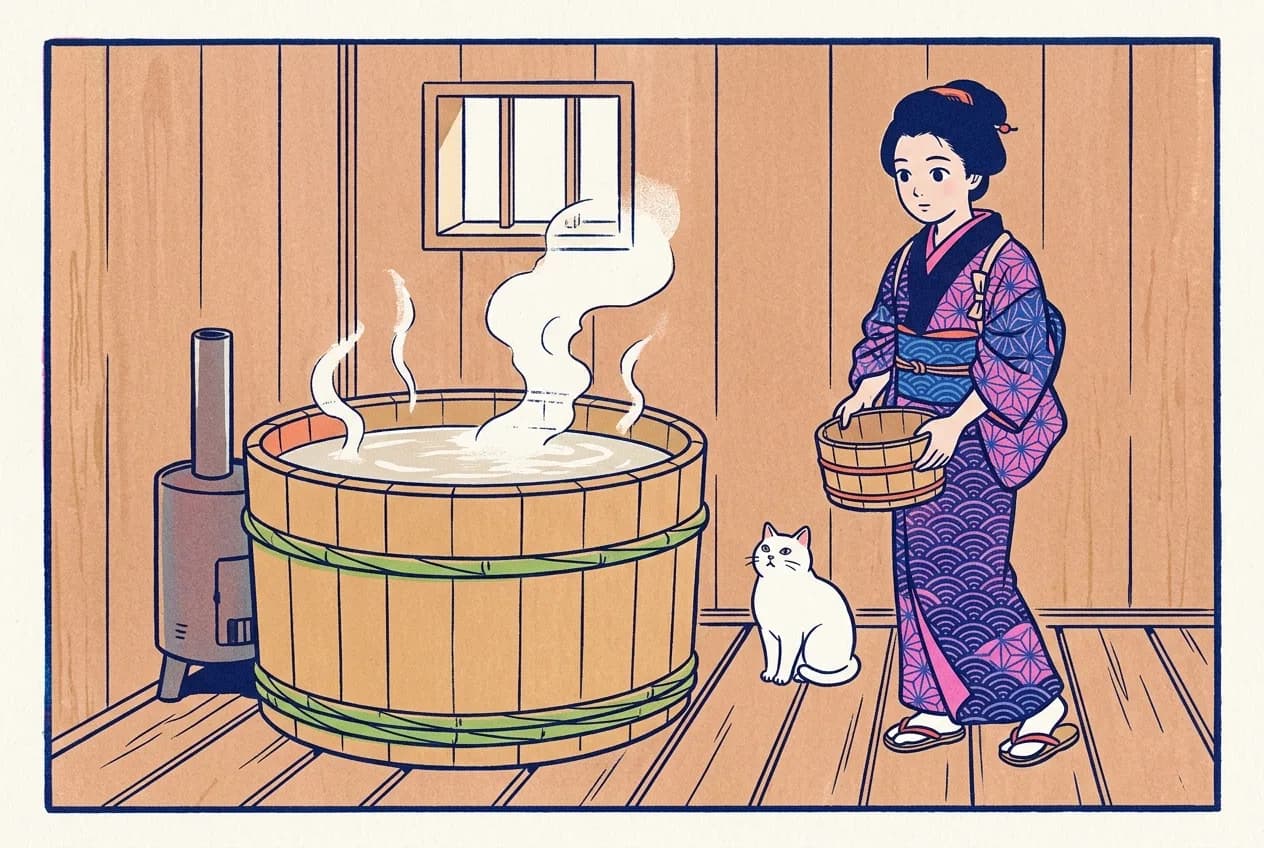
The English word bathroom can mean a restroom or a bath, and Japanese names each one differently. The word for a restroom also changes with where you ask, and this note covers the words only, not fixtures or manners.
In a store or a train station, you can ask a staff member:
すみません、お手洗いはどこですか。すみません、おてあらいはどこですか。 (sumimasen,otearaihadokodesuka.)
Excuse me, where is the restroom?
The restroom words are for stores, stations, and other people's homes, and おふろ (ofuro) is for talk about your evening at home. When you are looking for a restroom, do not ask for おふろ (ofuro), which means a bath.
What bathroom means in English and Japanese
Merriam-Webster lists two senses for the English word bathroom: a room with a bathtub or a shower, and a restroom. So one English word can point to either place.
Japanese does not use one word for both. トイレ (toire) names the toilet room, which this note calls a restroom, and おふろ (ofuro), also written お風呂 (ofuro), names the bath.
Digital Daijisen, a Japanese dictionary from Shogakukan, keeps the two apart as well. It defines トイレ (toire) as the facility itself, and also as the act of using it.
For 風呂 (furo), the same dictionary lists the equipment for bathing and the place where it is. It also lists the act of taking a bath.
The お (o) at the front of おふろ (ofuro) is a polite prefix, and the dictionary entry is 風呂 (furo) without it. This note writes the word as おふろ (ofuro), the way the example sentences do.
In English, you take a bath and you also take a shower. Japanese uses a different verb for each, so learn the verb together with the noun.
Here are the four words, each with a sentence you can reuse as it is. The Verb in the example column shows the verb each sentence is built on:
トイレを使ってもいいですか。トイレをつかってもいいですか。 (toirewotsukattemoiidesuka.)
May I use the restroom?
すみません、お手洗いはこの建物の中にありますか。すみません、おてあらいはこのたてもののなかにありますか。 (sumimasen,otearaihakonotatemonononakaniarimasuka.)
Excuse me, is there a restroom inside this building?
毎晩おふろに入ります。 (maiban'ofuronihairimasu.)
I take a bath every night.
朝はいつもシャワーを浴びます。あさはいつもシャワーをあびます。 (asahaitsumoshawaawoabimasu.)
I always take a shower in the morning.
トイレ (toire) and お手洗い (otearai)
トイレ (toire) and お手洗い (otearai) name the same place, and both are correct Japanese. What changes is how soft each one sounds where you are.
トイレ (toire) is the everyday word. People say it at home and with friends, and store and restaurant staff say it as well.
お手洗い (otearai) is the softer and more polite of the two. It sounds softer in a restaurant, a store, or another person's home, and it is also a good fit at a client's office.
Digital Daijisen classes お手洗い (otearai) as a refined word. It is 手洗い (tearai), in its sense of a restroom, with the polite お (o) added. That お (o) is the same polite prefix that appears in おふろ (ofuro).
The same dictionary treats トイレ (toire) as a loanword shortened from English, and it gives the word no politeness mark in either direction. So the gap between the two is one of softness, not of right and wrong.
Asking where the restroom is, you can use either word:
トイレはどこですか。 (toirehadokodesuka.)
Where is the restroom?
お手洗いはどこですか。 (otearaihadokodesuka.)
Where is the restroom?
Neither question is a mistake, and both have the same English translation. The one with お手洗い (otearai) sounds softer, so it suits a store or another person's home better.
The first example on this page asks with お手洗い (otearai) for that reason. It is a question for a store clerk or station staff.
Because staff use トイレ (toire) too, you may hear it in the reply, even after you asked with お手洗い (otearai). That does not mean your word was wrong.
You will also see お手洗い (otearai) on signs, and the field note on common signs covers that side of the word. For politeness across a whole sentence, see the field note on politeness levels.
おふろ (ofuro), the bath
おふろ (ofuro) can mean the bath itself, the place where it is, or the act of bathing. To say that you take a bath, use it with 入る (hairu), the verb for going into something.
A bath is water that you get into, so the usual verb is 入る (hairu). A shower is water that falls over you, so シャワー (shawaa) takes 浴びる (abiru) instead.
Tired after a long day out, you might say:
今晩はゆっくりおふろに入りたいです。こんばんはゆっくりおふろにはいりたいです。 (konbanwayukkuriofuronihairitaidesu.)
Tonight I want a long soak in the bath.
The おふろ (ofuro) sentence in the four-word list uses 入ります (hairimasu) for something you do every night. This one uses 入りたいです (hairitaidesu), the form for something you want to do.
For taking a bath, use 入る (hairu) rather than the shower verb:
❌ おふろを浴びます。 (ofurowoabimasu.)
⭕ おふろに入ります。 (ofuronihairimasu.)
I take a bath.
おふろに入ります (ofuronihairimasu) is the usual way to say it, because you get into a bath. 浴びる (abiru) describes water poured over your body, as with a shower.
In a friend's home, the polite お (o) tends to drop, and you may hear plain ふろ (furo). Both forms name the same bath.
The water in a bath has a noun of its own, 湯 (yu), and Digital Daijisen lists water heated for bathing as one of its senses.
Checking the bath before you get in, you might say:
お風呂の湯は熱いです。 (ofuronoyuhaatsuidesu.)
The bath water is hot.
熱い (atsui) here is the word for a hot thing that you touch, and the note on hot and cold words covers that choice.
どこですか (dokodesuka) or ありますか (arimasuka)
どこですか (dokodesuka) asks where something is, so it assumes the place exists. The restroom question near the start of this page works that way.
When you are not sure there is a restroom inside at all, ask with ありますか (arimasuka) instead. The お手洗い (otearai) sentence in the four-word list earlier on this page asks that question about one building.
In that sentence, この建物の中に (konotatemonononakani) means inside this building.
Both questions begin with すみません (sumimasen), a polite way to open when you speak to staff. The one with ありますか (arimasuka) is a yes or no question, while どこですか (dokodesuka) asks for a place.
The choice between あります (arimasu) and います (imasu) is covered in its own field note.
At a small café, the reply might be a short apology and a nod toward the station across the street.
Is toire or otearai more polite?
お手洗い (otearai) is the more polite of the two. In a store or at someone's home, it is the gentler way to ask.
トイレ (toire) is still correct Japanese. It is the everyday word, used by customers and staff alike.
Which Japanese word means bathroom?
It depends on which one you mean. For the toilet room, say トイレ (toire), or お手洗い (otearai) for a softer word. For the bath, say おふろ (ofuro).
Where Ukiyoe Japanese fits
Home & Daily-Life Words is the explainer in Ukiyoe Japanese for home words and the verbs they take, including おふろに入ります (ofuronihairimasu) and シャワーを浴びます (shawaawoabimasu). The Home & Daily Life topic points to it first, then gives its words in short sets, with トイレ (toire), お手洗い (otearai), and おふろに入る (ofuronihairu) among them. You can study each set in Flashcards, Listen first, or Practice.
{{トイレ}}, {{お手洗い|おてあらい}}, and {{おふろに入る|おふろにはいる}}: practice them in the Home & Daily Life topic
Popular
Latest