Japanese Convenience Store Phrases: the 5 Konbini Questions
Published 2026-07-29 · Updated 2026-09-03
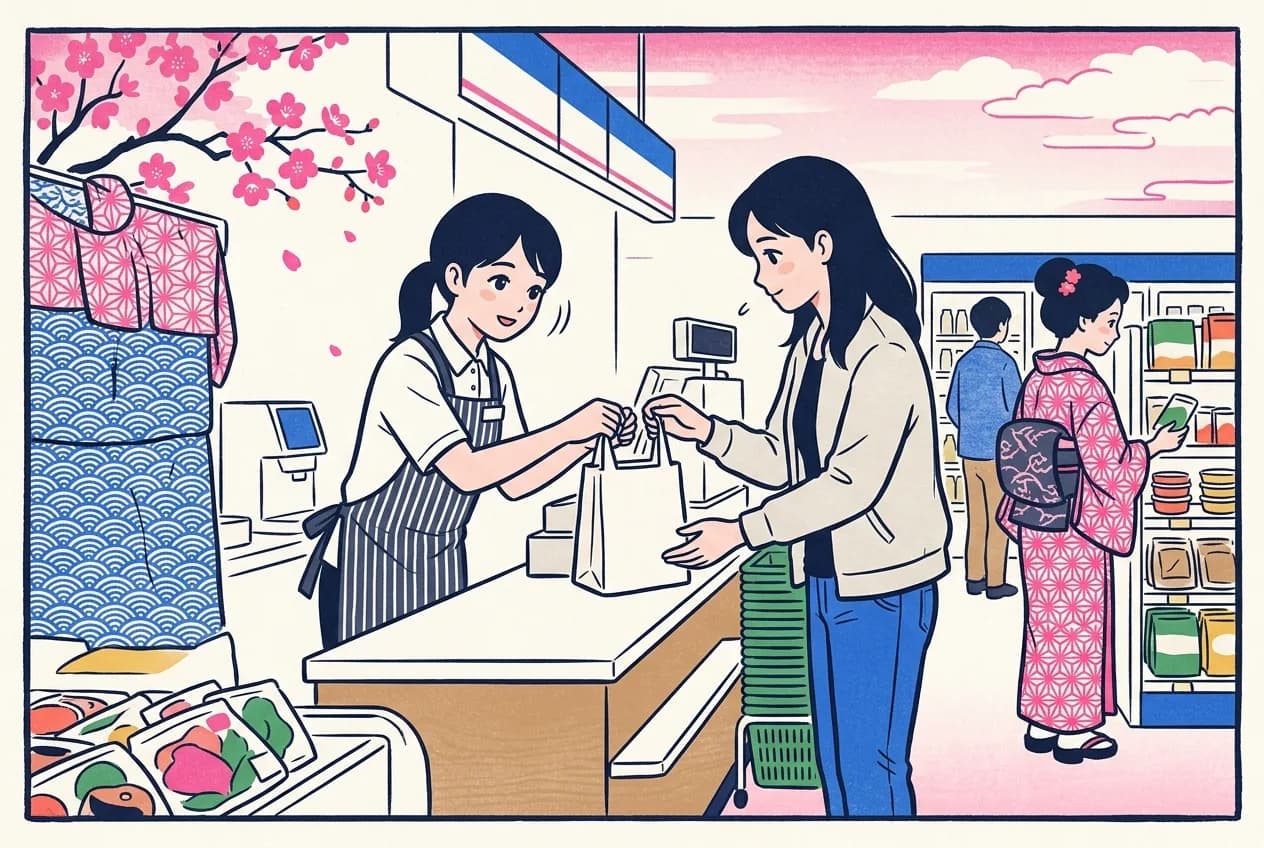
A konbini clerk works from a script: the same five questions, usually in the same order, at every chain. Learn those five questions and you have learned the whole exchange.
Here is a customer answering two of those questions at once:
はい、温めてください。お箸もお願いしますはい、あたためてください。おはしもおねがいします (hai,atatametekudasai.ohashimoonegaishimasu)
Yes, please heat it up. Chopsticks too, please.
Say お願いします (onegaishimasu) at any konbini register when you want what the clerk offered. Do not use it to decline, because a refusal needs 大丈夫です (daijoubudesu). The age-check question needs a tap on the screen instead of either phrase.
Konbini Japanese has a reputation for being fast and terrifying. The speed comes from the script. Because the lines are fixed, the wording barely changes from store to store.
One phrase, 大丈夫です (daijoubudesu), is a valid answer to almost all five questions.
Why the politest Japanese you'll hear all day happens at a konbini
Clerks use maximum-courtesy keigo because chains train it from a service manual. The register script is company policy, not a personal choice. That is also why it sounds so fast and formal: they have said it 10,000 times.
Nobody expects keigo back from you, though. はい (hai) and 大丈夫です (daijoubudesu) are perfect customer Japanese.
The five questions
In rough order of appearance at the register:
| They ask | Meaning | Yes | No |
|---|---|---|---|
| 袋はご利用ですか (fukurohagoriyoudesuka) | MeaningDo you want a bag? (paid, a few yen) | Yesお願いします (onegaishimasu) | No大丈夫です (daijoubudesu) |
| お弁当温めますか (obentouatatamemasuka) | MeaningShall I microwave your bento? | Yesお願いします (onegaishimasu) | No大丈夫です (daijoubudesu) |
| ポイントカードはお持ちですかポイントカードはおもちですか (pointokaadohaomochidesuka) | MeaningDo you have a point card? | YesShow it | No大丈夫です (daijoubudesu) |
| お箸はお付けしますか (ohashihaotsukeshimasuka) | MeaningChopsticks with that? | Yesお願いします (onegaishimasu) | No大丈夫です (daijoubudesu) |
| 年齢確認ボタンをお願いしますねんれいかくにんボタンをおねがいします (nenreikakuninbotanwoonegaishimasu) | MeaningAge-check button (alcohol, tobacco) | YesTap the screen | No— |
The two answers that run the whole conversation
お願いします (onegaishimasu) = “yes, please.” 大丈夫です (daijoubudesu) = “no, thank you.” That pair, plus pointing, completes almost every konbini transaction in Japan.
If you catch nothing else the clerk says, wait for the rising question intonation and use one of the two.
When you want something done, lead with it instead of waiting. Hand over the bento with 温めお願いします (atatameonegaishimasu) — “please heat it up” — and you'll get a small nod of respect.
Three konbini facts to enjoy while you wait in line
Japan has over 55,000 konbini, more than twice the number of post offices. At that same register you can pay utility bills, buy concert tickets, and ship your luggage.
In winter, the pot of おでん (oden) simmering by the counter is a national comfort food. Point at what you want, and the clerk serves it to you.
Key takeaways
Answer the bag, bento, and chopsticks questions with お願いします (onegaishimasu) for yes and 大丈夫です (daijoubudesu) for no.
For the point card, show it or say 大丈夫です (daijoubudesu), and for the age check, tap the screen.
Say 温めお願いします (atatameonegaishimasu) first when you want the bento heated.
Hear it before you need it
Reading the five questions is one thing. Catching them at a real clerk's speed is another.
Practice the listening flow in the konbini scenario, and the next real clerk will sound like they are reading their script slowly, for you alone.
Test yourself — take the free “Konbini Register Master” quiz