Japan by Region: Where to Go After Tokyo and Kyoto
Published 2026-07-31 · Updated 2026-09-03
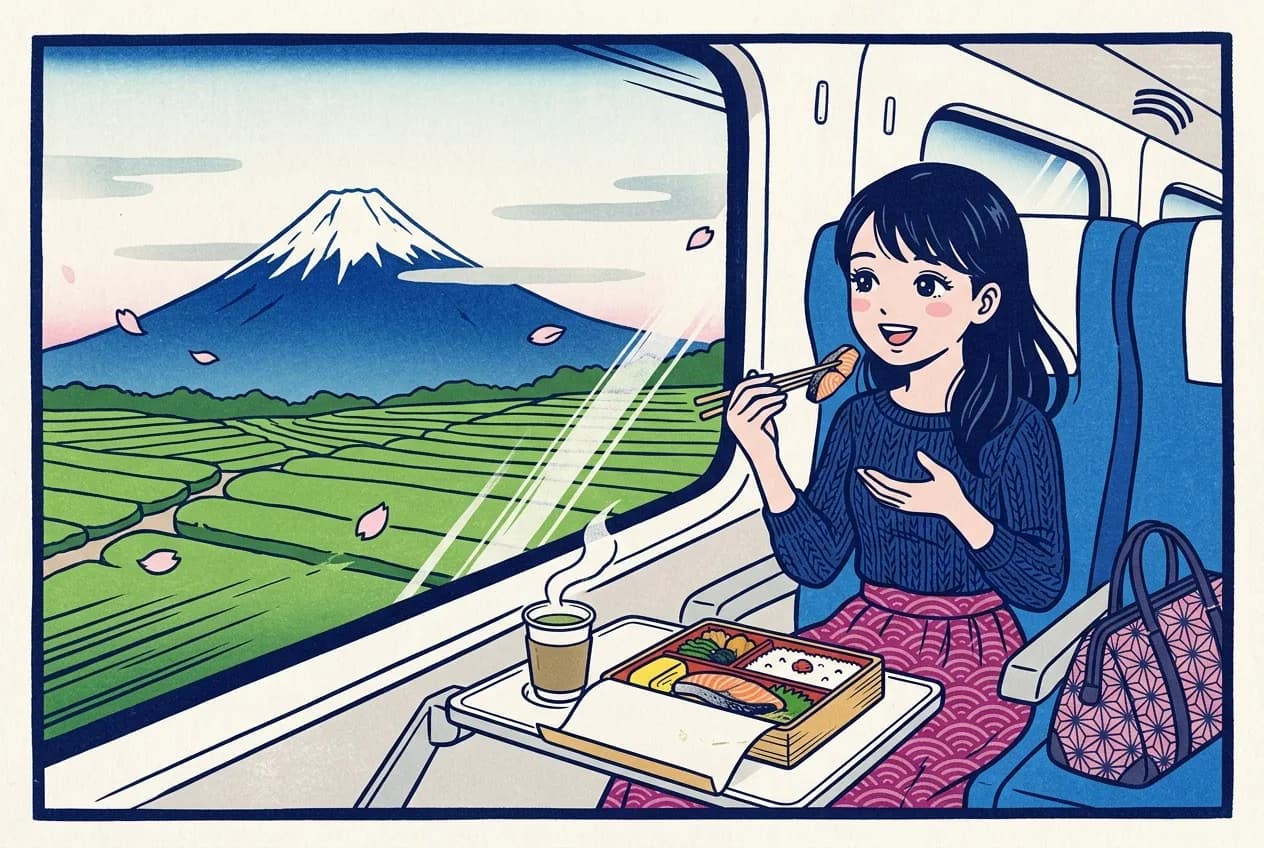
First trips to Japan tend to follow one line, the Golden Route. It goes from Tokyo to Kyoto by bullet train past Mount Fuji, with maybe a day in Osaka.
Travel agents gave it that name. It is popular because it is wonderful, and it covers a thin slice of one island out of four.
Japan is best understood as a chain of regions with strong, distinct personalities. There is a snowy seafood north and a mountain spine full of old post towns.
There is a comedy-loving merchant west, and a subtropical island south that used to be a different country. Your second trip is not “more Japan.” It is a different Japan.
So this is a menu, organized top to bottom: what each region is like, and what it wants to feed you. Plus the handful of travel words — 名物 (meibutsu), 駅弁 (ekiben), 旅館 (ryokan) — that make the whole country easier to navigate.
One word first: 名物 (meibutsu)
Japanese travel culture is food-first, and one word carries it. 名物 (meibutsu) means “the famous local thing.” Nearly every town, however small, promotes a signature dish or product.
Japanese travelers plan trips around eating the meibutsu at the source. Ask 名物は何ですか (meibutsuhanandesuka), “what's the local specialty?” and any station attendant, innkeeper, or taxi driver will light up.
This is why a region guide to Japan is half a food guide. It isn't shallow — it's the local logic. A place's pride, history and geography are usually all sitting on the plate.
The north: 北海道 (hokkaidou) and 東北 (touhoku)
Hokkaido, the big northern island, is Japan's frontier. Large-scale settlement only began in the late 1800s, which is why its cities have wide, grid-straight streets that feel almost North American.
The cold northern seas are the reason its 名物 (meibutsu) list reads like a seafood counter: crab, scallops, sea urchin, salmon. Its other claim is dairy. The island's pastures supply much of Japan's milk, butter, and soft-serve ice cream.
Locals will tell you the soft-serve alone justifies the flight.
In winter, Hokkaido's powder snow draws skiers from around the world, and Sapporo builds an entire festival out of massive snow sculptures.
東北 (touhoku), the northern end of the main island, is quieter: deep hot-spring country, and summer festivals with giant illuminated floats in Aomori. Its rice and sake regions get reverence from Japanese connoisseurs while overseas tourists drive straight past. That leaves you room.
The middle: 関東 (kantou) and the mountain spine
You know 関東 (kantou), the plain that holds Tokyo and its tens of millions of neighbors.
The second-trip move here is not skipping Tokyo. It is using Tokyo as a base for the day trips the Golden Route ignores.
Nikko has a mountain shrine complex. Kamakura has seaside temples and a giant bronze Buddha. Hakone has a hot-spring circuit with lake views of Mount Fuji.
Between Tokyo and Kyoto rises 中部 (chuubu), central Japan and the Japan Alps. This is where you find Takayama's preserved merchant streets and thatched-roof villages deep in the mountains.
Kanazawa is here too, a former castle town whose crafts survived the centuries. Its artisans still produce most of Japan's gold leaf. The local specialty is edible: gold-leafed soft-serve ice cream, glinting absurdly and tasting of nothing, which is the point.
The west: 関西 (kansai), where the volume goes up
関西 (kansai) is the old heart of Japan, and in personality it is Tokyo's opposite. Osaka drives it.
In the Edo period the city's warehouses ran the country's rice trade. That earned it the nickname 天下の台所 (tenkanodaidokoro), “the country's kitchen.” It has been obsessed with eating ever since.
The local word for it is 食い倒れ (kuidaore), roughly “eating yourself into ruin,” said with pride. Takoyaki, お好み焼き (okonomiyaki), and kushikatsu: Osaka's street food is cheap, hot, and immediate.
Osaka is also Japan's comedy capital. The national stereotype says an Osakan answers a straight question with a joke, and strangers really do talk to you here.
Kyoto, 20 minutes away, is quieter: the imperial capital for a thousand years, home to refined cuisine and temple gardens. In its geisha districts you may glimpse a 舞妓 (maiko), a teenage apprentice. Years of dance and music training come before she debuts as a full 芸妓 (geiko).
And half an hour further sits Nara, an even older capital. Its sacred deer roam the park and have famously learned to bow to tourists who bow first. Bow back, and you are in a negotiation about crackers.
The southwest: 中国 (chuugoku), 四国 (shikoku), 九州 (kyuushuu)
West of Kansai, the pace drops again. Hiroshima pairs its peace memorial with a fierce food rivalry. Its okonomiyaki is built in layers over noodles rather than mixed into a batter.
Suggest to a local that the Osaka version is the same dish, and you have started a friendly argument. Offshore, the island shrine of Miyajima floats its great torii on the tide.
四国 (shikoku), the smallest main island, holds Japan's great walking journey: the お遍路 (ohenro), an 88-temple pilgrimage circling the island. Pilgrims are said to have walked that road for more than a thousand years, and white-clad walkers still dot it. Locals hand them snacks and coins as a blessing called お接待 (osettai).
Kagawa prefecture, in the island's north, is Japan's udon heartland, with thick, chewy sanuki udon. The shops sometimes close by early afternoon, when the noodles run out.
九州 (kyuushuu) in the far southwest runs on volcanoes: steaming hot-spring towns like Beppu, and an active crater smoking over Kagoshima.
Fukuoka is a food city whose evening ritual is the 屋台 (yatai). These are open-air street stalls where strangers squeeze onto benches for rich pork-bone ramen. It is the friendliest possible place to practice your ordering in Japanese.
The far south: 沖縄 (okinawa) used to be another country
Okinawa is the fact most first-time visitors miss entirely. Until 1879 these islands were the Ryukyu Kingdom, an independent state with its own royal court, cuisine, and languages.
The Ryukyuan languages are siblings of Japanese, not dialects of it. A Tokyo speaker cannot follow traditional Okinawan, and UNESCO lists the island languages as endangered. You will still meet the old language on shop banners, in words like めんそーれ (menso-re), “welcome.”
The islands sit in the subtropics, so the draw is what the rest of Japan does not have. Warm turquoise sea, bright beaches, and reef fish you can meet with nothing but a mask.
The food is its own world too, with bitter-melon stir-fries and slow-simmered pork belly. These owe more to the old kingdom's trade routes than to Tokyo. Locals also joke about a slow island rhythm they call “Okinawa time.”
The regions at a glance
The whole country on one screen — pick your personality:
| Region | Personality | Eat this there |
|---|---|---|
| 北海道 (hokkaidou) Hokkaido | PersonalityBig-sky frontier, powder snow | Eat this thereCrab, sea urchin, soft-serve |
| 東北 (touhoku) Tohoku | PersonalityDeep 温泉 (onsen) country, float festivals | Eat this thereRice, sake, wanko soba |
| 関東 (kantou) Kanto | PersonalityTokyo + underrated day trips | Eat this thereSushi, monjayaki |
| 中部 (chuubu) Central | PersonalityJapan Alps, old post towns, crafts | Eat this thereHida beef, gold-leaf ice cream |
| 関西 (kansai) Kansai | PersonalityMerchant humor + ancient capitals | Eat this thereTakoyaki, okonomiyaki, kaiseki |
| 中国 (chuugoku) Chugoku | PersonalityInland sea calm, layered history | Eat this thereLayered okonomiyaki, oysters |
| 四国 (shikoku) Shikoku | PersonalityPilgrim island, slow travel | Eat this thereSanuki udon, citrus |
| 九州 (kyuushuu) Kyushu | PersonalityVolcanoes, onsen, street stalls | Eat this thereTonkotsu ramen at a yatai |
| 沖縄 (okinawa) Okinawa | PersonalityFormer kingdom, coral islands | Eat this thereGoya stir-fry, braised pork |
The travel kit: 旅館 (ryokan), 駅弁 (ekiben), and two seat words
Wherever you go, three pieces of travel vocabulary upgrade the trip. First, spend a night in a 旅館 (ryokan), a traditional inn. Expect a tatami room that transforms.
You have dinner at a low table. While you soak in the bath, staff slide the table aside and unroll futon bedding on the floor. Come morning the bedding vanishes and you are in a sitting room again.
A cotton 浴衣 (yukata) robe is provided, and at most inns wandering the halls and baths in it is completely normal.
Second, board a long-distance train hungry, because the platform kiosks sell 駅弁 (ekiben) — station bento, each one a box built around the region's 名物 (meibutsu). Grilled beef tongue in Sendai, crab rice on the Sea of Japan coast: the box is a preview of the place you're pulling into. Eating one at a window seat is a beloved travel ritual, not a faux pas.
Third, the ticket machine will ask you a question: 指定席 (shiteiseki) or 自由席 (jiyuuseki)? The first is a reserved seat, and the ticket names your exact car and seat. The second is cheaper, a set of non-reserved cars where anyone may sit in whatever is open.
On a busy holiday, the reserved seat is worth every yen. On a quiet weekday, free seating works fine.
You may board and find someone in your reserved seat. It happens, and it is usually an honest mistake. A smile and すみません (sumimasen) while showing your ticket resolves it in seconds.
Study the map before you fly
Every region in this guide appears in our Regions & Travel quiz. It covers the futon at the ryokan, the bento on the bullet train, and the kitchen of the nation.
Eight quick questions double as trip planning. See how much of Japan beyond the Golden Route you can already navigate.