Japanese Castles: Why Only 12 Are Real (and How to Tell)
Published 2026-07-31 · Updated 2026-09-03
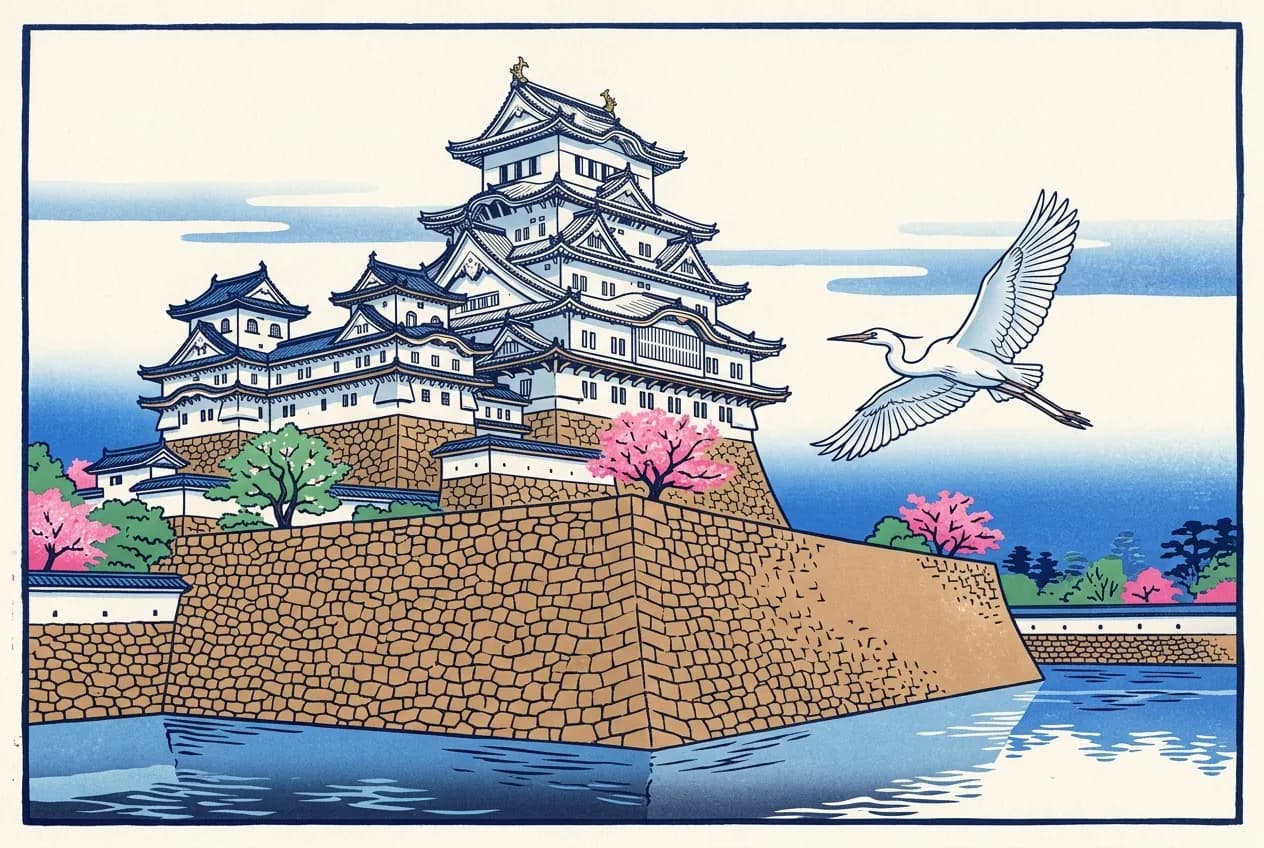
Of all the castle towers standing in Japan today, only 12 are originals. Every other famous silhouette, Osaka and Nagoya included, is a 20th-century reconstruction, some with elevators inside.
Hundreds of castles once studded the country. Twelve towers survived, and that's not a disappointment: it's the plot.
Know which towers are survivors, what killed the rest, and how to read the difference. Your castle visits then turn from photo-collecting into time travel.
The survivors' stories are excellent. One castle is so beautiful it's named after a bird. The golden ornaments on its rooftops are there to fight fires with magic.
Here's the anatomy, the history, the full list of the twelve, and what you're actually walking into when you visit each kind.
Castle anatomy in one minute
The tower on the postcards is the 天守 (tenshu) — the main keep. Surprise: it was less a residence than a statement, and many lords never actually lived in theirs. It stands on a base of dry-stacked stone walls, 石垣 (ishigaki).
Look at the profile and you'll see the trick. It starts lazy at the ground and steepens until it's nearly sheer, a shape poetically named 扇の勾配 (ouginokoubai) after the arc of an opening fan. That curve resists earthquakes and gives attackers nothing to climb, while looking like calligraphy.
Around it all runs the moat, 堀 (hori), and around that grew the 城下町 (joukamachi) — the castle town. Many of Japan's great cities began as one: Nagoya, Sendai, Kanazawa, and Hiroshima.
The layout still shows through. When a city's downtown district is called 大手町 (ootemachi), “main gate town,” you are reading the address of a castle gate that no longer exists.
Look up at the roof ridge next time you visit. Those golden creatures, tiger-headed fish with tails in the air, are しゃちほこ (shachihoko), mythical sea beasts with a reputation for summoning water.
They were mounted up there as fire insurance of the supernatural kind, fire being the wooden castle's true enemy. Nagoya's golden pair became the symbol of the whole city. Spoiler: the insurance mostly failed.
What happened to the other few hundred
Two waves did most of the damage. First, modernization. In 1873 the new Meiji government ordered most castles demolished or sold off.
The castles were symbols of the feudal order the new government had recently replaced. The majority vanished without a battle. Second, war: air raids in the 1940s burned several of the greatest survivors, Nagoya's original keep among them.
Add the ordinary enemies of wooden buildings — lightning, accidental fire, neglect — and by the mid-20th century, exactly 12 original keeps remained. The survivors survived by luck, by remoteness, and sometimes by townspeople who campaigned to save their castle when the demolition order came.
The White Heron: why 姫路城 (himejijou) is white
The star of the 12 is 姫路城 (himejijou) — nicknamed 白鷺城 (shirasagijou), “White Heron Castle,” because its brilliant walls and layered roofs suggest a white heron taking flight. In 1993 it was in Japan's very first group of UNESCO World Heritage sites.
Here's the part guidebooks skip: the white isn't paint, and it isn't vanity. The entire exterior, walls and eaves and everything, is coated in white 漆喰 (shikkui), a lime plaster whose real job is fireproofing the wood underneath.
The castle is beautiful because it's armored. The elegance and the engineering are the same layer. Once you know that, you can't unsee it.
After its latest restoration, the plaster was so fresh and bright that locals affectionately grumbled it should be renamed the “too-white heron.”
The 12 survivors
The full list of original keeps — 現存天守 (gensontenshu) — with the five National Treasures marked. Collectors have been known to visit all twelve; nobody regrets it:
| Castle | Where | Worth knowing |
|---|---|---|
| 姫路城 (himejijou) ★ | Hyogo | The White Heron, UNESCO, grandest of all |
| 松本城 (matsumotojou) ★ | Nagano | Striking black walls on a mountain plain |
| 犬山城 (inuyamajou) ★ | Aichi | Small keep above a river bend |
| 彦根城 (hikonejou) ★ | Shiga | Elegant keep near Lake Biwa |
| 松江城 (matsuejou) ★ | Shimane | Dark, brooding lakeside keep |
| 弘前城 (hirosakijou) | Aomori | Famous cherry-blossom moats |
| 丸岡城 (maruokajou) | Fukui | One of the oldest-style small keeps |
| 備中松山城 (bitchuumatsuyamajou) | Okayama | Mountaintop keep above a sea of clouds |
| 丸亀城 (marugamejou) | Kagawa | Tiny keep, towering stone walls |
| 伊予松山城 (iyomatsuyamajou) | Ehime | Hilltop complex over Matsuyama city |
| 宇和島城 (uwajimajou) | Ehime | Quiet harbor-town keep |
| 高知城 (kouchijou) | Kochi | Keep and palace both surviving together |
Reconstructions: what you're actually visiting
None of this makes the rebuilt castles fakes you should skip. Osaka Castle's current tower was built in 1931, in reinforced concrete, with an elevator.
It carries its own history: the gold-splashed exterior echoes the flamboyant taste of 豊臣秀吉 (toyotomihideyoshi), the warlord who built the original in the 1580s. Inside most reconstructed keeps you'll find a history museum, with an observation deck on top.
Set your expectations by which kind you're visiting. Go to a reconstruction for the museum, the views, and the grounds. The moats and 石垣 (ishigaki) are usually original even when the tower isn't.
Go to one of the 12 for the real thing. Expect steep dark stairways polished by four centuries of feet, low beams, and arrow slits with real draft.
Japan is still debating the next chapter. Nagoya has plans to rebuild its keep in authentic wood, elevator-free, and the argument over authenticity versus accessibility is genuinely unresolved.
Take the castle eye with you
You now read castles the way you read the rest of Japan in these guides, by parts. You have the whole vocabulary: the fan-curved 石垣 (ishigaki), the fish on the ridge, and the white plaster armor. The name 大手町 (ootemachi) hides a vanished gate.
Original or rebuilt, every castle has something to say to you.
Our castles quiz covers the same material, from keeps and moats to golden fish and the 12 survivors, in 10 questions. See how much sticks below.