Omiyage Explained: How Japan's Souvenir Gift Culture Works
Published 2026-07-31 · Updated 2026-09-03 · 6 min read
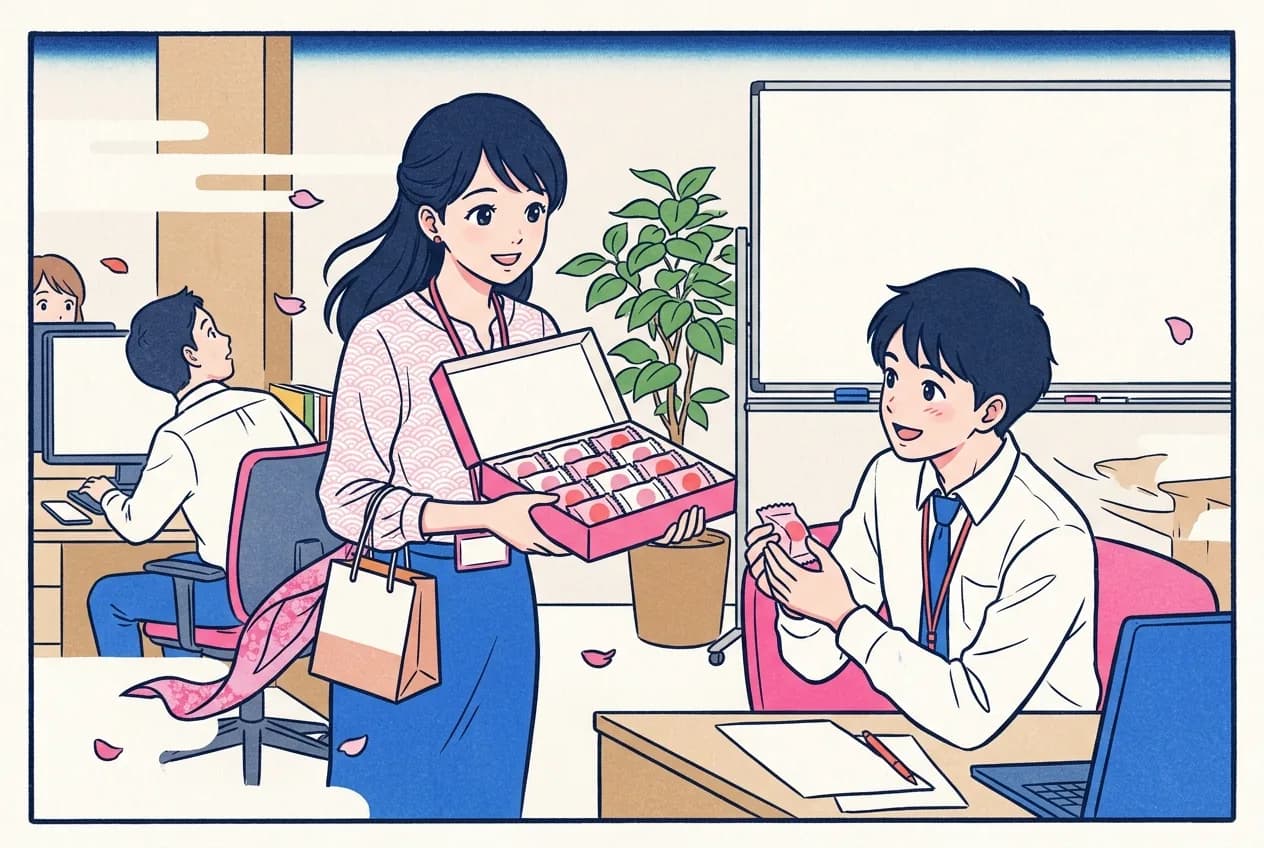
お土産 (omiyage) are not souvenirs you keep but local specialties, usually sweets, brought back from a trip to give away. An omiyage shares the journey with the people who weren't on it.
Walk through any Japanese airport or major station and you'll pass whole halls devoted to boxed sweets. The towers are neat, the regional names sit on the lids, and travelers stack three and four boxes into paper bags.
First-time visitors assume it's duty-free excess. It isn't. You're looking at the center of one of Japan's warmest social customs.
The keeping-it-for-yourself kind of shopping exists too. Omiyage is a different act, closer to a thank-you than a trinket.
This guide covers how the custom works: the office box, the individually wrapped interior, the regional-exclusive economics. It also covers what's actually worth buying, and the two phrases that hand a gift over gracefully.
お土産 (omiyage) vs. “souvenir”: a gift with a direction
The kanji spell the concept out. 土産 (miyage) is written with characters meaning “product of the land,” the thing a place makes that nowhere else quite does. An omiyage points outward: bought there, given here.
The reading is its own little mystery. The characters and the pronunciation have separate histories, and one old theory traces miyage to a word for the container of shrine offerings.
The custom has deep travel roots. In one widely told account, Edo-period villagers who couldn't all afford the great pilgrimage to Ise would pool their money and send one representative.
That representative was then honor-bound to come home with blessings and local goods for everyone who chipped in. The trip was communal property and the omiyage was the receipt. Swap the pilgrimage for a beach week in Okinawa and the logic hasn't changed.
The office box: the custom in its natural habitat
The modern home of omiyage is the workplace. Come back from vacation and the standard move is to set a box of sweets from your destination in the shared space. Better still, walk it around desk to desk, so each colleague takes one piece.
The unspoken script: while you were away, someone covered for you, and the box acknowledges it. It's gratitude with a postmark.
Is it mandatory? No. It's a custom, not a rule, and plenty of workplaces are relaxed about it.
But it's cheap goodwill, and Japanese has a word for the genre: ばらまき土産 (baramakimiyage) (“scatter souvenirs”). These are affordable boxes with a high piece count, engineered for exactly this ritual.
Count heads before you buy. A box of 12 for a team of 15 is the one small way to get this custom wrong. A size up fixes it.
Why every piece is individually wrapped
Foreign visitors often blink at the packaging: open a box of Japanese sweets and each piece sits in its own sealed sleeve. Wasteful?
Consider what the box is for. Individual wrapping means one box splits cleanly among 20 people, given out desk by desk, hygienic in transit, each piece fresh until its moment. The wrapper is delivery, not decoration.
The industry around this is seriously engineered. Boxes survive a suitcase, freshness dates cover the trip home, and sizes come in neat steps of 8, 12, 16, and 24.
One more trick keeps it all valuable: the 地域限定 (chiikigentei) (“region limited”) label. A flavor sold only in Hokkaido, a sweet only at its home shrine's approach: this is artificial scarcity in the sweetest possible form.
It is the reason the box means something. Anyone can buy chocolate, but this label proves you were there.
What to actually buy (a shortlist that reliably lands)
The safest choices are the regional classics with centuries of practice. From Kyoto comes 八ツ橋 (yatsuhashi), and the raw 生八ツ橋 (namayatsuhashi) kind is a tender, mochi-soft folded sweet with red-bean filling. Its gentle cinnamon note is the taste of the old capital for generations of Japanese travelers.
Shizuoka, whose hillsides under Mount Fuji grow a hefty share of the nation's tea, sends green tea in beautiful tins. That is the grown-up option, received gladly in offices everywhere.
For a gift that isn't food, the 手ぬぐい (tenugui) is the traveler's friend: a rectangle of light cotton dyed with seasonal or regional motifs. It works as a towel one day and a headband, bottle wrap, or wall hanging the next. It weighs nothing and folds flat, which your suitcase will appreciate.
And don't skip the 百円ショップ (hyakuenshoppu), the 100-yen shop: rows of chopsticks, ceramics, stationery, and clever kitchen gadgets at pocket prices. For the “fun extras” tier of your gift list, it's unbeatable, and locals buy there for the same reason.
Level up: のし (noshi) and the meaning of knots
For formal occasions — weddings, births, seasonal thank-you gifts — Japanese gift wrapping becomes a language of its own. The sheet of decorated paper on a formal gift is のし (noshi) paper, and the cord across it, the 水引 (mizuhiki), carries actual grammar in its knot.
A bow-style 蝶結び (choumusubi), which unties and reties, marks happy events you'd wish to repeat, such as birthdays and promotions. A tight one-time knot, 結び切り (musubikiri), marks events meant to happen once: weddings, or recovery from illness.
You won't be expected to master this. Department store counters wrap formal gifts correctly if you tell them the occasion. The service is free and famously meticulous.
Knowing the knots exist, though, turns the wrapped gifts around you into sentences you can read.
How to hand it over: two phrases and both hands
Presentation is half the gift. Hand a gift over with both hands, the same respect signal as receiving a business card, and add a softening phrase.
The traditional one is つまらないものですが (tsumaranaimonodesuga), literally “it's a trifling thing, but…” That is ritual humility. The phrase shrinks the gift on purpose, so the gesture cannot sound like showing off, however long you actually spent picking it out.
If that feels heavy, modern Japanese offers a lighter standard, ほんの気持ちです (honnokimochidesu). It means “it's just a small token of my feelings,” and it is warm, current, and impossible to get wrong.
Receive with both hands and warm thanks. A present is traditionally set aside rather than opened on the spot, so an unopened gift isn't indifference. Among friends, asking 開けてもいいですか (aketemoiidesuka) (“may I open it?”) is common and welcome.
The gift matrix on one screen
The whole custom, compressed for your camera roll:
| Situation | Bring | Say |
|---|---|---|
| Back at work after a trip | Bringばらまき土産 (baramakimiyage) — big-count box, one piece each | Sayどうぞ (douzo) “please, help yourself” |
| Visiting someone's home | Bring手土産 (temiyage) — sweets or fruit brought in hand | Sayほんの気持ちです (honnokimochidesu) |
| Formal occasion | BringGift wrapped with のし (noshi) paper | Sayつまらないものですが (tsumaranaimonodesuga) |
| For friends back home | Bring地域限定 (chiikigentei) flavors, 手ぬぐい (tenugui), 100-yen finds | SayThe story of where you found it |
Forgot to buy any? Here's the recovery
Say you're back at your Japanese workplace or host family, and everyone else's trip has turned into sweets while yours has not. Relax, because omiyage is a kindness, not a debt.
Major stations sell boxed sweets from around the country, precisely because travelers think of these things on the way home. A box that appears the next morning with 遅くなりましたが (osokunarimashitaga) (“this is a bit late, but…”) is received every bit as warmly. The custom rewards the thought, and the thought can run a day behind.
Now read the gift shelf like a local
Boxed sweets with a mission, knots that mean things, and a phrase that talks a treasure down: that's the omiyage system. Walk past that hall of boxed sweets again and you see a system, not excess. Our Specialties & Gifts quiz covers the same subjects (tea towns, Kyoto sweets, and the humble handover) in eight quick questions.
Test yourself — take the free Specialties & Gifts quiz
Popular
Latest