Shrine or Temple? A 3-Second Test and How to Pray at Each
Published 2026-07-31 · Updated 2026-09-03
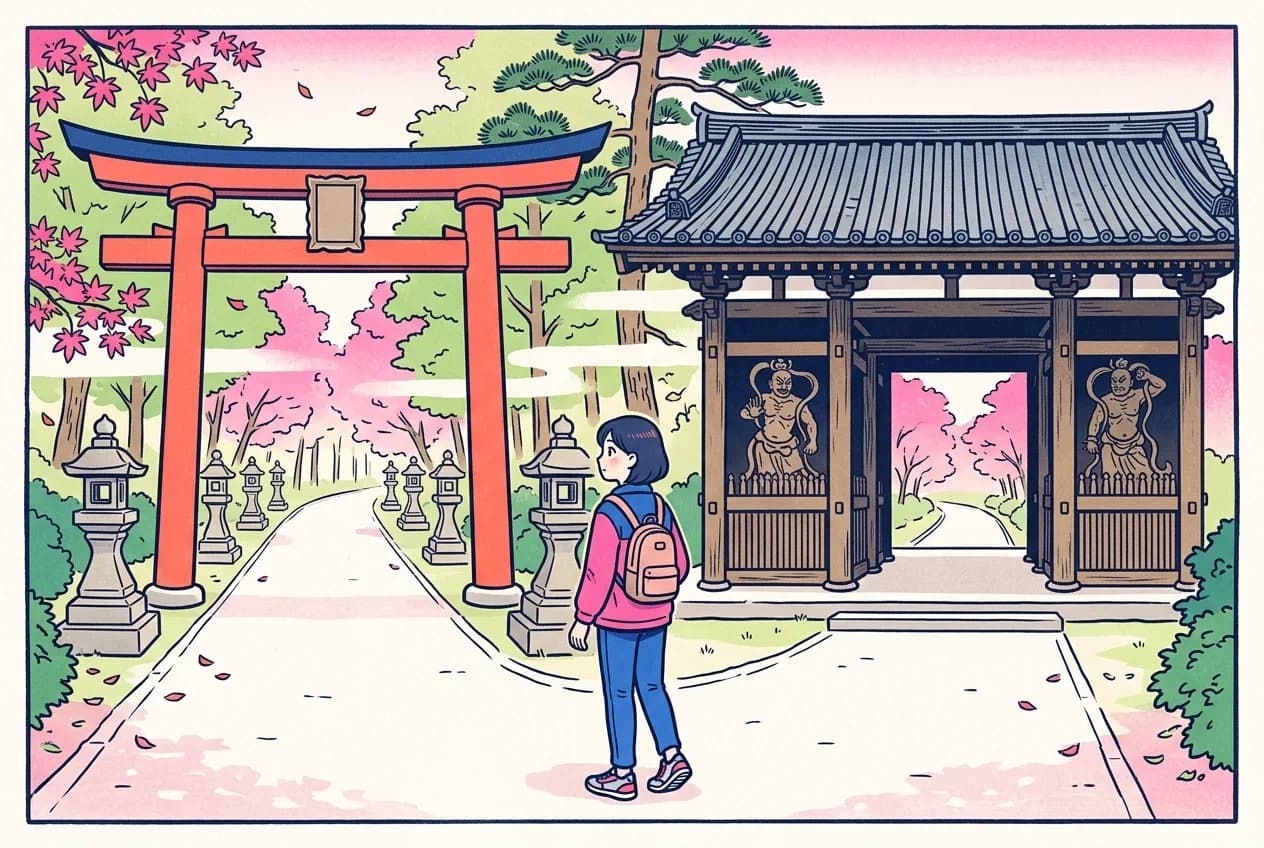
One look at the gate tells you whether you are at a Shinto shrine or a Buddhist temple. The test takes three seconds and needs no reading.
Two bare pillars with two crossbeams, often vermilion, make a 鳥居 (torii), and that means a shrine. A wooden gate with a heavy tiled roof, usually guarded by two muscular statues, is a 山門 (sanmon), and that means a temple.
Japan has both, everywhere, side by side, because two religions have shared the country for some 14 centuries. Shinto is the homegrown tradition of kami (神 (kami)), the spirits of places, forests, and ancestors. Buddhism arrived from the continent in the 500s.
Rather than one replacing the other, they settled into a division of labor. Most Japanese people move between both without any sense of contradiction, commonly celebrating weddings at shrines and holding funerals at temples.
Knowing which is which matters for one practical reason: each has its own way to pray. Doing the shrine routine at a temple, or the reverse, is one of the most common visitor mix-ups in Japan. Here's everything, including exactly what to do with your hands.
The 3-second checklist, expanded
Beyond the gate, every other clue agrees with it. Shrines post a pair of 狛犬 (komainu), stone lion-dogs, while temple gates hold the 仁王 (niou), fierce muscled protectors.
Look closely at either pair and you'll find one mouth open and one closed. They are pronouncing 阿 (a) and 吽 (un), the sounds that open and close the alphabet in Sanskrit tradition. The pair silently spells “beginning and end.”
Japanese even built an idiom on them: 阿吽の呼吸 (aunnokokyuu), the wordless sync of two people who need no signals. It comes from exactly these statues.
The name is a clue too, and it works like the sign-parts from our reading guides. Endings in 神社 (jinja), 大社 (taisha), or 神宮 (jinguu) mean shrine. Endings in 寺 (tera) or 院 (in) mean temple.
伏見稲荷大社 (fushimiinaritaisha) — shrine. 金閣寺 (kinkakuji) — temple. You can now sort nearly every famous name in the guidebook.
How to pray at a shrine (the full walkthrough)
Bow lightly once at the torii, where you cross from the everyday world into sacred ground. Many etiquette guides suggest walking a little to the side of the path's center, which is traditionally reserved for the kami.
At the water basin (手水舎 (chouzuya), also read temizuya), take the ladle. Rinse your left hand, then your right, then pour water into a cupped hand to rinse your mouth. Never drink from the ladle.
A shortened version is fine. Visible care counts for more than a perfect routine done in a panic.
At the main hall, drop a coin in the offering box (賽銭箱 (saisenbako)). If there is a rope and bell, ring it to announce your visit.
The classic coin is 5 yen, and the reason is a pun that became custom. 五円 (goen) sounds exactly like ご縁 (goen), “good fortune in your connections.” Everyone treats it as a pun rather than a fee, and any coin works.
Then the main sequence, worth memorizing as a rhythm: 二礼二拍手一礼 (nireinihakushuichirei) — bow twice, clap twice, make your silent wish, bow once more. That's the standard nearly everywhere, with famous local exceptions: at 出雲大社 (izumotaisha) in Shimane, the custom is four claps.
How to pray at a temple (one big difference)
Temples are gentler, and there are no claps. Offer your coin, put your hands together silently in 合掌 (gasshou) with palms flat and fingers up, bow, and the prayer is done.
If there is an incense burner, you can light a stick of 線香 (senkou) and add it to the sand. Wafting the smoke toward yourself is said to bring good health. Visitors pat it toward whatever part of them needs the help.
The clap rule is the one to remember. Claps greet kami at shrines, and at a temple the silence is the point. If you remember nothing else from this guide, remember where your hands make noise.
The scorecard: shrine vs temple
The whole comparison, sized for a screenshot:
| Clue | Shrine (神社 (jinja)) | Temple (寺 (tera)) |
|---|---|---|
| Religion | Shrine (神社 (jinja))Shinto — kami of places and nature | Temple (寺 (tera))Buddhism |
| The gate | Shrine (神社 (jinja))鳥居 (torii) — two pillars, two crossbeams | Temple (寺 (tera))山門 (sanmon) — roofed wooden gate |
| The guardians | Shrine (神社 (jinja))狛犬 (komainu) lion-dogs | Temple (寺 (tera))仁王 (niou) statues in the gate |
| How to pray | Shrine (神社 (jinja))Bow ×2, clap ×2, bow ×1 | Temple (寺 (tera))Hands together silently — no claps |
| Name endings | Shrine (神社 (jinja))神社 (jinja)・大社 (taisha)・神宮 (jinguu) | Temple (寺 (tera))寺 (tera)・院 (in) |
| You'll also see | Shrine (神社 (jinja))手水舎 (chouzuya), fortune slips, vermilion | Temple (寺 (tera))Incense, Buddha statues, pagodas |
Try the test on the famous ones
Run your new checklist over the postcards. The tunnel of thousands of vermilion gates in Kyoto? Torii, so 伏見稲荷大社 (fushimiinaritaisha) is a shrine.
Every one of those gates is a donation, given as thanks for a granted wish or in hope of one.
The great gate rising from the sea near Hiroshima? Torii again, so 厳島神社 (itsukushimajinja) is a shrine.
The gold-leafed pavilion over its pond in Kyoto? 金閣寺 (kinkakuji), and the 寺 (tera) ending marks it as a temple.
Once you see the pattern, every travel photo becomes a quiz you can win. Speaking of which — our temples-and-shrines quiz has 10 questions of exactly this kind, golden pavilions and floating gates included. Test the 3-second eye below.