Japanese Festivals by Season: A One-Year Calendar of Matsuri
Published 2026-07-31 · Updated 2026-09-03
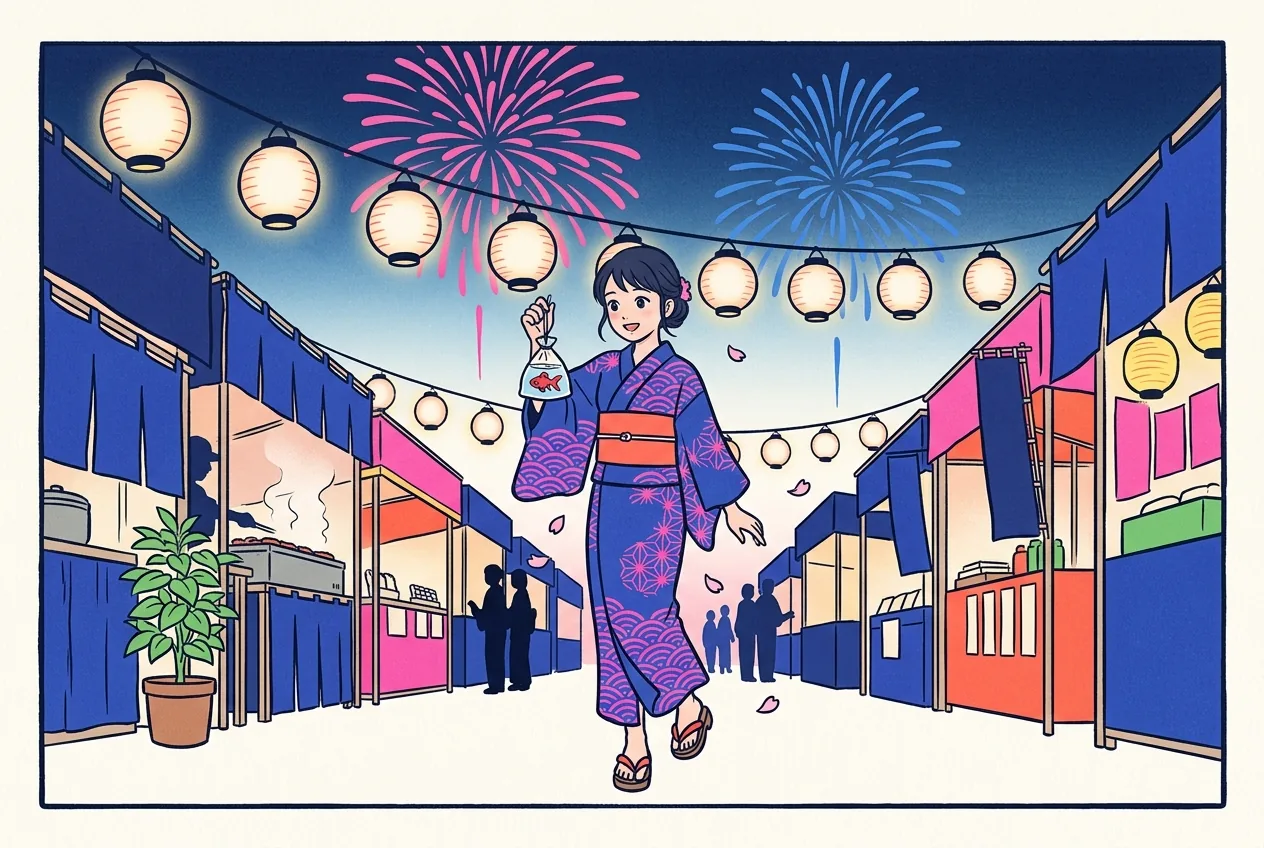
Japan keeps two calendars: the ordinary week of work and school, and an older loop of seasonal festivals, 祭り (matsuri). The second one tells everyone what to eat, what to wear, and where to be outside, month by month.
The quick answer for trip planners: spring means picnics under cherry blossoms, and summer means lantern-lit street festivals and fireworks. Autumn means chasing red leaves. Winter means the great New Year reset, plus one day in February when families throw beans at a demon.
Each season has a headline act, and you're welcome to join in.
Here's the year, in order, with the customs decoded and a calendar table at the end you can plan against.
Spring: 花見 (hanami), the picnic with a deadline
When the cherry trees bloom — late March to early April in most of the country — Japan goes outside. 花見 (hanami), literally “flower viewing,” is in practice a picnic. Friends, families, and entire companies spread tarps under the blossoms for a long afternoon of food, drink, and looking up.
The blossoms last barely two weeks, and that deadline is the point. The fleeting bloom has been a symbol of beautiful impermanence in Japanese art for centuries. If your trip falls in those two weeks, plan around it.
The logistics have their own comedy. Prime spots in famous parks are claimed hours ahead. The job of sitting on the empty tarp all morning famously falls to a team's junior member.
Guarding a blue rectangle of grass is practically a rite of passage at some companies. Spring newscasts, meanwhile, chart the 桜前線 (sakurazensen) — the “cherry blossom front” — as it advances up the archipelago like a weather system. The whole country knows exactly when its deadline hits.
Summer: the anatomy of a 夏祭り (natsumatsuri)
Summer evenings belong to the 夏祭り (natsumatsuri), the summer festival, and once you can picture one, you can navigate them all. Streets or shrine grounds fill with 屋台 (yatai), festival food stalls: grilled corn, yakisoba, candied apples, shaved ice.
Paper lanterns — 提灯 (chouchin) — string the paths with warm light. Game stalls run all evening, most famously 金魚すくい (kingyosukui), goldfish scooping with a paper scoop that dissolves if you hesitate.
The dress code is the best part. The 浴衣 (yukata) is a casual kimono cut from a single breezy layer of cotton, tied with a soft sash and finished with wooden sandals.
It began life as bathhouse wear, which is exactly why it suits humid festival nights. Rental shops in tourist areas will happily dress you in one for the evening.
Visitors in yukata are not seen as playing dress-up. They are seen as doing the festival properly.
Many festivals build to one of two crescendos. One is a 花火大会 (hanabitaikai), a fireworks show, often launching thousands of shells over a river.
The other is 盆踊り (bon'odori), a circle dance around a raised platform. Its simple repeating steps are designed so that anyone, including you, can join.
Summer's three big dates: 七夕 (tanabata), 祇園祭 (gionmatsuri), お盆 (obon)
七夕 (tanabata) (July 7) is the Star Festival. In the old legend, two lovers are stars separated by the Milky Way, allowed to meet on this one night a year.
On the ground, people ink a wish onto a slim paper card, a 短冊 (tanzaku), and fasten it to a stalk of bamboo. Shopping streets and schools sprout wish-covered bamboo every July.
Kyoto's 祇園祭 (gionmatsuri) fills the whole month of July, and it is one of Japan's grandest festivals. It began in 869 as a ritual to drive out an epidemic.
Its parades of towering wooden floats have crossed the city for over a thousand years. Some floats are stories tall, pulled by teams of rope-hauling volunteers.
お盆 (obon) in mid-August (July in some regions) is the tender one: the days when ancestral spirits are welcomed home. Families return to their hometowns, visit graves, and dance the evening 盆踊り (bon'odori), a dance traditionally understood as entertaining the returning spirits.
Tokushima's version, the Awa Odori, is famous for its self-aware chant. It goes: “the dancers are fools and the watchers are fools — so you may as well dance.”
In early August, shortly before Obon, Aomori holds ねぶた (nebuta) — parades of giant, glowing paper warriors. Anyone in the hopping-dancer costume can join the procession, you included.
Autumn: 紅葉狩り (momijigari) and a children's day out
Autumn's ritual is 紅葉狩り (momijigari) — “autumn-leaf hunting.” The word 狩り (kari) really does mean hunting. Your quarry is a mountainside at peak color, tracked with the same seriousness as spring's blossoms.
Newscasts chart the color change sweeping south, this time from the mountains down. Temples in Kyoto and the valleys of Nikko light their maples at night, and the crowds rival cherry-blossom season.
November 15 brings 七五三 (shichigosan), the “seven-five-three” day. Children of those ages are dressed in miniature formal wear and taken to a shrine to give thanks for their growth.
If you're near a shrine that day, you'll see very small people in very formal clothes. They'll be clutching long bags of red-and-white 千歳飴 (chitoseame), “thousand-year candy,” sold to wish them a long life.
Winter: お正月 (oshougatsu), the great reset
お正月 (oshougatsu), the New Year, is the heavyweight of the Japanese holiday calendar, closer in role to Christmas in the West than to a countdown party. The country largely closes for the first days of January and goes home.
Three customs sit at the center. 初詣 (hatsumoude) is the year's first shrine or temple visit, made by millions in the first three days. おせち (osechi) is lacquered boxes of symbolic foods prepared in advance: sweet black beans for health, herring roe for a thriving family.
お年玉 (otoshidama) is envelopes of cash handed to children, and it makes January very popular with Japanese kids.
A month later comes the year's most cheerfully odd ritual: 節分 (setsubun), in early February. To mark the turn toward spring, families throw roasted soybeans outside, or at a parent gamely playing the ogre in a paper mask.
The shout is 鬼は外、福は内 (onihasoto,fukuhauchi): “demons out, fortune in.” You then eat beans for luck, often one for each year of your age. February also hosts the Sapporo Snow Festival, where city blocks fill with building-sized snow sculptures.
The festival year on one screen
The calendar, ready for screenshots and trip math:
| When | Festival | What happens |
|---|---|---|
| WhenLate Mar–early Apr | 花見 (hanami) | What happensPicnics under the cherry blossoms |
| WhenJuly 7 | 七夕 (tanabata) | What happensWishes on paper strips, hung on bamboo |
| WhenAll of July | 祇園祭 (gionmatsuri) | What happensKyoto's giant float parades |
| WhenJul–Aug evenings | 夏祭り (natsumatsuri) & 花火大会 (hanabitaikai) | What happensFood stalls, lanterns, yukata, fireworks |
| WhenMid-Aug (Jul in places) | お盆 (obon) | What happensAncestors welcomed home, bon-odori |
| WhenOct–Nov | 紅葉狩り (momijigari) | What happensAutumn-leaf “hunting,” temples lit up |
| WhenNov 15 | 七五三 (shichigosan) | What happensChildren 7, 5, and 3 blessed at shrines |
| WhenJan 1–3 | お正月 (oshougatsu) & 初詣 (hatsumoude) | What happensFirst shrine visit, osechi, otoshidama |
| WhenEarly Feb | 節分 (setsubun) | What happensBean-throwing: “demons out, fortune in” |
| WhenEarly Feb | Sapporo Snow Festival | What happensBuilding-sized snow sculptures |
How to join in (yes, you're invited)
The most useful thing to know about matsuri: they are participatory, not spectator events. The bon-odori circle exists so that passersby can join it. Copy the person in front of you, half a beat behind, and you're doing it right.
Getting the steps wrong is part of the tradition, and the Awa Odori chant about dancing fools has been giving everyone permission for generations. Yukata rental, goldfish scooping, wish-writing at Tanabata: all open to you.
One phrase carries you through the food stalls: これください (korekudasai) — “this one, please” — with a point. And if the crowd sweeps you into a dance circle you didn't plan on, the only wrong move is standing still.
Test your festival year
Blossoms, beans, bamboo wishes, and a yukata: our Seasons & Festivals quiz covers the same calendar in seven quick questions. See how much of Japan's second calendar you can already read.