Japanese Numbers: Count to 10,000, Plus the First 5 Counters
Published 2026-08-17 · Updated 2026-09-03 · 12 min read
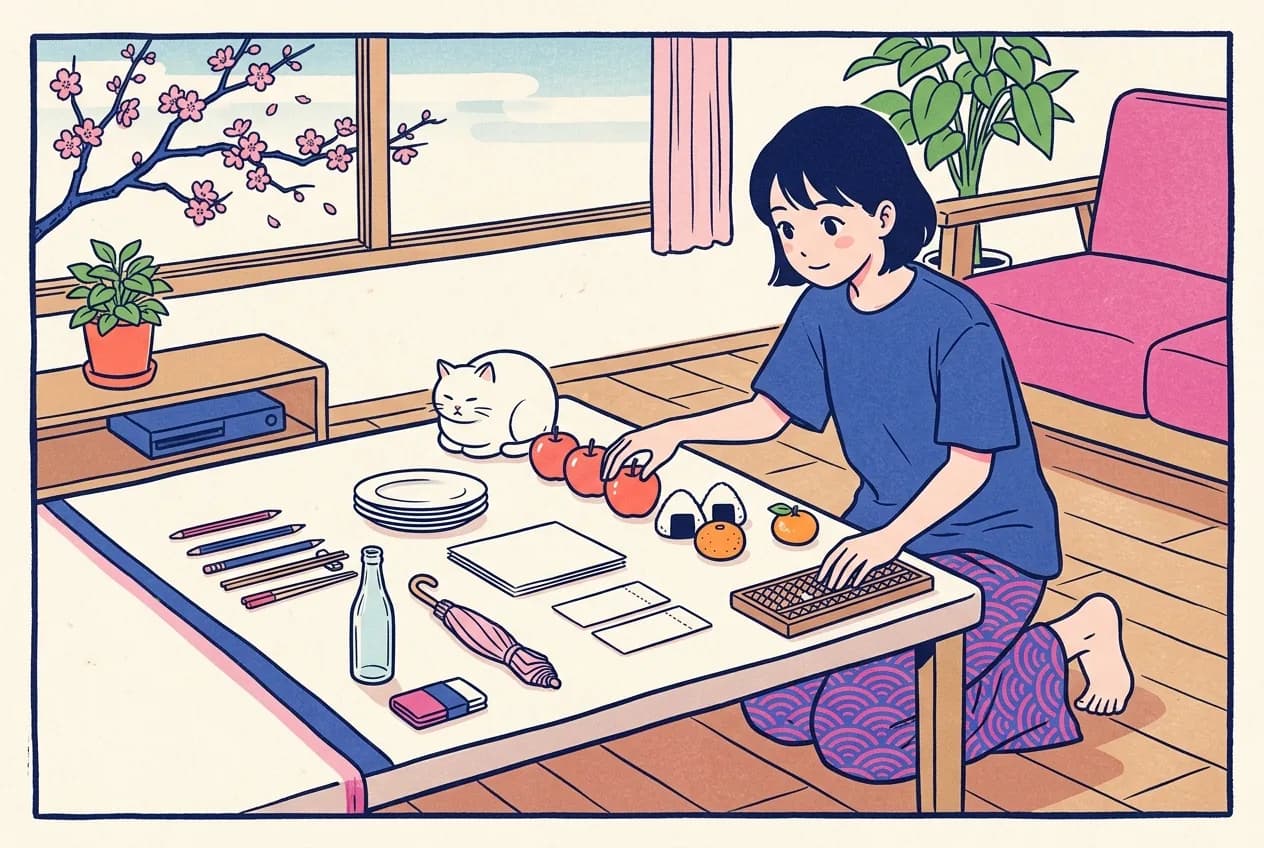
Japanese numbers have a reputation for being complicated, and the reputation comes from a real place. Almost nobody needs all of Japanese counting at once, and the part you need first is small.
Start with what a convenience-store clerk says at the register:
三百八十円になります (sanbyakuhachijuuenninarimasu)
That comes to 380 yen.
You need these numbers the first time you pay at a register or order from a menu. A number on its own is not enough, because a counter word joins it and names what you are counting. Some counters change the sound of the number: 一本 (ippon), not 一 (ichi) plus 本 (hon).
There are two counting systems and three numbers with two readings each. There is also a family of counter words that change how a number sounds depending on what you are counting. Seen on one page, that is a lot.
This guide sorts Japanese counting into the order you will meet it. Ten sounds for 1–10. A rule, not a list, for 11–99.
Three big-number words reach 10,000 and beyond. Then comes the older system behind ひとつ (hitotsu) and ふたつ (futatsu), the five counters for prices, people, and orders, and the four sound changes behind 三百 (sanbyaku).
Everything is written in kana with a romanized hint, so you can say it as well as recognize it.
Learn the 10 sounds, the five counters in the table below, and the four sound changes. Do that and you can handle a convenience-store total, a restaurant headcount, and a menu order this week.
Everything past that can wait until you meet it.
Japanese numbers 1–10: the only 10 sounds you need today
Japanese counts from one to 10 like this: 一 (ichi), 二 (ni), 三 (san), 四 (yon), 五 (go), 六 (roku), 七 (nana), 八 (hachi), 九 (kyuu), 十 (juu). Say them out loud in order a few times before you read on. The rest of Japanese counting is built out of these 10 sounds and very little else.
Two small notes. Zero is ゼロ (zero) in everyday speech, with the older 零 (rei) surviving in a few set uses like 零度 (reido), zero degrees.
Three of the ten, 4, 7, and 9, have a second reading you will hear in specific places. That is the next section, and it is the only real wrinkle in the first ten.
Why 4, 7, and 9 have two readings (and which one to say)
The short answer: when you're counting or saying a number on its own, use よん (yon), なな (nana), and きゅう (kyuu). The second readings — し (shi) for 4, しち (shichi) for 7, く (ku) for 9 — belong to the same Chinese-derived series as the other numbers. They remain the standard reading inside a set of fixed words.
The catch is that し (shi) sounds exactly like 死 (shi), death, and く (ku) like 苦 (ku), suffering. So in open speech よん (yon) and きゅう (kyuu) are preferred. なな (nana) is preferred for 7 as well, with the practical bonus that it can't be misheard as いち (ichi).
Where the second readings live: months and clock times, mostly. April is 四月 (shigatsu), July is 七月 (shichigatsu), and September is 九月 (kugatsu).
Four o'clock is 四時 (yoji) (a clipped よ (yo), without the ん (n)), seven o'clock is 七時 (shichiji), and nine o'clock is 九時 (kuji). Four people is 四人 (yonin), and seven people can be either 七人 (shichinin) or 七人 (nananin).
Everywhere else, in phone numbers, prices, floors, and counting objects, the defaults are safe: 四百 (yonhyaku) (400), 七十 (nanajuu) (70), 九階 (kyuukai) (ninth floor).
You do not need to memorize when to switch. The fixed forms come to you as vocabulary, and you learn 四月 (shigatsu) as one word, the way you learned “April.” The pattern settles in from examples, and what you need right now is the default: よん (yon)・なな (nana)・きゅう (kyuu).
11 to 99 is arithmetic, not memory
Every number from 11 to 99 is built by saying the tens digit, then 十 (juu), then the ones digit. No new words at all.
Eleven is 十一 (juuichi) (ten-one). Twenty is 二十 (nijuu) (two-ten). Twenty-one is 二十一 (nijuuichi).
Thirty-four is 三十四 (sanjuuyon). Ninety-nine is 九十九 (kyuujuukyuu). That is the whole system: learn 1–10, then stack.
Two things to notice. Ten in the tens place never becomes “one-ten,” so 10 is 十 (juu) and 11 is 十一 (juuichi), not いち (ichi)-じゅう (juu)-いち (ichi).
In the tens, 4, 7, and 9 keep their default readings: 四十 (yonjuu), 七十 (nanajuu), 九十 (kyuujuu). What you learned in the last section carries straight through.
A good first drill is your own phone number, digit by digit. It's 10 sounds you already care about, and Japanese speakers read phone numbers digit by digit too.
100, 1,000, 10,000: Japanese counts in tens of thousands
Three words take you into the big numbers: 百 (hyaku) (100), 千 (sen) (1,000), and 万 (man) (10,000). They stack exactly the way 十 (juu) did: 200 is 二百 (nihyaku), 5,000 is 五千 (gosen), 380 is 三百八十 (sanbyakuhachijuu), and 2026 is 二千二十六 (nisennijuuroku).
On their own, 100 and 1,000 are plain ひゃく (hyaku) and せん (sen), with no いち (ichi) in front. The number 10,000 is always 一万 (ichiman), with the いち (ichi). And 4, 7, and 9 keep their defaults here too: 四百 (yonhyaku), 七千 (nanasen), 九万 (kyuuman).
The part that confuses English speakers is not the words but the grouping. English regroups every three digits: thousand, million, billion. Japanese regroups every four, so 万 (man) is 10,000 and everything up to 99,999,999 is some number of 万 (man).
So 100,000 is not “hundred-thousand” but 十万 (juuman) (ten ten-thousands), and 1,000,000 is 百万 (hyakuman) (a hundred ten-thousands). When you meet a large yen figure, split it four digits from the right and it reads itself.
A handful of these compounds change their sound. 300 is 三百 (sanbyaku), 600 is 六百 (roppyaku), 800 is 八百 (happyaku), 3,000 is 三千 (sanzen), and 8,000 is 八千 (hassen). They look like exceptions to memorize. They're really four small rules, named below once the counters are on the table — because the same four rules explain the counters too.
Hitotsu, futatsu: the older counting system you'll still hear
Japanese has a second, older set of numbers, native Japanese words rather than Chinese-derived ones. It runs from one to 10 only.
The set is ひとつ (hitotsu) (1), ふたつ (futatsu) (2), みっつ (mittsu) (3), よっつ (yottsu) (4), いつつ (itsutsu) (5), むっつ (muttsu) (6), ななつ (nanatsu) (7), やっつ (yattsu) (8), ここのつ (kokonotsu) (9), and とお (too) (10). From 11 on, counting switches to the 十一 (juuichi) series.
You'll use this set more than its size suggests. It's the everyday way to count things when you don't know — or don't need — a specific counter: ふたつ (futatsu) is “two of them,” and nothing more. It's what you say when ordering: point at the menu and say これをふたつ (korewofutatsu), “two of these.”
It's also hiding inside 一人 (hitori) (one person) and 二人 (futari) (two people). And it's how you ask “how many?” — いくつ (ikutsu), which as おいくつですか (oikutsudesuka) also politely asks someone's age. Learn these 10 as a chant; they pay for themselves the first time you order.
Counters: the five you meet first (people, things, yen, long objects, flat objects)
A counter is a short word attached to a number that says what kind of thing you are counting. English does a little of this, as in “two sheets of paper” and “three head of cattle.” Japanese does it for nearly everything.
There are dozens. You need five to start, and each has one or two irregular spots worth knowing in advance.
人 (nin) counts people, using the older words for one and two: 一人 (hitori), 二人 (futari), then 三人 (sannin), 四人 (yonin), 五人 (gonin), and on. つ (tsu) — or the more neutral 個 (ko) — counts objects: みっつ (mittsu) or 三個 (sanko) for three of something.
円 (en) counts yen and is almost perfectly regular. The one wrinkle is that 4 yen is 四円 (yoen), and in practice you will say 三百八十円 (sanbyakuhachijuuen), 380 yen, far more often than 4 yen.
本 (hon) counts long, thin things: bottles, pens, umbrellas, and, as a favorite surprise, trains and phone calls. 枚 (mai) counts flat things: sheets of paper, tickets, plates, shirts, and stamps.
Here they are side by side from one to ten, plus the “how many?” form for each. 円 (en) is the exception: it behaves too well to need a row beyond 四円 (yoen).
Screenshot this one. Once you can read the whole table aloud, the sound-change rules in the next section will already feel familiar.
| Number | つ (tsu) things | 人 (nin) people | 本 (hon) long things | 枚 (mai) flat things |
|---|---|---|---|---|
| 1 一 (ichi) ichi | つ (tsu) things一つ (hitotsu) | 人 (nin) people一人 (hitori) | 本 (hon) long things一本 (ippon) | 枚 (mai) flat things一枚 (ichimai) |
| 2 二 (ni) ni | つ (tsu) things二つ (futatsu) | 人 (nin) people二人 (futari) | 本 (hon) long things二本 (nihon) | 枚 (mai) flat things二枚 (nimai) |
| 3 三 (san) san | つ (tsu) things三つ (mittsu) | 人 (nin) people三人 (sannin) | 本 (hon) long things三本 (sanbon) | 枚 (mai) flat things三枚 (sanmai) |
| 4 四 (yon) yon / shi | つ (tsu) things四つ (yottsu) | 人 (nin) people四人 (yonin) | 本 (hon) long things四本 (yonhon) | 枚 (mai) flat things四枚 (yonmai) |
| 5 五 (go) go | つ (tsu) things五つ (itsutsu) | 人 (nin) people五人 (gonin) | 本 (hon) long things五本 (gohon) | 枚 (mai) flat things五枚 (gomai) |
| 6 六 (roku) roku | つ (tsu) things六つ (muttsu) | 人 (nin) people六人 (rokunin) | 本 (hon) long things六本 (roppon) | 枚 (mai) flat things六枚 (rokumai) |
| 7 七 (nana) nana / shichi | つ (tsu) things七つ (nanatsu) | 人 (nin) people七人 (shichinin) / 七人 (nananin) | 本 (hon) long things七本 (nanahon) | 枚 (mai) flat things七枚 (nanamai) |
| 8 八 (hachi) hachi | つ (tsu) things八つ (yattsu) | 人 (nin) people八人 (hachinin) | 本 (hon) long things八本 (happon) | 枚 (mai) flat things八枚 (hachimai) |
| 9 九 (kyuu) kyū / ku | つ (tsu) things九つ (kokonotsu) | 人 (nin) people九人 (kyuunin) | 本 (hon) long things九本 (kyuuhon) | 枚 (mai) flat things九枚 (kyuumai) |
| 10 十 (juu) jū | つ (tsu) thingsとお (too) | 人 (nin) people十人 (juunin) | 本 (hon) long things十本 (juppon) | 枚 (mai) flat things十枚 (juumai) |
| How many? 何 (nan) nan | つ (tsu) thingsいくつ (ikutsu) | 人 (nin) people何人 (nannin) | 本 (hon) long things何本 (nanbon) | 枚 (mai) flat things何枚 (nanmai) |
The four sound changes behind sanbyaku, roppyaku, and ippon
Every irregular form in this article comes from four small changes, and none of them is random. They are what the mouth does when two sounds meet.
Rule one: 1, 8, and 10 clip their last syllable into a small pause (っ ()). That happens before a counter beginning with a k, s, t, or h sound: 一個 (ikko), 八千 (hassen), 十本 (juppon). Six does the same before k and h (六個 (rokko), 六百 (roppyaku)) but not before s, so 6,000 is 六千 (rokusen).
Rule two: after that clip, an h sound becomes p, as in 一本 (ippon), 六百 (roppyaku), 八百 (happyaku), and 十本 (juppon). Rule three: 3 and the question word 何 (nan) (how many) turn a following h into b, and せん (sen) into ぜん (zen): 三本 (sanbon), 三百 (sanbyaku), 三千 (sanzen), 何本 (nanbon).
Rule four: 4 drops its ん (n) before a few counters, as in 四人 (yonin), 四時 (yoji), and 四円 (yoen). Now look back at the table: every unusual cell is one of these four.
You don't need to run these rules consciously. Most learners absorb them from a dozen example words, and the table above is built so those examples are already in front of you. Read it aloud a few times and さんぼん (sanbon) starts to sound right while さんほん (sanhon) starts to sound wrong.
Clock times and dates have a few more of their own — 四時 (yoji), 七時 (shichiji), 九時 (kuji), and the first days of the month like 一日 (tsuitachi) and 二日 (futsuka). Those deserve their own field note, and that's where they live.
Where you'll actually use numbers this week: prices, people, orders
Prices are the first place Japanese numbers get real, because the clerk says the total out loud. You will hear 三百八十円になります (sanbyakuhachijuuenninarimasu), “that comes to 380 yen.”
Everything you need to catch it is in this article: a hundreds word with its sound change, a tens word, and 円 (en). If the total goes by too fast, the register display shows it in Arabic numerals.
The konbini field note covers the rest of the checkout script. You will know which line is the price and which is the bag question.
People come next: 何名様ですか (nanmeisamadesuka), “how many in your party?” You answer with 一人です (hitoridesu) or 二人です (futaridesu), or with held-up fingers. (Staff use the more formal 名 (mei) counter, and you answer with 人 (nin).)
Orders use the older set: これをふたつ (korewofutatsu), or ビールを二本 (biiruwonihon). The restaurant field note has the rest of that exchange. The gestures field note covers how Japanese speakers count on their own fingers, thumb first, folding in.
And then the writing. The number kanji 一 (ichi) through 十 (juu), plus 百 (hyaku), 千 (sen), 万 (man), and 円 (en), sit at the very start of most N5 kanji lists. That is 14 characters, 15 with 何 (nan), “how many.”
They let you read a price tag, a floor button, and a menu, and they appear again on the sound-change side, as in 三百 (sanbyaku).
If you are starting kanji, start here. They are the simplest characters with the biggest everyday value, and the kanji field note explains why the order you learn them in matters.
Key takeaways
Say よん (yon), なな (nana), and きゅう (kyuu) unless the number sits inside a fixed word.
Build 11 to 99 by naming the tens digit, then 十 (juu), then the ones digit.
Split a large figure four digits from the right, because Japanese groups by 万 (man).
Is it yon or shi?
Say よん (yon) when counting, giving a phone number, a price, or a floor. Use し (shi) only inside fixed words you learn as vocabulary, and 四月 (shigatsu), April, is the one you will meet first.
Four o'clock and four people take a third form, a clipped よ (yo): 四時 (yoji), 四人 (yonin). When in doubt, よん (yon) is understood everywhere.
How do you say 100 in Japanese?
百 (hyaku) — on its own, without いち (ichi) in front. Multiples stack: 二百 (nihyaku) is 200, 五百 (gohyaku) is 500, with three sound changes to know — 三百 (sanbyaku) (300), 六百 (roppyaku) (600), 八百 (happyaku) (800). A hundred yen is 百円 (hyakuen), and 1,000 works the same way: plain 千 (sen), no いち (ichi) in front.
What is a counter in Japanese?
A counter is a suffix that follows a number and names the category of thing being counted. 人 (nin) for people, 本 (hon) for long objects, 枚 (mai) for flat ones, 円 (en) for yen.
English has a few of these, such as “two slices of bread,” and Japanese uses them for nearly everything. When you do not know the right one, the general-purpose ひとつ (hitotsu)・ふたつ (futatsu) series or 個 (ko) will be understood, and nobody will mind.
Do Japanese people write numbers in kanji or Arabic numerals?
Both, and mostly Arabic numerals in daily life: prices, timetables, phone numbers, and anything written horizontally use 1, 2, 3. Kanji numerals appear in vertical text, on traditional menus and signs, in some formal documents, and inside set words like 一人 (hitori) and 二日 (futsuka).
That is why the 10 number kanji become useful so quickly. You can find yourself reading them on a soba-shop menu the same week you learn them.
Where Ukiyoe Japanese fits
In Ukiyoe Japanese, the numbers are the front door to kanji. The first two N5 kanji sets in the app are 一 (ichi)–五 (go) and 六 (roku)–十 (juu), each character with its readings and origin story. A later set adds 百 (hyaku), 千 (sen), 万 (man), and 円 (en) under “shopping and big numbers.”
The reason to say the numbers out loud, though, is Speak. The restaurant scenario asks you お一人ですか (ohitoridesuka) and closes with a bill of 八百円 (happyakuen), built only from what you have already covered.
So the first time you say 一人です (hitoridesu) is not at the door of a real restaurant. Ten sounds, five counters, four rules. That is the week.
Explore the kanji sets — every character with its origin story
Popular
Latest