7 Japanese Gestures That Don't Mean What You Think
Published 2026-07-30 · Updated 2026-09-03 · 5 min read
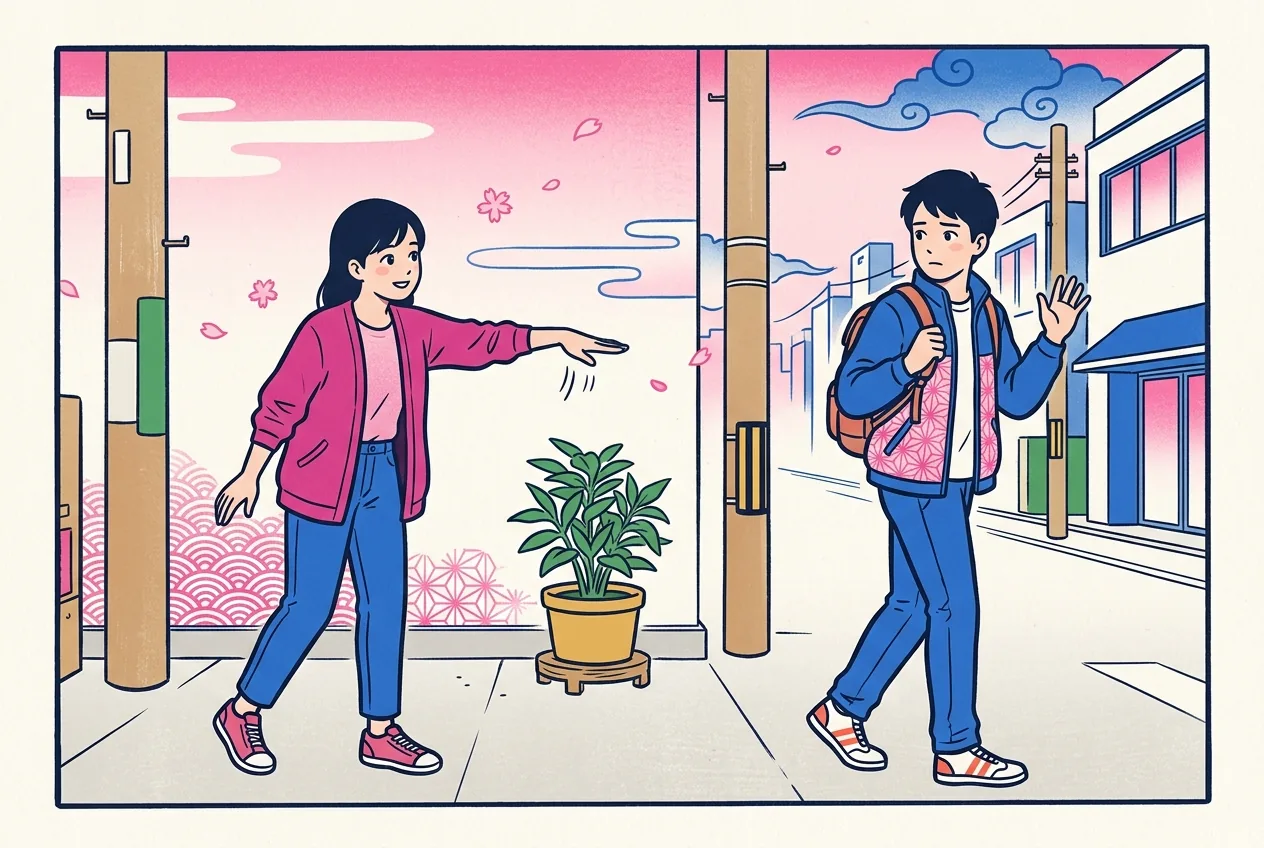
When a Japanese friend flaps a hand at you palm-down, they're not shooing you away. They're calling you over.
Your textbook probably skipped this one. Walk off, as many first-time visitors do, and you'll leave a very confused friend on the corner.
Gestures feel universal. But they're vocabulary: each culture learns its own set, and the sets don't always agree.
Japan's everyday repertoire includes a “me?” pointed at the nose and an “excuse me” made with a chopping hand. It also has a pair of full-body symbols for yes and no.
The good news: this vocabulary is tiny compared to actual Japanese. Learn the seven signals below and you'll read most of the body language around you. The mistakes you do make are the charming kind, fixed with a smile.
1. “Me?” points at the nose#
Ask a question in a group and watch who answers: the person will touch an index finger to their own nose — 私 (watashi)? (“me?”). Where English speakers put a hand on the chest, Japanese speakers point at the center of the face.
It works in reverse too: if someone points at their nose while you're talking, they're asking whether you mean them. Nothing needs to be said — the gesture carries the whole question.
2. “Come here” flaps palm-down#
The Japanese beckoning gesture, おいでおいで (oideoide), extends the arm palm-down and flaps the fingers toward the body. To many Westerners it looks like “go away” or a royal dismissal.
That's exactly backwards. It's a warm “come here,” used with friends, children, and pets alike.
You've already seen this gesture in ceramic form. The 招き猫 (manekineko), the beckoning cat in shop windows, holds its paw in precisely this palm-down position — it's not waving hello, it's calling customers in.
The palm-up, one-finger curl that means “come here” in English? It is best avoided in Japan. Pointed at a person, it can seem provocative, the way you'd summon a suspect in a drama.
3. The hand chop that means “excuse me”#
To cross a crowded room, a Japanese speaker raises one hand into a vertical blade. That's the 手刀 (tegatana), literally “hand sword.”
They chop it gently up and down while slipping through, with a small bow and a murmured すみません (sumimasen). It means “pardon me, just passing through,” and it clears a path politely.
The same hand shape has a ceremonial life: sumo wrestlers cut a small 手刀 (tegatana) over prize money before accepting it. In the street version, think of it as a knife politely slicing the crowd — apology and request in one motion.
4. The face fan that means “no, no”#
Wave a flat hand back and forth in front of your face and you're saying no — “not me,” “no need,” “no, really.” You'll see it when someone declines a compliment (いえいえ (ieie), “oh no, not at all”) or refuses seconds at dinner. It also appears when someone gets asked if they speak English.
First-time visitors sometimes read it as “something smells” or “stop talking.” It's neither — it's the everyday bodily form of polite denial, and it usually comes with a smile.
5. Big circle, big X — a full-body yes and no#
Japan has a two-symbol system for correct and wrong: まる (maru) (circle) and ばつ (batsu) (X). Teachers mark homework with circles, not checkmarks. Quiz shows sort answers into ○ and ×.
People also make the symbols with their bodies: arms curved overhead for “yes, fine,” forearms crossed in an X for “no, closed, not allowed.”
The X is the one to know as a listener. Staff crossing their forearms — or two index fingers for a small X — are telling you it's sold out, full, or closed. No translation needed once you know the code.
6. Bowing to someone who can't see you#
Stand in any Japanese office and you'll witness it: a coworker bowing into a phone, repeatedly and sincerely. The greeting is お世話になっております (osewaninatteorimasu) (“thank you for your continued support”), bow, bow.
The caller sees nothing. The body bows anyway.
It looks comical. But it is the most honest demonstration of how deep the bow runs. The bow is not a performance for the other person so much as a reflex of the politeness itself.
You may notice yourself doing it within a month, and that is a milestone.
7. Counting that folds inward#
Watch someone count to themselves in Japan. The hand starts open. The thumb folds in for one, then each finger closes in turn until five makes a fist.
Counting up from a fist, finger by finger, the way many Westerners do, is the reverse of that.
When showing a number to someone else, though, people switch to raised fingers exactly as elsewhere — the folding style is mostly for counting to yourself. If a shopkeeper's fingers seem to be doing the opposite of yours, now you know why.
Gestures are a language — treat them like one#
None of these signals is instinct, and all of them are learned, the way words are. That's one of the most useful ideas to take away. Your own gestures are also a dialect, not a universal default, and the palm-down beckon that surprises Westerners is standard across much of Asia.
It also means gesture mistakes are language-learner mistakes — the most forgivable kind there is. Misread a beckon, point at your chest instead of your nose, and the worst outcome is a laugh and a fun story. A smile and すみません (sumimasen) reset everything.
Here's the whole vocabulary in one screenshot:
| The gesture | Easy to misread as | What it really means |
|---|---|---|
| Index finger to own nose | Easy to misread as“something on my face?” | What it really means“me?” |
| Palm-down flapping — おいでおいで (oideoide) | Easy to misread as“go away” | What it really means“come here” |
| Vertical hand chop — 手刀 (tegatana) | Easy to misread asA karate warm-up | What it really means“excuse me, passing through” |
| Hand waved before the face | Easy to misread as“something smells” | What it really means“no, no” / “not me” |
| Arms in a circle — まる (maru) | Easy to misread asA stretch | What it really means“correct / OK” |
| Forearms crossed — ばつ (batsu) | Easy to misread as“stay back!” | What it really means“no / closed / sold out” |
| Fingers folding inward | Easy to misread asWaving goodbye slowly | What it really meansCounting 1 to 5 |
How to learn them without studying#
You don't drill gestures with flashcards — you watch for them. Street interviews, dramas, and café scenes are full of nose-points and face-fans once you know to look. Spotting one in the wild fixes it in memory better than any list.
Then close the loop the same way you would with words: test whether you can read each signal cold. The quiz below deals you six situations — a flapping hand, crossed forearms, a bow into a telephone — and asks what happened.